The Cosmograph Daytona is Rolex’s flagship chronograph — launched in 1963 for professional racing drivers and, today, one of the hardest watches in the world to buy at retail. Over the last decade Rolex carried out the first major movement upgrade to the line in more than 20 years, replacing the Caliber 4130 with the Caliber 4131 and refining the case and dial along the way. The result is a set of reference numbers that look nearly identical on a listing page but differ meaningfully in movement, proportions, and price.
This guide maps the modern steel “Panda” and Everose-gold Daytonas in one place: every reference, what changed between generations, and how to choose. If you’re comparing two specific references, jump to the table for your pairing.
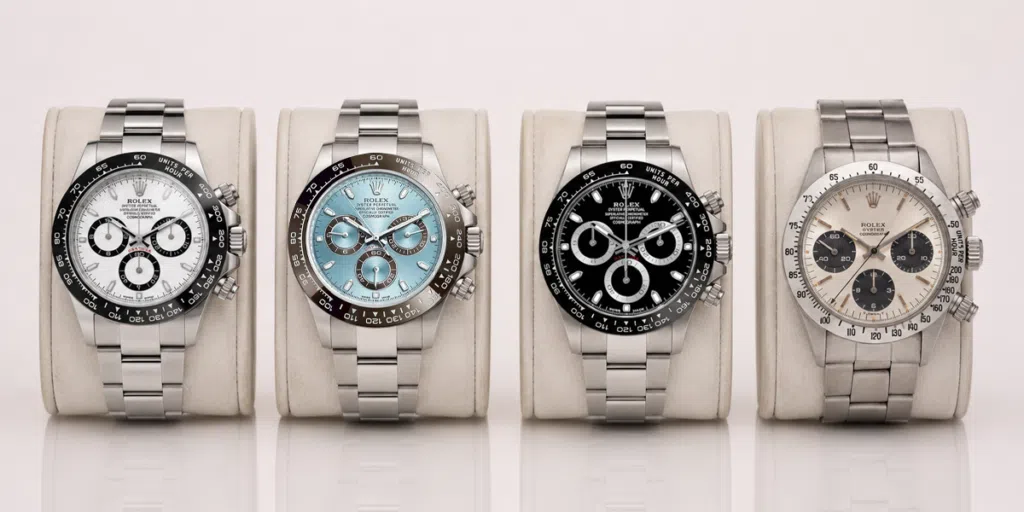
Table of Contents
How to read a Rolex Daytona reference number
Every Daytona reference encodes the watch’s model family, case metal, and bezel in its digits and letters. Once you know the pattern, you can decode almost any modern Daytona at a glance.
Digit count tells you the era. Vintage and Zenith-era Daytonas use 5-digit references (6239, 16520). Modern Daytonas use 6-digit references beginning with 116xxx (in-house Caliber 4130, 2000–2023) or 126xxx (Caliber 4131, 2023–present).
The last digit is the metal code:
| Last digit | Metal | Example |
|---|---|---|
| 0 | Oystersteel | 126500 |
| 3 | Oystersteel + 18k yellow gold (Rolesor) | 126503 |
| 5 | 18k Everose gold | 126505 |
| 6 | 950 platinum | 116506 |
| 8 | 18k yellow gold | 126508 |
| 9 | 18k white gold | 126509 |
Letter suffixes describe the bezel. LN stands for lunette noire, a black Cerachrom ceramic bezel (as on the 126500LN). TBR denotes a baguette diamond-set bezel (as on the 126539TBR). Rolex’s suffix letters are abbreviations of French words, since Rolex is Geneva-based, which is why a black bezel is noire rather than “black.”
Quick example — 126515LN: 6-digit modern (Caliber 4131 era) · 5 = Everose gold · LN = black ceramic bezel. So: an Everose-gold, ceramic-bezel, current-generation Daytona.
The four generations at a glance
| Generation | Years | Hallmark movement | Defining trait | Key references |
|---|---|---|---|---|
| Manual-wind | 1963–1988 | Valjoux-based (72 → 727), hand-wound | The original pre-automatic Cosmograph; home of the “Paul Newman” exotic dials | 6239, 6241, 6262, 6263, 6264, 6265 |
| Zenith | 1988–2000 | Caliber 4030 (modified Zenith El Primero) | First automatic Daytona | 16520, 16523, 16528 |
| In-house 4130 | 2000–2023 | Caliber 4130 (Rolex’s own) | First fully in-house Daytona movement; ceramic bezel from 2016 | 116500LN, precious-metal 1165xx |
| Caliber 4131 | 2023–present | Caliber 4131 | 60th-anniversary update: Chronergy escapement, refined case and dial | 126500LN, precious-metal 1265xx |
The early Daytona: manual-wind and Zenith eras
Manual-wind era (1963–1988)
The first Cosmograph Daytonas were hand-wound chronographs built on the Valjoux 72 movement platform — a column-wheel, lateral-clutch design — later upgraded to the higher-beat caliber 727.
- Ref. 6239 (1963–1969): the original, with an engraved steel tachymeter bezel, pump-style chronograph pushers, and a manual-wind Valjoux movement.
- Ref. 6241: the 6239 with a black acrylic bezel insert; pump pushers.
- Refs. 6262 & 6264 (c. 1970–71): short-lived transitional models using the upgraded caliber 727 — the 6262 with a steel bezel, the 6264 with an acrylic bezel; both still pump pushers.
- Refs. 6263 & 6265: introduced the Oyster case with screw-down pushers for real water resistance — the 6263 keeping the acrylic bezel, the 6265 the steel bezel.
These manual-wind references are also where the legendary “Paul Newman” exotic dials appear.
Zenith era (1988–2000): the reference 16520
In 1988 Rolex made the Daytona automatic for the first time with the 16520, powered by the caliber 4030 — a modified version of the Zenith El Primero (base caliber 400) with roughly 200 Rolex changes: the date was removed, the escapement revised, the beat rate lowered from 36,000 to 28,800 vph, and the power reserve raised from about 42 to about 52 hours. The Zenith Daytona ran for 12 years before the in-house caliber 4130 arrived in 2000.
Shop the Zenith-era references: Daytona 16520 (steel), 16523 (steel and yellow gold), and 16528 (yellow gold).
The steel ceramic-bezel Daytona (“Panda”)
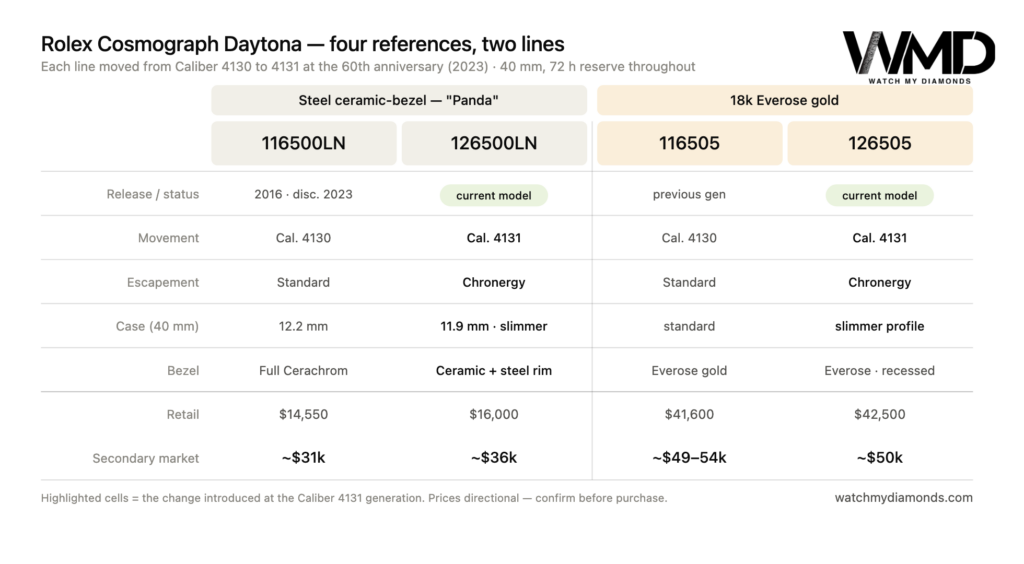
| 116500LN | 126500LN | |
|---|---|---|
| Image Ref: | 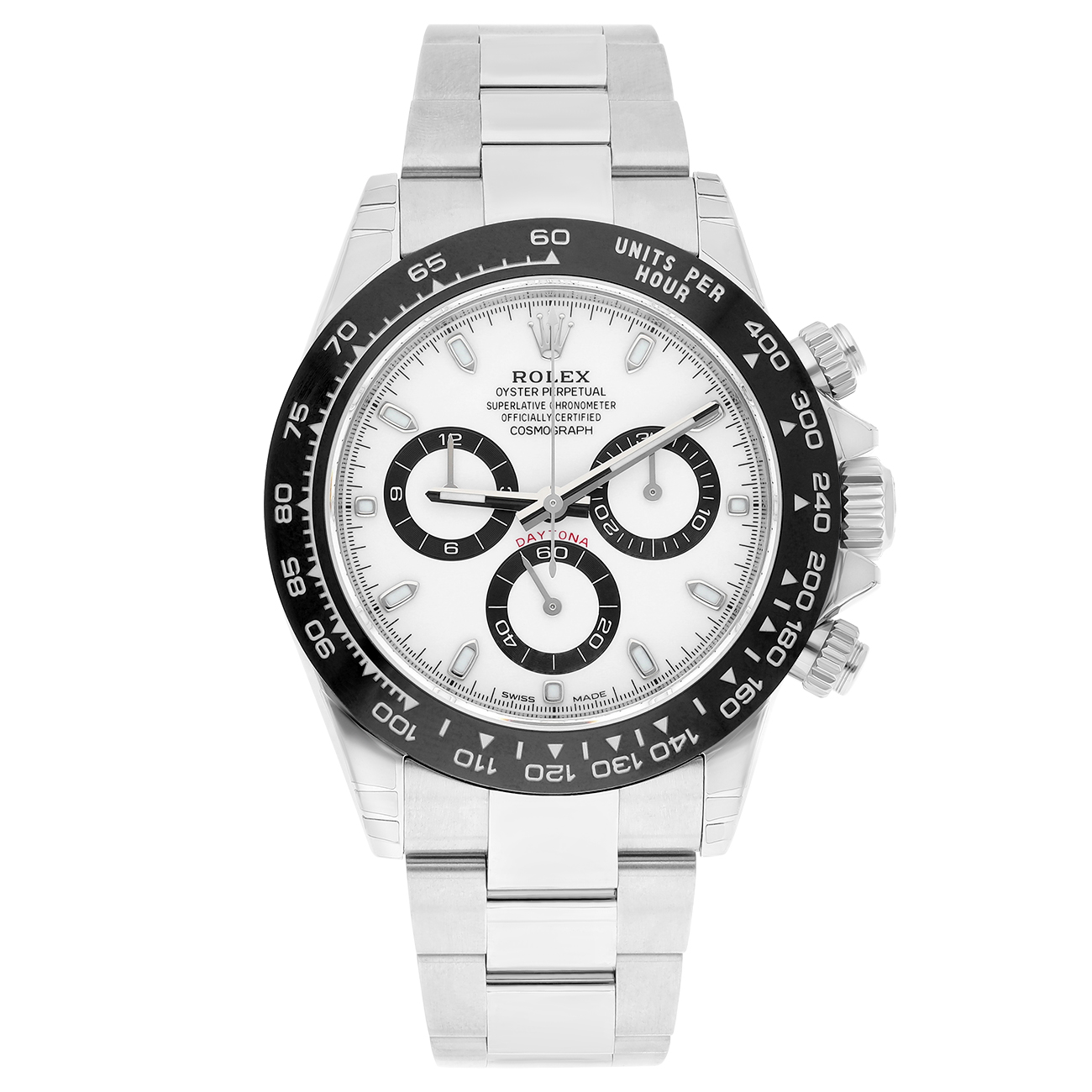
|  |
| Release year | 2016 | 2023 |
| Case diameter | 40 mm | 40 mm |
| Case thickness | 12.2 mm | 11.9 mm |
| Movement | Cal. 4130 | Cal. 4131 |
| Power reserve | 72 h | 72 h |
| Bezel | Full Cerachrom ceramic | Ceramic with polished steel rim |
| Lugs | Asymmetrical | Symmetrical |
| Subdials | Snailed, thicker frames | Vertically brushed, thinner frames |
| Main dial finish | Smooth | Sunray brushed |
| Hour markers | Bolder indices | Slimmer, more angular indices |
| Crown logo at 6 o’clock | No | Yes |
| Escapement | Standard | Chronergy escapement |
| Shock protection | KIF system | Paraflex shock absorbers |
| Rotor | Standard | Skeletonized, more ball bearings |
| Status | Discontinued (2023) | Current model |
| Retail | $14,550 | $16,000 |
Rolex Daytona 116500 vs 126500

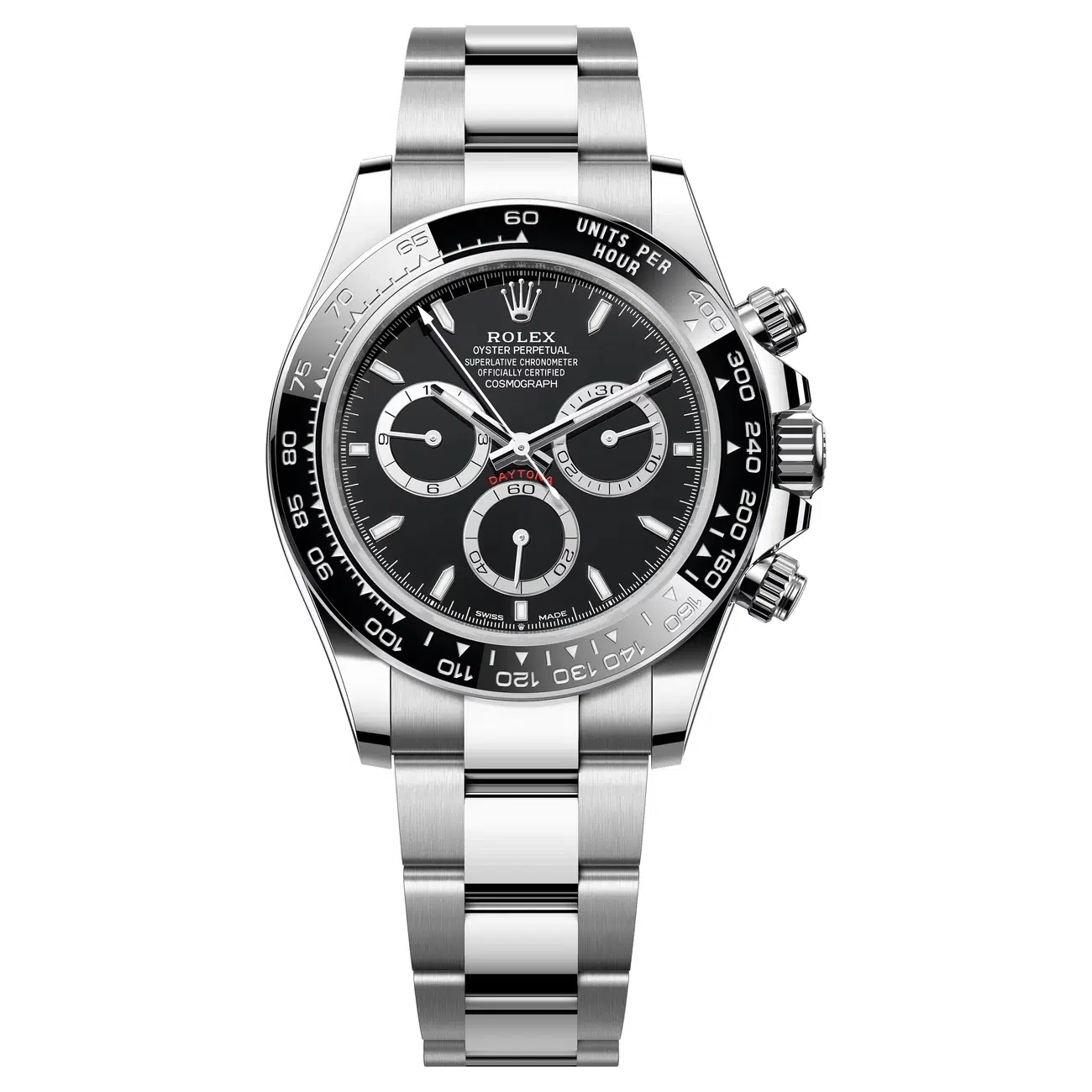
116500LN → 126500LN (the generational change). The headline is the movement. The 116500LN debuted at Baselworld 2016 as the first steel Daytona with a black Cerachrom ceramic bezel, running the in-house Caliber 4130. In 2023, the 60th-anniversary 126500LN introduced the Caliber 4131 — the first major movement revision since the 4130. Both keep the same core chronograph architecture (column wheel and vertical clutch) and the same 72-hour power reserve, but the 4131 uses fewer components, a skeletonized rotor on twice the number of ball bearings, the patented Chronergy escapement (nickel-phosphorus, paired with the paramagnetic blue Parachrom hairspring), and Paraflex shock absorbers in place of the older KIF system, along with Côtes de Genève finishing.
The case and dial were refined to match. The 126500LN is slimmer at 11.9 mm versus the 116500LN’s 12.2 mm, thanks to a thinner movement and flatter caseback, and switches from asymmetrical to symmetrical lugs. A polished steel lip now rings the ceramic bezel (both retain the platinum-filled tachymeter scale). On the dial, the 126500LN has thinner subdial frames set slightly more inward, vertically brushed subdials against a sunray-brushed center (the 116500LN pairs snailed subdials with a smooth main dial), slimmer angular hour markers, and a small crown logo between “Swiss” and “Made” at 6 o’clock denoting the upgraded movement.
The Everose gold Daytona
| 116505 | 126505 | |
|---|---|---|
| Image Ref: | 
|  |
| Case diameter | 40 mm | 40 mm |
| Case profile | Standard | Slimmer, slightly more recessed bezel |
| Material | 18kt Everose gold | 18kt Everose gold |
| Movement | Cal. 4130 | Cal. 4131 |
| Power reserve | 72 h | 72 h |
| Accuracy (after casing) | −2/+2 sec/day | −2/+2 sec/day |
| Water resistance | 100 m (330 ft) | 100 m (330 ft) |
| Dial options | Chocolate, black, ivory, sundust pink gold | (not specified in source) |
| Special features | Available with baguette diamond hour markers | Côtes de Genève decoration on bridges |
| Bracelet | Three-piece solid-link Oyster, Oysterlock clasp | Three-piece solid-link Oyster, Oysterlock clasp |
| Retail | $41,600 | $42,500 |
Rolex Daytona 116505 vs 126505

116505 → 126505. The Everose line follows the same movement story: the 116505 runs the Caliber 4130 (Rolex’s first in-house chronograph movement, introduced in 2000), while the 126505 carries the upgraded Caliber 4131. Both share the 72-hour power reserve, −2/+2 sec/day chronometer accuracy after casing, bidirectional Perpetual rotor, paramagnetic blue Parachrom hairspring, Paraflex shock absorbers, and 100 m water resistance. The 4131 achieves the same specifications with fewer components and adds Rolex Côtes de Genève decoration on the bridges.
Both watches use 18kt Everose gold — Rolex’s patented rose-gold alloy (gold, copper, and platinum) introduced in 2005 — throughout the case, fixed tachymeter bezel, and Oyster bracelet, with screw-down pushers and crown, sapphire crystal, and the Oysterlock safety clasp. The 126505 keeps the 40 mm diameter but adopts a slimmer case profile and a slightly more recessed bezel. The 116505 was offered in several dials (chocolate brown, black, ivory, and sundust pink gold), with diamond-set options available.
The rest of the modern lineup (4th & 5th generation)
Beyond the steel and Everose references compared above, the modern Daytona spans the full metal range. Every reference below is a live collection you can browse:
4th generation — caliber 4130 (2000–2023): 116503 Rolesor, 116505 Everose, 116506 platinum, 116508 yellow gold, 116509 white gold, 116515 Everose/Oysterflex, 116518 yellow gold/Oysterflex, 116519LN white gold/Oysterflex, 116523 Rolesor, 116528 yellow gold, 116599 gem-set.
5th generation — caliber 4131 (2023–present): 126503 Rolesor, 126505 Everose, 126508 yellow gold, 126509 white gold, 126515LN Everose/Oysterflex, 126518LN yellow gold/Oysterflex, 126519LN white gold/Oysterflex, 126539TBR white gold with diamond bezel.
The steel 116500 and 126500LN covered above complete the lineup.
Movement: Caliber 4130 vs Caliber 4131
This is the change that defines the new generation across both lines. The 4131 is an evolution, not a redesign — it keeps the proven column-wheel-and-vertical-clutch chronograph architecture and the 72-hour power reserve, then improves on it:
- Fewer components for reliability and lower maintenance.
- Chronergy escapement — nickel-phosphorus geometry that delivers torque more efficiently to the balance and adds magnetic resistance, paired with the blue Parachrom hairspring.
- Skeletonized rotor mounted on twice as many ball bearings, for quieter, more durable winding.
- Paraflex shock absorbers replacing the older KIF system.
- Côtes de Genève finishing on the bridges (the steel version adds a polished groove between bands and gold-colored chaton settings).
The 4130 remains a highly regarded movement in its own right and is the reason many traditional collectors still favor the 116500LN and 116505.
“Panda” and “reverse-panda” dials
The Daytona’s most-requested look is the “panda” — a white dial with contrasting black sub-dials, like a panda’s face, most associated with the steel 116500LN and 126500LN. The inverse, a black dial with white or silver sub-dials, is the “reverse panda.” Both are dial variants, not separate references. Browse reverse-panda Daytonas.
Which Daytona should you buy?
- Want the latest spec? The current references — 126500LN (steel) and 126505 (Everose) — give you the Caliber 4131, the slimmer case, and the refined dial detailing.
- Prefer the proven movement and “last of the line” status? The discontinued 116500LN and 116505 run the Caliber 4130 and appeal to collectors who value the original ceramic-bezel steel Daytona or the long-running Everose generation.
- Bold vs. refined wrist presence (steel)? The 116500LN wears with bolder indices and chunkier subdial framing; the 126500LN reads cleaner and slimmer thanks to the sunray dial and thinner profile.
- Buying Everose? Choose by dial. The 116505 offers the widest documented dial range (including the sought-after chocolate variant); the 126505 brings the newer movement and case profile.
Market notes
Secondary-market prices move constantly, and the Daytona carries some of the longest authorized-dealer waitlists of any Rolex — multi-year in many cases — so most buyers purchase from resellers at a premium over retail rather than wait for an allocation. The figures below are directional, as of July 2026 (sources: WatchCharts, Loupe, Chrono24); verify current numbers before buying.
- 126500LN (steel, current): secondary values have hovered around the mid-$30,000s (a fair-market value near $34,800 in mid-2026, with a 90-day band of about $33,000–$36,000), roughly double retail. The white “panda” dial trades about $6,000 above the black.
- 116500LN (steel, discontinued 2023): has settled around the mid-$20,000s, typically a few thousand below the current 126500LN and still well above its last retail of about $14,550. Here too the white dial carries roughly a $3,000 premium over the black.
- 116505 and 126505 (Everose gold): generally trade from the high-$40,000s into the $70,000s and beyond, depending on generation, dial, and condition, with rare dials (chocolate, meteorite, or diamond-set) reaching $100,000+.
Across the board, the white “panda” dial commands a premium over the black. For the full pricing picture, see our guide to how much a Rolex Daytona costs. [Link to the price guide (c1p0) once published.]
Frequently asked questions
What’s the biggest difference between the 116500LN and 126500LN?
The movement. The 126500LN introduced the Caliber 4131 — the first major Daytona movement upgrade in over 20 years — with a Chronergy escapement, skeletonized rotor on more ball bearings, and Paraflex shock absorbers, replacing the 116500LN’s Caliber 4130. The 126500LN is also slimmer (11.9 mm vs 12.2 mm), has symmetrical lugs, a steel-rimmed bezel, and a cleaner sunray dial.
Do the steel and Everose lines use the same movements?
Yes. Within each generation the caliber is shared: the 116500LN and 116505 both use the Caliber 4130, and the 126500LN and 126505 both use the Caliber 4131. All four share the 72-hour power reserve.
Has the 116500LN been discontinued?
Yes — Rolex discontinued the 116500LN in 2023, replacing it with the 126500LN.
What is Everose gold?
Everose is Rolex’s patented 18kt rose-gold alloy — a mix of gold, copper, and platinum introduced in 2005 — engineered to keep its warm hue over time. It is used on the 116505 and 126505.
Why do these references look so similar but cost different amounts?
Generation (the 4130-to-4131 movement and case/dial updates), material (steel vs Everose gold), dial variant, condition (original, unpolished, full-set examples command more), and current market demand. Steel u0022Pandau0022 dials in particular tend to trade at a premium over black dials.
How many generations of Rolex Daytona are there?
Four: the manual-wind era (1963 to 1988), the Zenith automatic era (1988 to 2000), the in-house Caliber 4130 era (2000 to 2023), and the current Caliber 4131 era (2023 onward).
Which Rolex Daytona had the Zenith movement?
The reference 16520, made from 1988 to 2000. It used the Caliber 4030, a heavily modified Zenith El Primero, and was the first automatic Daytona.
Enjoying our watch coverage? Get more of it in Google Search.