Rolex only manufactures about 1 million watches every year, according to industry analysts. Recent estimates for 2021 put Rolex’s production closer to 1.05 million watches. Rolex does not disclose official production numbers. Knowing how many Rolex watches are produced each year can help you understand why they’re so hard to find. In this article, we’ll share estimated numbers on annual Rolex production and provide breakdowns of production volumes for models like the Submariner and Daytona. We’ll also dive into why limited Rolex production drives demand among consumers and watch enthusiasts.

Table of Contents
Why Rolex Keeps Production Numbers Secret
The strategy behind the mystery
Rolex operates as a private company. This means it faces no legal obligation to disclose production figures to the public. This corporate structure allows the brand to maintain complete control over what information reaches competitors, collectors and customers. Other publicly traded companies must reveal sales data and manufacturing volumes to shareholders. Rolex has built an entire business strategy around keeping these numbers under wraps.
Watchmakers treat information about production and distribution as valuable assets. Brands like Rolex, Patek Philippe and Audemars Piguet keep data about production volumes and distribution networks out of public view. This serves dual purposes: protecting business intelligence and maintaining brand positioning. Courts insisted on transparency with Rolex’s pre-2018 data. The brand faced potential exposure of how carefully fine-tuned their scarcity narrative really is.
The brand doesn’t just hide numbers for competitive reasons. Rolex limits information about how many watches are made. This ensures that each piece reflects their quality standards. The approach reinforces the exclusivity and prestige attached to the name and guarantees that every watch represents true horological artistry.
Image source: rolex.com
Creating artificial scarcity
Scarcity isn’t an accident when it comes to watches. Brands create it as a marketing tactic and as protection from competitors. More than one CEO has publicly said that they wished they could make one less watch per year than was demanded of them. No one is actually able to hit that sweet spot, but you can understand the thinking.
Audemars Piguet is an example. They make roughly 50,000 watches per year total. Company higher-ups have publicly admitted that they do not make more than 1,200 pieces of highly coveted models like the Royal Oak Jumbo per year. There’s been zero indication that they plan to increase production anytime soon. By carefully limiting how many watches they produce each year they’ve generated waiting lists that are years long.
Rolex takes much of the same approach. They purposefully limit supply of their watches. The brand produces roughly one million watches per year, but could sell far more if they chose to increase production. Limiting how many watches they produce prevents saturation that would hurt the value of their watches. It also means that preowned Rolex watches are always in demand. Many of them sell for two, three, or more times what they originally retailed for.
How secrecy drives demand
The psychological effect of unavailability cannot be overstated. The harder it becomes to acquire a Rolex, the more desirable it appears. This mirrors strategies that luxury fashion houses use when they limit production to maintain exclusivity.
Brand executives focus intently on balancing ‘sell in’ (watches sold to retailers) with ‘sell out’ (watches sold to clients). Most now use digital software tools to monitor these metrics. This careful management explains why we’ve seen major watch groups temper production during market downturns.
Rolex cut production in 2024 by about 2%. This marked the first time the brand produced fewer watches than the previous year since the Global Financial Crisis in 2008 and 2009. Sales increased by about 5% due to higher prices and product mix. This reduction demonstrates how the brand prioritizes maintaining value over maximizing volume.
The illusion of unattainability plays the most important role in brand positioning. Long waiting lists for most professional models and sought-after references have become standard. Demand outstripping supply benefits brand image and desirability, though making a watch completely unobtainable risks alienating core customers. Rolex walks this tightrope by never revealing exactly how many watches are made. This keeps both aspiration and frustration alive in equal measure.
How Many Rolexes Are Made Each Year: The Estimated Numbers
Industry estimates and expert analysis
Determining precise Rolex production volumes can involve some sleuthing. Analysts will assess manufacturing capabilities, estimate the number of authorized dealers globally, and monitor how often new watches are spotted in dealerships. Those insights paired with export data released by the Federation of the Swiss Watch Industry (FH) enable analysts to develop rough estimates.
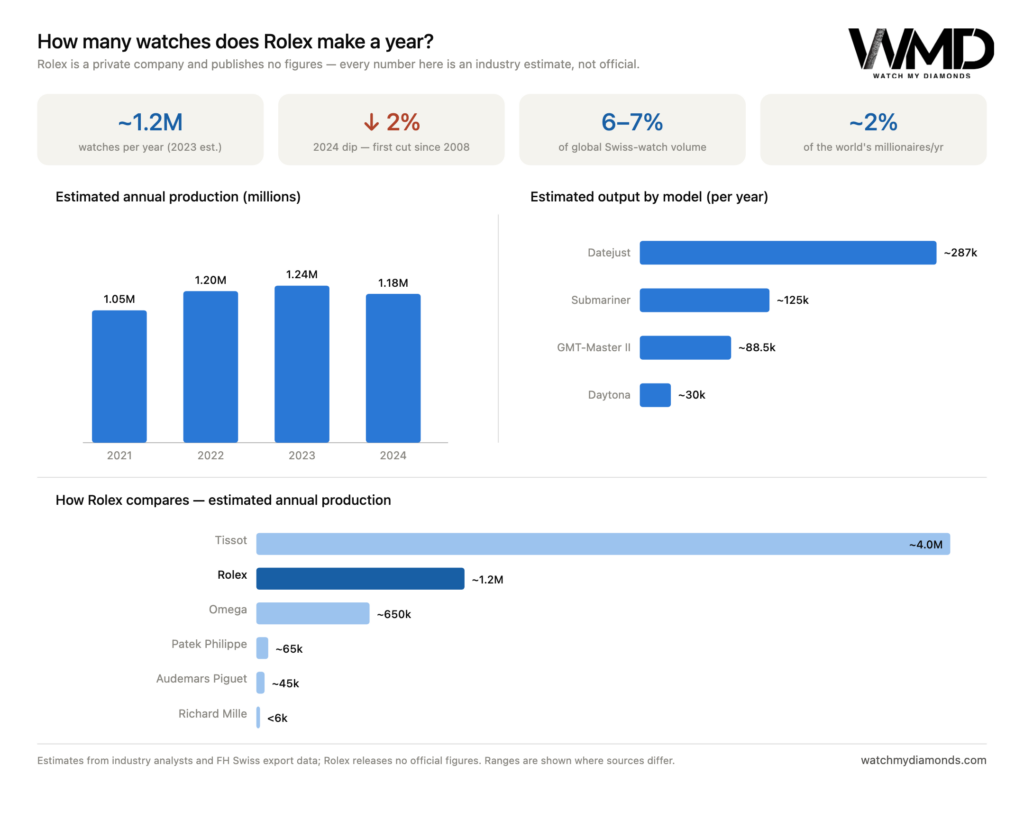
Most analysts converge around annual production of roughly 1 million timepieces. Though some estimates stretch as low as 800K and as high as 1.25 million. The discrepancies are owed to different methodologies and slight variations in estimated production capacity. After-all, Rolex is a private company that shares no official data. In 2021, Rolex produced about 1.05 million watches. 2022 production ticked up to 1.2 million timepieces. In 2023 production rose again to 1.24 million watches.
Rolex dialed back production in 2024. Production slipped to 1.18 million, the first annual contraction since 2008-2009 during the Global Financial Crisis. Sales still grew roughly 5%, thanks to price increases and adjustments to product mix.
Breaking down 1 million watches globally
Divide 1 million watches across thousands of Rolex boutiques worldwide and the allocation per location becomes very small. This distribution explains why walking into an authorized dealer rarely results in purchasing a professional sports model on the spot.
Production splits between two main collections. The Classic collection accounts for 54.6% of all Rolex watches, while the Professional collection represents 45.4%. The Classic lineup produces roughly 575,000 models annually, with the Datejust alone comprising nearly half of that volume.
The entire Swiss watch industry produces roughly 15 to 16 million timepieces annually. Rolex represents approximately 6 to 7 percent of total volume. But the brand commands a far larger share of total revenue. Rolex generated CHF 10.58 billion in 2024, with retail value reaching CHF 15.45 billion.
How this compares to other luxury brands
Rolex operates at a scale that sets it apart from ultra-exclusive manufacturers while maintaining positioning far above mass-market producers. Patek Philippe, widely regarded as the most prestigious independent Swiss watchmaker, produces roughly 60,000 to 70,000 pieces annually. Audemars Piguet sits at approximately 40,000 to 50,000 watches per year. Richard Mille produces fewer than 6,000 timepieces.
Omega produces somewhere between 600,000 and 700,000 watches annually. Tissot manufactures about 4 million watches each year. This positions Rolex in a unique middle ground between true haute horology houses and more available luxury brands.
Over 60 million millionaires exist worldwide. Rolex manufactures enough timepieces for only about 2% of this demographic each year, even at peak production of 1.24 million watches. Much of annual production consists of ladies’ models and precious metal pieces, leaving steel professional models in perpetual shortage.
Production Numbers for Popular Rolex Models
Rolex Submariner production estimates
The Submariner represents the largest single model production within Rolex’s professional lineup. Industry estimates place annual Submariner output between 100,000 and 150,000 watches. Rolex’s official publications reveal more precise figures for current-generation models. The Submariner Date reference 126610, introduced in 2020, shows an average annual production of 44,332 units. The no-date variant 124060 produces fewer pieces by a lot and maintains roughly a 2:1 ratio between date and no-date models.
Production has increased across generations. The reference 16610, manufactured from 1988 to 2010, averaged 29,392 pieces annually. The subsequent reference 116610, produced between 2010 and 2020, jumped to 41,491 units per year. This upward trend confirms that Rolex has expanded Submariner manufacturing capacity over decades gradually.
Rolex Daytona production figures

The Daytona sits at the opposite end of production volume among professional models. Estimates for annual Daytona production range from 20,000 to 40,000 watches and make it one of the brand’s most restricted offerings. Some analysts place the figure between 30,000 and 40,000 units, though experts contest the exact number.
The Daytona’s limited availability stems from considered production constraints. Named after Florida’s famous racetrack, the chronograph launched in 1963 for professional race drivers. Vintage variants command remarkable prices at auction. Paul Newman’s personal Daytona achieved a record-breaking USD 17.80 million in 2017 and cemented its position as one of the most expensive Rolex watches that ever sold. Waitlists at authorized dealers stretch from two to five years for this model.
GMT-Master II and other professional models
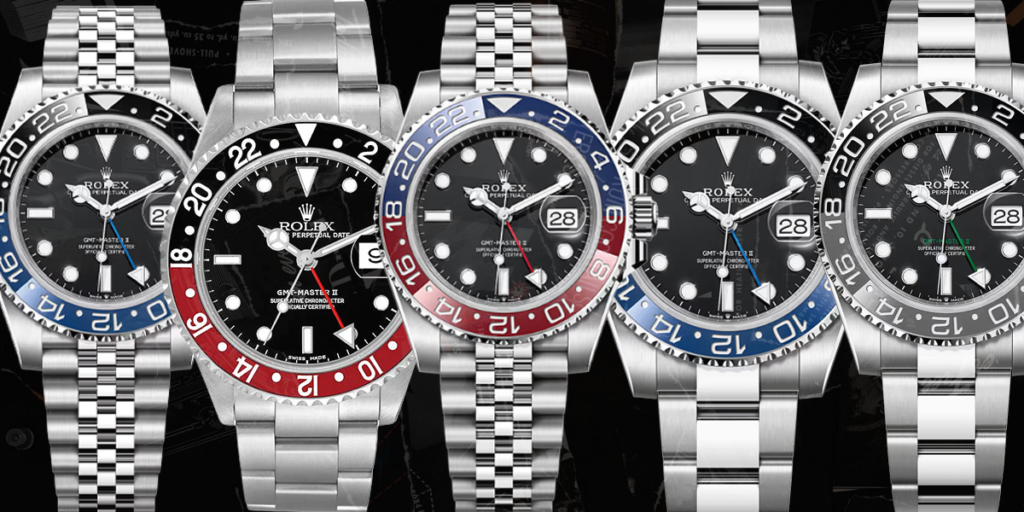
The GMT-Master II sits in the middle between the high-volume Submariner and exclusive Daytona. Annual production estimates fall between 80,000 and 100,000 pieces, with approximately 88,500 watches manufactured yearly. Stainless steel versions account for roughly 54,000 of that total.
Other professional models including the Yacht-Master and Sea-Dweller add much to overall output while maintaining production volumes below the Submariner but above the Daytona. These models balance accessibility with the exclusivity expected from Rolex’s professional collection.
Classic collection models (Datejust, Day-Date)
The Datejust dominates Rolex’s Classic collection production. The Datejust alone has nearly half of that volume within the roughly 575,000 Classic models produced annually. Rolex introduced the Datejust in 1945 to commemorate the company’s 40th anniversary and pioneered the automatically changing date display. Its broad appeal across demographics explains the substantial production allocation.
What Affects Rolex Production Volume
Quality control over quantity
Rolex’s core philosophy emphasizes quality over quantity. The brand refuses to ramp up production if doing so means sacrificing standards. This commitment shows in every aspect of manufacturing. Each watch undergoes meticulous testing and quality control at every production phase, from raw material sourcing to final inspection. Expert watchmakers hand-assemble each movement, a delicate process that requires extreme precision. Every movement receives adjustment in five different positions to ensure consistent performance.
The brand takes about a year to turn raw materials into a finished, fully tested watch. Each phase goes through repeated checks. Rolex fixes or replaces parts that fail inspection instead of moving them forward. This slows production but keeps quality consistent.
Manufacturing capacity and facilities
Rolex operates four production facilities in Switzerland. World headquarters in Geneva Acacias houses executive operations and design. Research and development plus final assembly units are also located there. Cases and bracelets are manufactured in Geneva Plan-Les-Ouates, which also contains the in-house foundry. All movements are constructed at the Bienne facility, while dial production occurs in Geneva Chêne-Bourg.
The brand is expanding by a lot. A new facility in Bulle, set to open in 2029, will cost upward of one billion Swiss francs and employ around 2,000 workers. Three temporary factories in Romont and Villaz-Saint-Pierre, employing 250 to 300 workers each, will operate until the Bulle site opens.
Raw material availability
Rolex produces its own high-performance Oystersteel, a grade 904L steel manufactured since 1985. Rich in chromium and molybdenum, this steel undergoes microscopic inspection throughout shaping and priming processes. The brand smelts its own gold and manufactures proprietary alloys. This gives it big advantages in quality and manufacturing flexibility. Oystersteel uses 60% waste from European industry on average, with the remaining percentage comprising ferroalloys.

Image source: rolex.com
Skilled watchmaker shortage
The watchmaking world faces a severe lack of skilled workers who can build and repair timepieces. This shortage affects specialists in 15 watchmaking professions, from precision mechanics to engineers and finishers. Seven government-sponsored watchmaking schools graduate only 400 to 500 watchmakers annually. Large numbers of baby-boomer watchmakers are retiring while few young people show interest in the profession.
Market demand and economic factors
Global economic factors shape Rolex production strategy. Luxury brands adjust production levels to maintain exclusivity and brand value during uncertain times. Rolex reduced production for the first time since 2008-2009 in 2024, yet grew revenue by increasing average prices.
How Limited Production Impacts the Watch Market
Why authorized dealers have empty shelves
Rolex production constraints create ripple effects throughout retail channels. Most authorized dealers worldwide have display cases that sit empty. The main reason behind this lack stems from a breakdown between supply and demand. While over 60 million millionaires exist around the world, annual production reaches only 1.05 million watches. Steel professional models face chronic shortages as a result.
Waitlists for the Daytona and GMT-Master II stretch between two and five years. Wait times for some models have shortened, and more references now trade below retail on the secondary market. This shows better availability. Steel Submariners remain the hardest models to acquire, especially GMTs and Daytonas. Demand is still nowhere near meeting supply for these models.
The thriving secondhand market
The pre-owned watch market is expected to reach USD 29 to USD 32 billion in sales by 2025. Rolex dominates as the leading brand in this space. Buyers unable to secure watches through authorized dealers can turn to the secondary market for immediate availability.
Gray market dealers provide authentic watches outside official channels. They source inventory from collectors and international distributors. This route eliminates waiting but commands premium pricing.
Rolex as an investment asset
Average Rolex prices increased over 550%, rising from approximately USD 2,000 in 2010 to USD 13,426 in 2025. The Datejust showed 639% appreciation over 15 years. The GMT-Master II achieved 506% appreciation. The Submariner climbed roughly 268% in value.
Prices peaked at USD 17,206 in March 2022 before correcting to USD 11,785 by December 2022. They settled around USD 13,426 by June 2025.
Premium pricing in the aftermarket
Steel Daytonas with ceramic bezels retail for USD 16,900 but command upwards of USD 35,000 on the gray market. The no-date Submariner reference 124060 costs USD 10,050 but trades around USD 14,000 in mint condition. This represents a 30% premium over retail.
Conclusion
Rolex only makes around 1 million watches per year. This explains why Rolex watches are almost impossible to find. Rolex values quality over quantity by design. Rolex scarcity is what keeps the luxury watch industry alive.
Rolex Submariners and Daytona models are always sold out. You can usually expect to be on waiting lists for years if you purchase from your local Rolex dealer. The grey market profits off of this high demand.
Knowing these facts can help you navigate the market better and have reasonable expectations when looking to purchase your next Rolex.
Enjoying our watch coverage? Get more of it in Google Search.