The Datejust is the backbone of the Rolex catalogue — introduced in 1945 as the first self-winding wrist chronometer to show the date in a window on the dial, and still the brand’s most recognizable dress watch more than 75 years later. Because the silhouette has barely changed, modern Datejust references look almost identical on a listing page yet differ meaningfully in movement, case proportions, bracelet construction, dial details, and price.
This guide maps the most-cross-shopped Datejust references in one place: the 36mm two-tone and smooth-bezel lines, the larger 41mm “Datejust II / Datejust 41,” and the vintage 26mm Lady-Datejust pair. If you are comparing two specific references, jump to the table for your size and generation.
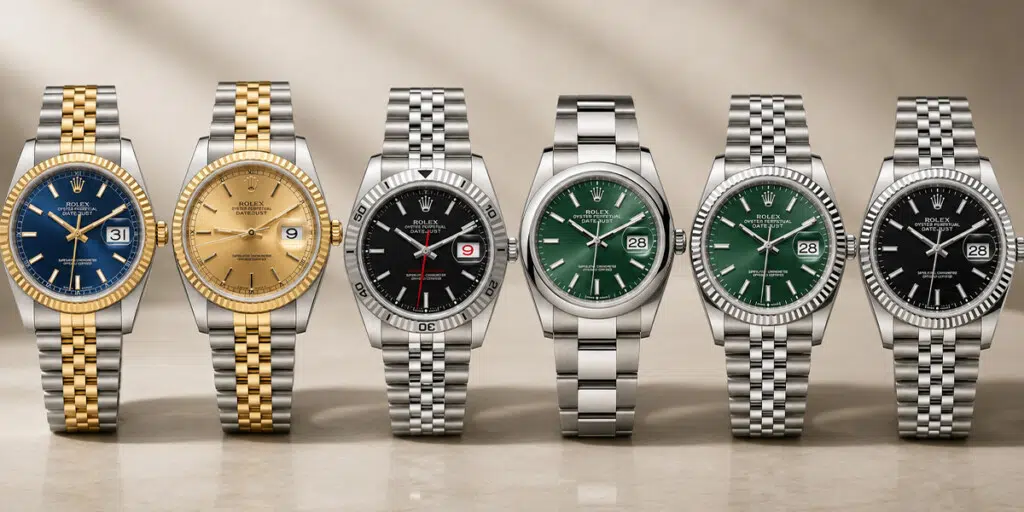
How to read the references: the leading digits track the generation. The 162xx / 692xx numbers are the older (pre-2000s) families; 1162xx / 1163xx are the mid-2000s generation; 1262xx / 1263xx are the current generation. Most generational jumps boil down to a movement upgrade, an engraved rehaut, solid bracelet links, and a dial clean-up.
Table of Contents
At-a-glance: The modern 36mm Datejust references
| 16233 | 116233 | 116200 | 126200 | 116234 | 126234 | |
|---|---|---|---|---|---|---|
| Generation | Older | Mid-2000s | Mid-2000s | Current | Mid-2000s | Current |
| Years | Late 1980s–1990s | Mid-2000s onward | 2004–2019 | Current | 2005–2018 | 2019–present |
| Case diameter | 36 mm | 36 mm | 36 mm | 36 mm | 36 mm | 36 mm |
| Bezel | Fluted yellow gold | Fluted yellow gold | Smooth (steel) | Smooth (steel) | Fluted white gold | Fluted white gold |
| Metal | Yellow Rolesor (two-tone) | Yellow Rolesor (two-tone) | Steel | Steel | Steel + white gold bezel | Steel + white gold bezel |
| Movement | Cal. 3135 | Cal. 3135 | Cal. 3135 | Cal. 3235 | Cal. 3135 | Cal. 3235 |
| Power reserve | 48 h | 48 h | 48 h | 70 h | 48 h | 70 h |
| Beat rate | 28,800 bph | 28,800 bph | 28,800 bph | 28,800 bph | 28,800 bph | 28,800 bph |
| Accuracy | — | — | −4/+6 s/day | −2/+2 s/day | — | −2/+2 s/day |
| Rehaut engraving | None | “ROLEXROLEXROLEX” | None | “ROLEX” pattern | “ROLEX” pattern | “ROLEX” pattern |
| Bracelet links | Hollow center | Solid (SEL) | Hollow | Solid three-piece (SEL) | Super Jubilee, hidden Crownclasp | Solid links, hidden clasp + microadjust |
| Water resistance | 100 m | 100 m | 100 m | 100 m | 100 m | 100 m |
| Lume | Tritium/Luminova (early) | Super-LumiNova | — | — | Super-LumiNova (green) | Chromalight (blue, ~8 h) |
The 16233/116233 are the two-tone, fluted yellow-gold-bezel pair. The 116200/126200 are the all-steel, smooth-bezel pair. The 116234/126234 are the steel with fluted white-gold bezel pair. All three pairs share the 36mm Oyster case.
The Datejust 41mm “Datejust II / Datejust 41”
| 116334 (Datejust II) | 126334 (Datejust 41) | |
|---|---|---|
| Years | 2009–2016 | 2016–present |
| Case diameter | 41 mm | 41 mm |
| Case thickness | 12.2 mm | 11.7 mm |
| Lug-to-lug | 49.5 mm | 47.5 mm |
| Movement | Cal. 3136 | Cal. 3235 |
| Power reserve | 48 h | 70 h |
| Bezel | Thicker fluted | Slimmed-down fluted |
| Lugs | Thicker, angular | Softer, more tapered |
| Hour markers | Roman numerals (non-luminous), 18k gold | Luminous stick indexes, 18k gold (~8 h glow) |
| Dial options | Black, slate, ivory, champagne | Silver, white, champagne, mint green |
| Bracelet | Oyster only | Oyster or Jubilee |
| Clasp | Folding Oysterclasp + Easylink | Folding Oysterclasp + Easylink |
| Shock protection | Paraflex | Paraflex (+ Chronergy escapement) |
At-a-glance: The vintage 26mm Lady-Datejust
| 69173 | 69174 | |
|---|---|---|
| Production era | 1980s | 1980s |
| Case diameter | 26 mm | 26 mm |
| Metal | Yellow Rolesor (steel + 18k yellow gold) | White Rolesor (steel + white gold) |
| Gold elements | Crown, bracelet center links, bezel | Bezel only |
| Bezel | Fluted yellow gold | Fluted white gold |
| Movement | Cal. 2135 | Cal. 2135 |
| Power reserve | 42 h | 42 h |
| Crystal | Sapphire | Sapphire |
| Water resistance | 100 m | 100 m |
| Bracelet | Jubilee or Oyster | Jubilee or Oyster |
| Avg. market price | ~$3,995 | ~$4,400 |
The 36mm two-tone line: 16233 vs 116233
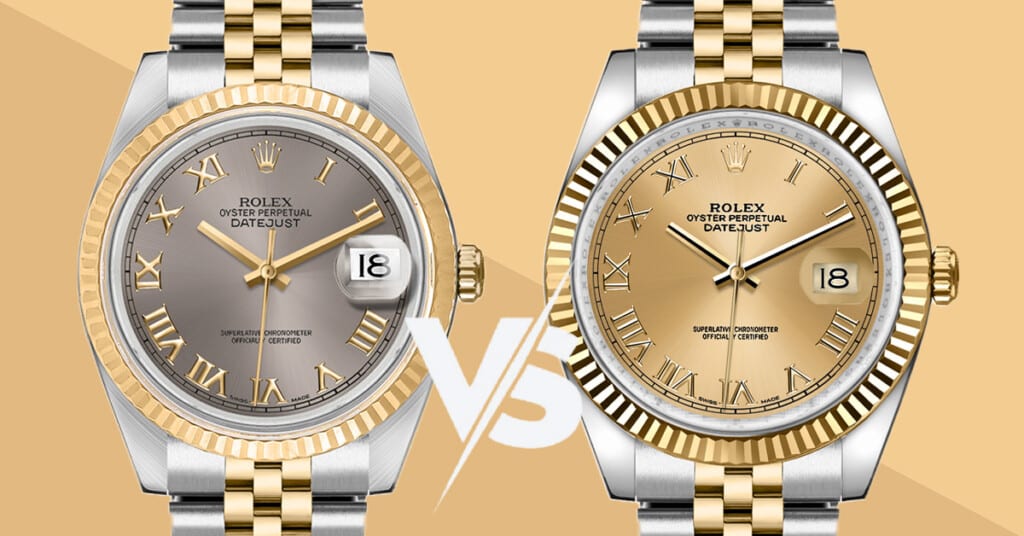
Both references are 36mm yellow Rolesor (Rolex’s two-tone steel-and-18k-gold) Datejusts with a fluted yellow-gold bezel, 100m water resistance, and the COSC-certified Caliber 3135 (28,800 bph, 48-hour power reserve, Parachrom hairspring). The differences are evolutionary:
- Case finish: the 16233 pairs brushed lugs with polished case sides for a more subdued, vintage look; the 116233 moved to fully polished surfaces throughout.
- Lug profile: the 16233 has slim, tapered lugs; the 116233 has broader lug shoulders for more wrist presence at the same 36mm diameter.
- Rehaut: the 116233 introduced the engraved “ROLEXROLEXROLEX” inner-bezel ring (an anti-counterfeiting and design detail); the 16233 has none.
- Bracelet: the 16233 uses hollow center links (lighter, but prone to stretch and rattle over time); the 116233 uses solid links with solid end links (SEL) — heavier and more rigid.
- Clasp: the 16233 has a basic flip clasp (the so-called “tuna can”); the 116233 uses the modern Oysterclasp or the hidden Crownclasp, and adds tool-based micro-adjustment without removing links.
- Lume: early 16233s used tritium (“T SWISS T” on the dial), with a switch to Luminova around 1998 and Swiss Super-LumiNova by 2000; 116233s use Super-LumiNova throughout.
A note on accuracy standards: Rolex tightened its “Superlative Chronometer” rating to −2/+2 seconds per day in 2015 (from the COSC −4/+6) and extended the warranty from two to five years. Because both of these references predate or straddle that change, accuracy depends on the individual watch’s production year rather than the reference itself.
The 36mm all-steel smooth-bezel line: 116200 vs 126200

Both are 36mm all-steel Datejusts with a smooth bezel and 100m water resistance. This is a true generational jump driven by the movement.
- Movement: the 116200 uses Caliber 3135 (48-hour reserve, −4/+6 s/day). The 126200 uses the next-generation Caliber 3235 (introduced 2015; 14 patents; over 90% new components; Chronergy escapement ~15% more efficient; 70-hour reserve; −2/+2 s/day). Both share 28,800 bph and a 28.50mm movement diameter, and both keep Rolex’s instantaneous midnight date change.
- Case: the 116200 has thicker, fully polished lugs that read more “square”; the 126200 has thinner lugs and flatter case sides for a more balanced, vintage-16xx-inspired profile.
- Rehaut: the 126200 has the engraved “ROLEX” rehaut; the 116200 does not. (The engraving became standard across Oyster models by 2008 and was refined from block letters to a finer etch in 2015.)
- Bracelet & clasp: the 116200 has hollow links and a Crownclasp; the 126200 has solid three-piece links, solid end links (SEL) for a seamless case-to-bracelet transition, and an Oysterclasp with the 5mm Easylink comfort extension.
- Weight: the 126200 weighs roughly 123.6–123.8 g on the bracelet — more substantial on the wrist.
- Dials: the 116200 was offered in a wide variety (silver, black, concentric circles, floral motifs, “Jubilee” logo dials, and some “Bull’s Eye” two-zone dials with roulette date wheels); the 126200 takes a cleaner approach with no railway/minute track (the color-shifting blue dial is a highlight).
The 36mm steel + white-gold-bezel line: 116234 vs 126234

Both are 36mm steel Datejusts with a fluted white-gold bezel, 100m water resistance, the Twinlock screw-down crown, a laser-etched coronet at 6 o’clock, and the engraved “ROLEX” rehaut. Again the headline is the movement.
- Movement: the 116234 uses Caliber 3135 (48-hour reserve). The 126234 uses Caliber 3235 (70-hour reserve, Chronergy escapement ~15% more efficient with a skeletonized escape wheel and thinner pallet stones, nickel-phosphorus components for better magnetic resistance, Paraflex shock absorbers, Parachrom hairspring, −2/+2 s/day).
- Dial: the 116234 has “railroad tracks” (a minute track) and a sought-after “Roulette Date wheel” option (alternating red/black numbers) with Super-LumiNova (green glow). The 126234 removes the railroad track and uses Chromalight (blue glow lasting up to ~8 hours).
- Case & lugs: the 126234 has more rounded, wider high-polished lugs versus the 116234’s thicker lugs, with rich brushed-and-polished contrast. The 126234 is cited at 36mm diameter, ~12mm thick, 43.3mm lug-to-lug.
- Bracelet: both offer Jubilee (five-piece link) or Oyster (three-piece link). The 116234’s “Super Jubilee” uses a hidden Crownclasp; the 126234 adds solid links, a hidden clasp, and microadjustment.
The 41mm line: 116334 (Datejust II) vs 126334 (Datejust 41)

Rolex launched the larger Datejust II (116334) at Baselworld 2009, discontinued it in 2016, and replaced it with the Datejust 41 (126334). Both are 41mm, but they wear differently.
- Movement: the 116334 uses Caliber 3136 (a 3135 derivative with a larger mainplate and an oversized date wheel sitting ~1mm further from dial center; 48-hour reserve). The 126334 uses Caliber 3235 (14 patents, 90%+ new components; Chronergy escapement; ~30% better overall energy efficiency from an upgraded gear train and thin-walled high-capacity barrel; 70-hour reserve). Both use the Paraflex shock-absorption system.
- Case: the 116334 is 12.2mm thick with a 49.5mm lug-to-lug; the 126334 is 11.7mm thick with a 47.5mm lug-to-lug. Same 41mm diameter, but the Datejust II wears bigger and blockier while the Datejust 41 wears more refined.
- Bezel & lugs: the 116334 has a thicker, more prominent fluted bezel and thicker, angular lugs; the 126334 has a slimmed fluted bezel and softer, more tapered lugs.
- Dial: the 116334 uses 18k gold Roman numerals (non-luminous) in conservative colors (black, slate, ivory, champagne); the 126334 uses 18k gold luminous stick indexes (~8-hour glow) and adds options like silver, white, champagne, and the distinctive “mint green.” Both keep the Cyclops date lens at 3 o’clock.
- Bracelet: the 116334 came only on the Oyster bracelet; the 126334 offers Oyster or the dressier five-link Jubilee. Both use the Folding Oysterclasp with Easylink.
The 26mm Lady-Datejust line: 69173 vs 69174

Two 1980s Lady-Datejust references, both 26mm (the standard Lady-Datejust size until Rolex moved to 28mm in 2015), both on the in-house Caliber 2135 (introduced 1983; 28,800 bph; 42-hour reserve; Quickset date; sapphire crystal; 100m water resistance; Oyster case). The defining difference is the metal:
- 69173 — yellow Rolesor: steel with 18k yellow gold on the crown, bracelet center links, and the fluted bezel. Warmer, more traditional two-tone look.
- 69174 — white Rolesor: steel with white gold appearing only on the fluted bezel. More understated.
Both came in a wide range of dials (champagne, white, black, blue sunburst, silver, plus luxury versions in mother-of-pearl, lapis lazuli, or malachite, and diamond or Roman-numeral markers) and on either the Jubilee (five-link) or Oyster (three-link) bracelet.
Which Datejust should you buy?
- Want a two-tone, fluted-bezel 36mm? The 116233 is the more modern build (solid bracelet, engraved rehaut, better clasp); the 16233 suits buyers who prefer the lighter, slimmer vintage feel and the older dial.
- Want all-steel and the latest tech? The 126200 gives you the 70-hour Caliber 3235, solid SEL bracelet, Easylink, and tighter accuracy. The 116200 is the value entry point to a Datejust.
- Want the white-gold fluted bezel in 36mm? The 126234 is the better daily wearer (70-hour movement, Chromalight, solid links/hidden clasp); the 116234 appeals to those who want the discontinued railroad-track dial or roulette date option.
- Want a larger 41mm? The 126334 (Datejust 41) is the more refined and better-equipped pick (70-hour movement, slimmer profile, Oyster or Jubilee, luminous indexes). The 116334 (Datejust II) is for those who specifically want the bigger, blockier sports-watch presence — pre-owned only.
- Buying a vintage 26mm Lady-Datejust? Choose by metal/finish: warm two-tone 69173 vs. understated 69174. Specs are identical.
- Across the board: if you want the latest movement and the cleanest dial, choose a current “126xxx” reference; if you want value or a specific vintage detail, the older references deliver authentic Datejust character for less.
Market notes
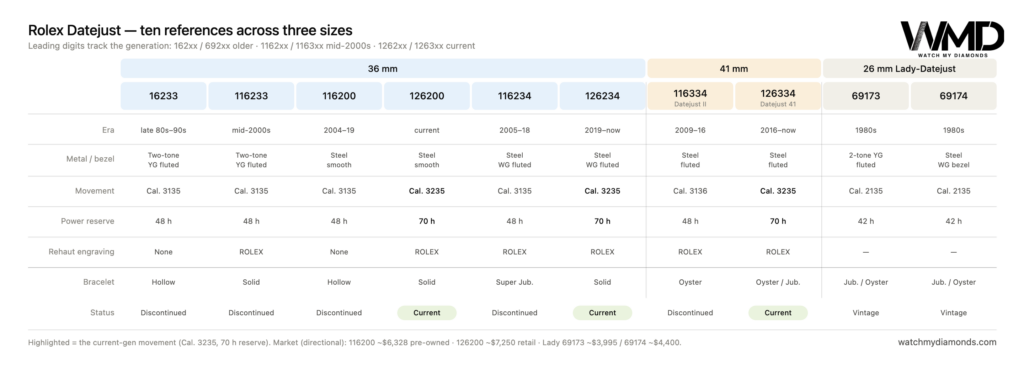
Secondary-market prices move constantly, so treat figures as directional, not advice. As referenced at the time the source material was written: the steel 116200 averaged about $6,328 pre-owned against a 126200 retail of about $7,250; the Lady-Datejust 69173 traded around $3,995 and the 69174 around $4,400 (with diamond/stone-dial variants commanding premiums). The discontinued references (16233, 116200, 116234, 116334) are pre-owned only and can carry collector appeal as transitional designs; original box and papers can add meaningfully to value.
Frequently asked questions
What is the single biggest difference between an older and a current Datejust?
The movement. Current “126xxx” references use Caliber 3235 (3136 in the case of the 41mm) with a 70-hour power reserve and −2/+2 s/day accuracy, replacing the Caliber 3135’s 48-hour reserve. The newer movement adds the Chronergy escapement (~15% more efficient) and better magnetic resistance.
What is the rehaut engraving and which references have it?
The rehaut is the inner ring between the dial and crystal. Rolex began engraving it (the repeated “ROLEX” motif) as an anti-counterfeiting feature in the mid-2000s. Among the references here, the 16233 and 116200 lack it, while the 116233, 126200, 116234, 126234, and the 41mm models have it.
Hollow vs. solid bracelet links — does it matter?
Yes. Older references (16233, 116200) use hollow links, which are lighter but can stretch and rattle over time. Newer references use solid links and solid end links (SEL) for a heavier, more rigid feel and a seamless case-to-bracelet transition.
Why is the Datejust II (116334) a different wear from the Datejust 41 (126334) if both are 41mm?
The Datejust II is thicker (12.2mm vs 11.7mm) with a longer lug-to-lug (49.5mm vs 47.5mm), a bulkier fluted bezel, and angular lugs, so it wears bigger and blockier. The Datejust 41 has a slimmer profile and softer, tapered lugs for a more classic look.
What’s the difference between the Lady-Datejust 69173 and 69174?
Only the metal. The 69173 is yellow Rolesor (gold on the crown, bracelet center links, and bezel); the 69174 is white Rolesor (white gold on the bezel only). Both share the 26mm case and Caliber 2135.
Are all these models water resistant enough for daily wear?
Every reference here is rated to 100m (330 ft) via Rolex’s screw-down Oyster crown system — fine for hand-washing, rain, and swimming, though not diving.
Enjoying our watch coverage? Get more of it in Google Search.