
Most Expensive Rolex Watches That Broke Auction Records
Paul Newman’s personal Rolex Daytona ref 6239 would make anyone’s jaw drop. The timepiece reached an astounding $17.8 million at the time it went under

The Nautilus is the watch that turned Patek Philippe into a sports-watch powerhouse. Born in 1976 from Gérald Genta’s porthole-inspired design, it has since branched into a small family of references that look almost interchangeable on a listing page but differ sharply in material, movement, complication, and price. Two transitions matter most to buyers today: the discontinued steel time-and-date 5711 giving way to its white-gold successor the 5811, and the chronograph 5980 sitting alongside the Travel Time chronograph 5990.
This guide maps those four references in one place — what each one is, what actually changed between them, and how to choose. If you’re comparing two specific references, jump to the table for the pair you’re weighing.
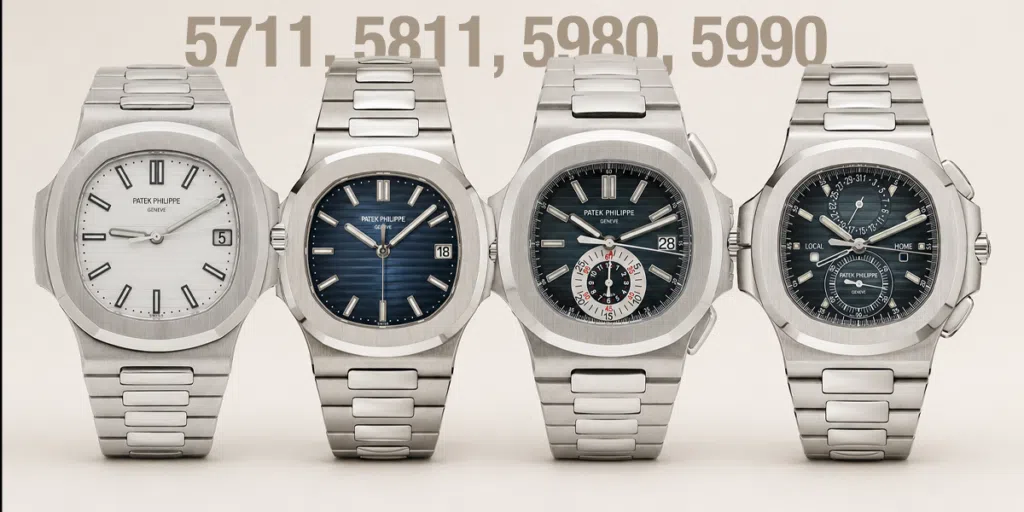
How to read the references: the Nautilus splits into two lines here. The time-and-date line runs steel 5711 (40mm) → white-gold 5811 (41mm). The chronograph line runs 5980 (chronograph) and 5990 (chronograph + Travel Time), both at 40.5mm. The 5711 and the steel 5990/1A have both been discontinued, which drives much of their secondary-market behaviour.
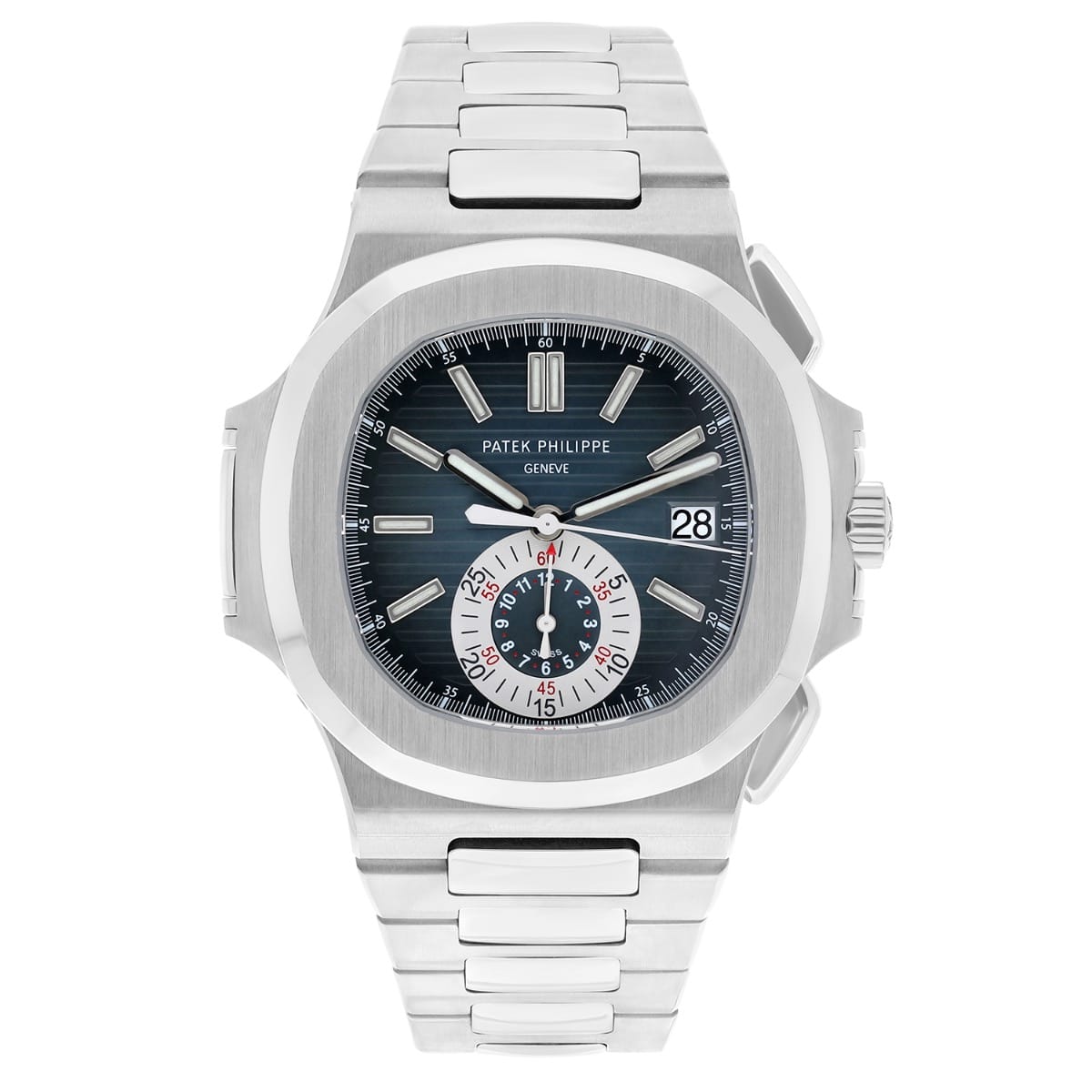
| 5711/1A | 5811/1G | 5980/1A | 5990/1A | |
|---|---|---|---|---|
| Image Ref: | 
|  | 
| 
|
| Line | Time & date | Time & date | Chronograph | Chrono + Travel Time |
| Years | 2006–2021 | 2022–present | 2006—2014 | debut 2014 (Baselworld); steel disc. 2021 |
| Case diameter | 40 mm | 41 mm | 40.5 mm | 40.5 mm |
| Case thickness | 8.3 mm | 8.2 mm | 12.6 mm | 12.53 mm |
| Case material (this ref) | Stainless steel | White gold | Stainless steel | Stainless steel |
| Case construction | 3-part | 2-part monobloc | 2-part | 3-part |
| Movement | Cal. 26-330 S C (final models) | Cal. 26-330 S C | CH 28-520 C | CH 28-520 C FUS |
| Beat rate | 28,800 vph (4 Hz) | 28,800 vph (4 Hz) | 28,800 vph (4 Hz) | 28,800 vph (4 Hz) |
| Power reserve | 35–45 h | 35–45 h | 45—55 h | 45—55 h |
| Water resistance | 120 m | 120 m | 120 m | 120 m |
| Key complications | Date | Date | Flyback chronograph (mono-counter) | Flyback chronograph + Travel Time (dual time, day/night) |
| Retail (this ref) | ~$30,000 | $69,790 | ~$69,790 | $68,600 (2023) |
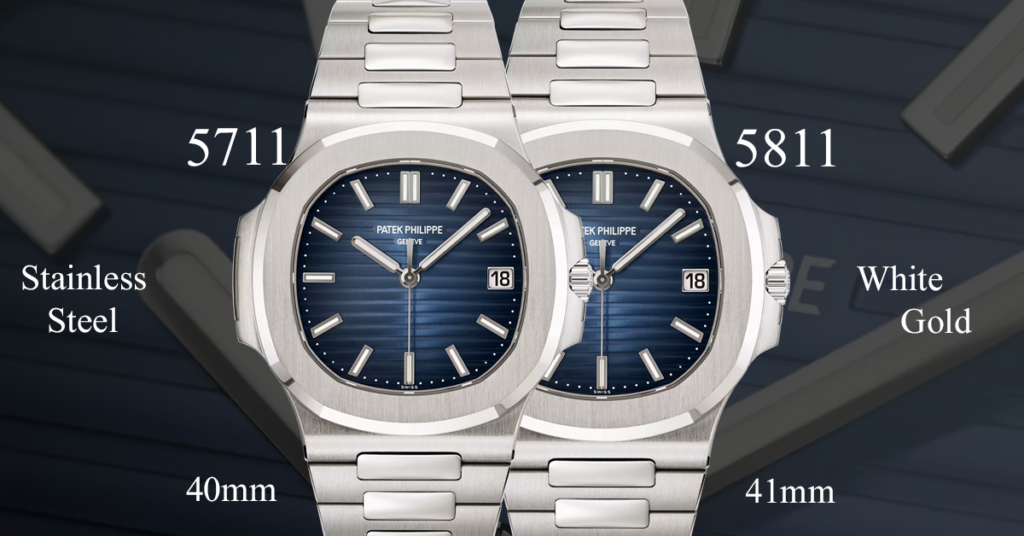
The 5811/1G is the direct replacement for the steel 5711, and the differences run deeper than the obvious material swap.
Material and size. The 5711 is a 40mm stainless steel watch standing 8.3mm tall. The 5811 grows to 41mm in diameter while shaving 0.1mm of height to 8.2mm, and switches to white gold for both case and bracelet. The 1mm of extra diameter gives it more wrist presence — useful on wrists over roughly 18cm, where the 5711 can read small — while the white gold adds noticeable weight and a more substantial feel.
Case construction. This is the most interesting technical change. The 5711 (2006–2021) used a three-part case. The 5811 returns to the two-part monobloc construction of the original 1976 Nautilus (reference 3700), where the mid-case and caseback are a single piece. That choice forces dial-side access for servicing and required Patek to develop a new patent-pending pull-out-piece lever system for the crown in place of the old split-stem design. It is also harder to manufacture: a flaw during production can mean scrapping a whole section rather than a single part.
Dial. The 5711 carries a flat blue dial with the signature horizontal embossed pattern and an unframed date window at 3 o’clock. The 5811 keeps the embossed pattern but moves to a sunburst blue dial with black gradation that shifts from a lighter centre to darker edges, and adds a white-gold frame around the date window (a detail that first appeared on the green-dial Nautilus). Hour markers and baton hands are applied and lume-coated on both; the 5811 uses white-gold markers to match its case.
Bracelet and clasp. The 5711’s brushed steel bracelet and standard clasp give way to a white-gold bracelet with alternating polished and satin-brushed finishes, plus a new patented fold-over butterfly clasp. The clasp adds a lockable micro-adjustment that extends the bracelet 2–4mm without tools — a genuine comfort upgrade in warm weather.
Movement. Both the final 5711 and every 5811 use caliber 26-330 S C (212 parts, 21k yellow-gold rotor, 27mm × 3.32mm, 28,800 vph, Gyromax balance, Spiromax balance spring). Power reserve is rated 35–45 hours on both. The practical difference is the stop-seconds (hacking) function: earlier 5711s with caliber 324 SC could not hack — setting exact time meant pushing on the back of the crown — whereas the 26-330 SC (introduced on the 5711 in 2019 and carried into the 5811) lets you stop the seconds hand to set time precisely.
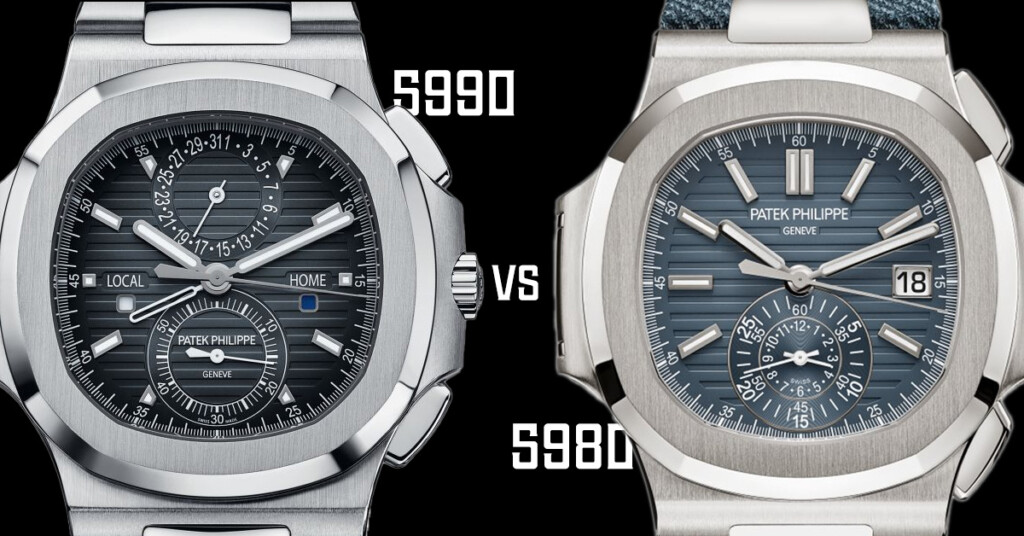
Both are 40.5mm Nautilus chronographs with 120m water resistance, but they serve different purposes.
Complication. The 5980 is a pure flyback chronograph built on the CH 28-520 C caliber, with a distinctive mono-counter subdial at 6 o’clock that displays both elapsed minutes and hours in one register. The 5990 uses the CH 28-520 C FUS movement: it keeps the flyback chronograph (now a conventional 60-minute counter at 6 o’clock) but trades the hour totalizer for a Travel Time function — dual time zones shown by two central hour hands (a skeletonized hand for home time, a solid hand for local time), with day/night indicators for both zones. The date moves with it, from a window at 3 o’clock on the 5980 to a pointer-date subdial at 12 o’clock on the 5990, paired with local time.
Case and dimensions. The added pushers for the dual-time function pushed the 5990 to a three-part case (bezel, middle, back) versus the 5980’s two-part case; the travel-time pushers integrate into the left-side “ear.” Despite the extra complication, the 5990 is fractionally thinner — 12.53mm vs the 5980’s 12.6mm.
Dial. Both share the horizontal embossed guilloché pattern. The 5990 has worn a graduated grey sunburst over its life; the current 5990/1A-011 carries a blue sunburst with a radial gradient that matches the modern Nautilus look.
Secondary-market prices for the Nautilus move constantly and have been unusually volatile, so treat every figure here as directional, not advice — and confirm current pricing before you act.
Patek actively manages scarcity: CEO Thierry Stern has stated the company is vigilant about rarity and buys back a few hundred pieces a year from the secondary market to monitor flipping.
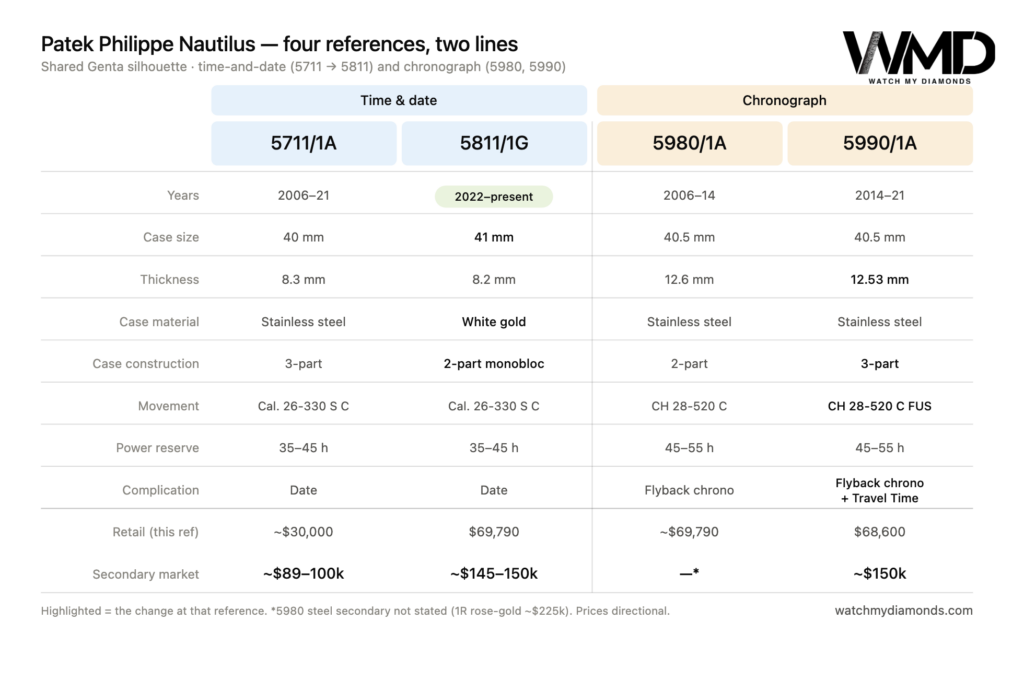
Material and construction. The 5711 is 40mm stainless steel with a three-part case; the 5811 is 41mm white gold with a two-part monobloc case (a nod to the original 1976 Nautilus). The 5811 also adds a sunburst-gradient dial, a framed date window, a micro-adjustable butterfly clasp, and — versus early 5711s — a hacking seconds function. Both use the same caliber 26-330 S C.
Yes. The final 5711 models and every 5811 use caliber 26-330 S C (28,800 vph, 35–45h power reserve). Earlier 5711s used calibers 315 SC and 324 SC; the 324 SC lacked the stop-seconds (hacking) function that the 26-330 SC introduced.
Complication and layout. The 5980 is a pure flyback chronograph with a mono-counter at 6 o’clock. The 5990 keeps the flyback chronograph but adds a Travel Time (dual time zone) function with day/night indicators, moving to a 60-minute counter at 6 o’clock and a pointer-date subdial at 12 o’clock. The 5990 also has a three-part case and wears fractionally thinner despite the extra complication.
The original steel 5990/1A was discontinued in 2021, but Patek has introduced newer variants such as the blue-sunburst 5990/1A-011, which remains in the collection.
Material (steel vs. white/rose gold), complication (date vs. chronograph vs. travel-time chronograph), production status (discontinued references are scarcer), and current market demand. Discontinued steel references and rose-gold variants tend to command the strongest premiums.
Paul Newman’s personal Rolex Daytona ref 6239 would make anyone’s jaw drop. The timepiece reached an astounding $17.8 million at the time it went under
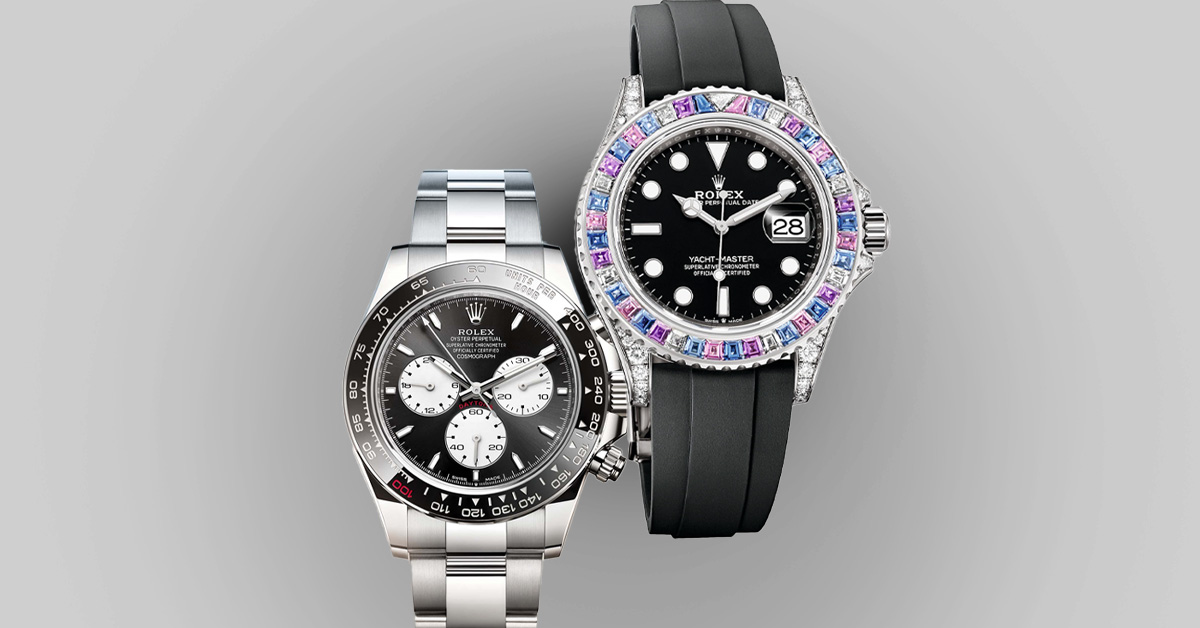
The Cotton Candy Rolex reframes what a modern luxury timepiece can be. From its 2022 launch, this unique Yacht-Master 40 stood apart from other watches.

The Rolex Glidelock stands out as one of the most important breakthroughs in watch bracelet technology since 2008. Your wrist swells up in hot weather