
Do Rolex Watches Glow In The Dark? Well yes they do but not like they used to years ago. Today Rolex watches are made with some of the latest high tech luminous material that can last up to 8 hours in pitch black darkness. Also not every model glows the same or even the same color. Some older Rolex watches may not glow at all because the luminous material is no longer working. Older radioactive substances such as Tritium fade away after about a 12.5 year half life. To understand if all Rolex watches glow in the dark and how Rolex watches glow in the dark you must know what luminous material is in your watch. In this article we will cover the evolution of Rolex luminous material and how each type works. We will also show you how you can tell what type your watch has.
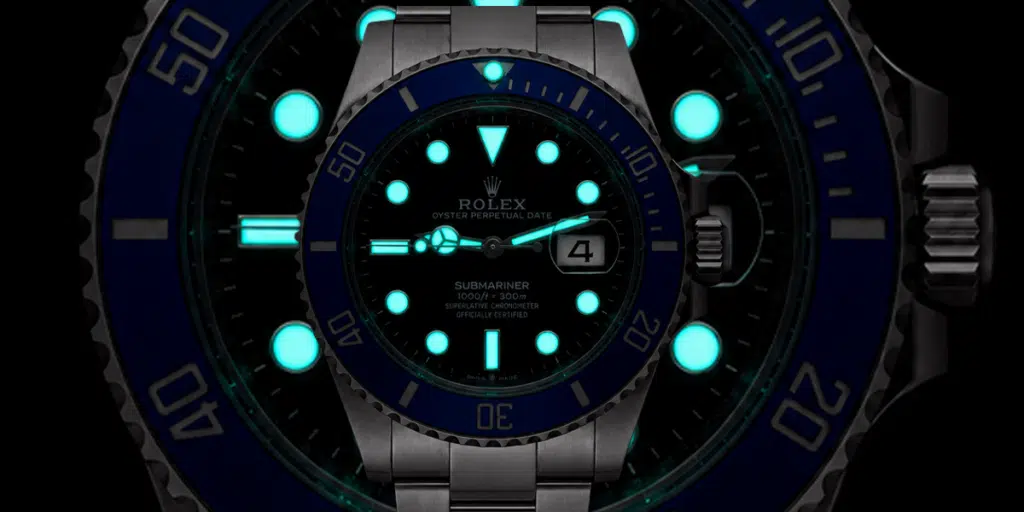
Table of Contents
Yes, Rolex Watches Do Glow in the Dark (But Not All the Same Way)
All Rolex sports watches are equipped with luminous materials. However, the application and brightness levels differ greatly depending on the model and production year. Professional models like the Submariner are packed with extra lume on their large hands and hour markers for a brighter and longer lasting glow. Dress watches like the Daytona have less.
Do All Rolex Watches Glow in the Dark?
Yes, all Rolex watches come with some sort of luminous material on the hands and hour markers. Not all Rolex watches glow the same. The more lume that is applied to the hands and hour markers, the brighter and longer it will glow. Sports watches are layered liberally because they are expected to be used in low light conditions versus dress watches.
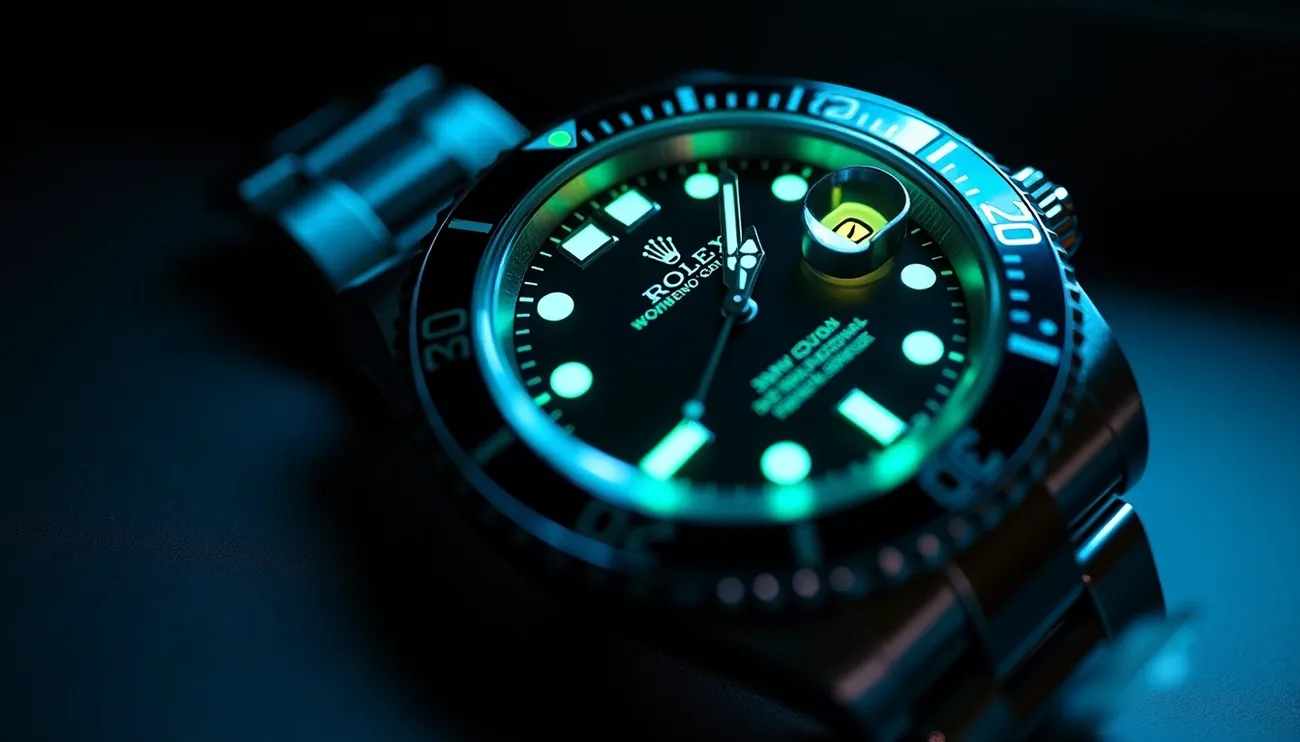
New Rolex watches need exposure to light to charge up. If you keep a watch in your safe or under the sleeve it came in, it will not glow in the dark whatsoever. Place another new watch in direct sunlight for five minutes and you’ll have yourself a watch that glows blue brightly for hours. Chromalight has been documented glowing for up to eight hours straight after being charged.
How Real Rolex Watches Glow Compared to Fakes
Real Rolex watches glow brightly, evenly and will last for hours. Both Chromalight (blue) and Super- LumiNova (green) are applied masterfully and uniformly on all indexes and hands.
Fake watches usually glow dimly, patchily, and/or will stop glowing within minutes. Some counterfeits won’t even have lume applied to them at all. Rolex has a special formula called Chromalight which only they can produce. You will quickly be able to identify if your watch is real or fake by placing it under a light for 5 minutes. If it stops glowing after an hour or less, your watch is fake.
Real Rolex watches need to be charged by either sunlight or artificial light. Once charged the glow will last for hours.
Why Some Vintage Rolex Watches No Longer Glow
Vintage Rolex watches used radioactive tritium gas to make the watches glow in the dark. Tritium does not need to be exposed to light to charge it up like modern watches. The downside to tritium is that it has a half life of approximately 12.5 years. After 25 years, only 6% of the original light output is still producing light.
After 25-30 years, tritium will only produce a faint toast colored patina that you can see maybe an inch or two away from your face at night. The reason there is no glow in the dark is because of the limitations of the materials used when it was made, not because it was abused or worn out. Some collectors actually prefer this old patina look.
The Evolution of Rolex Luminous Materials
Rolex has evolved through four generations of luminescent material technologies. Safety concerns and performance needs motivated each shift.
Radium Era: The Early Radioactive Glow (Pre-1963)
In 1898 Marie and Pierre Curie discovered radium. Rolex used radium first with zinc sulfide to create a glowing substance on their watches. Their formula produced a brighter shine than radium-only mixes. Rolex relied on radioactive radium as their standard until 1963.
Early on, the hazardous effects of radium weren’t realized. Women factory workers would often wet their brush tips by licking them. They did this to sharpen the paint brush tip for more accurate application. When it was discovered just how toxic radium really was, it was too late. Many of these women suffered and died fromradium poisoning. Rolex would recall watches like the GMT-Master ref 6542 with radium bezels. Each one was returned to Rolex where they replaced the bezel with an aluminum version at no cost.
Tritium Period: Safer But Still Radioactive (1963-1998)
Growing concerns about health and safety lead Rolex to change their ingredients. In 1963, Rolex replaced radium with tritium. Tritium watches were still radioactive, but far less so than radium. Tritium’s half life is significantly shorter than radium.
At 12.5 years, tritium will noticeably lose its strength after 30-40 years. As tritium ages it also changes color. Depending on the age of the tritium, you may notice a yellowish or cream colored patina on vintage luminescent markers. Tritium was still radioactive, so Rolex marked their dials with “T Swiss T” or “Swiss T<25” to caution buyers.
LumiNova and Super-LumiNova: The Non-Radioactive Move (1998-2008)
Photoluminescent material called Luminova was invented in 1993 by Nemoto & Co. They patented it in 1995. No radioactive elements were used in the creation of Luminova. Rolex began using Luminova in 1998 and upgraded to Super-LumiNova just two years later in 2000. Both of these non-radioactive luminescent materials will glow green and must be charged by light.
Chromalight: Rolex’s Proprietary Blue Glow (2008-Present)
Rolex introduced Chromalight in 2008 to the watch world on their Sea-Dweller Deepsea. Instead of green like other manufacturers use, Chromalight glows blue. It also offers long lasting visibility of up to 8 continuous hours. That’s over twice as long as other glowing materials on the market. Rolex then expanded the use of Chromalight to the Submariner and GMT-Mas view solution t II.
How Rolex Luminous Materials Actually Work
Vintage Rolex watches use radioluminescent paint while modern watches use photoluminescent paint.
Radioluminescent vs. Photoluminescent Materials
Radioluminescent materials such as radium or tritium watch paint emit light via radioactive decay. Radioluminescent materials don’t need charging as they emit light continuously day and night. The light is so weak that you cannot see it during the day but it will last forever.
Photoluminescent paint particles such as Super- LumiNova and Chromalight work differently. To make them glow brightly again, you need to charge them by exposing them to a light source. Photoluminescent materials absorb and store energy from the light when they are charged. They will slowly release this energy in the dark. Humans can see this light that is emitted.
When photoluminescent materials are charged by a light source, some of the photons are absorbed by the electrons in the atoms. These electrons are then boosted to a higher energy level. When the electrons settle back to their normal energy state, they release the stored energy in the form of visible light.
How to Charge Modern Rolex Lume for Maximum Brightness
The optimal light source to charge your watch is sunlight. Take your watch outside and leave it in direct sunlight for 10 to 15 minutes. If you don’t have access to sunlight, you can hold an LED flashlight close to the watch dial for 2 to 3 minutes.
Ultra-violet light from UV torches/lamps will charge your watch lume the quickest. Exposing your watch to UV light for 10-30 seconds will recharge it and allow it to fully luminesce again. Do not leave your watch under high intensity lights for long periods of time. This could cause damage to your watch by heating up the surface of your watch and prematurely degrade the phosphors.
Chromalight watches will charge quicker than Super- LumiNova watches. Chromalight will also store more energy and can last up to 8 hours once fully charged.
Why Some Rolex Watches Glow Green and Others Glow Blue
Rolex uses Super- LumiNova for their green glowing watches and Chromalight for their blue glowing watches. Although green light appears brighter to our eyes initially, blue will provide better legibility for a longer period of time. Blue watches are less disruptive to your dark-adapted eyes. For professional uses, blue watches are often preferred as they help preserve night vision. Blue also has a higher visibility underwater than green light.
How to Identify Which Lume Your Rolex Has
Checking your dial reveals which luminous material Rolex installed at manufacture or during service.
Reading the Dial Markings
Look at the text below the 6 o’clock position. Radium-era watches display “SWISS” without any T designation. Tritium dials show “T SWISS T” or “Swiss-T<25”. The T<25 marking indicates radiation levels below 925 MBq (25 mCi). You’ll find this marking on sports models with more lume application.
Post-1998 watches using LumiNova often show “SWISS” alone. Super-LumiNova dials read “SWISS MADE”. Chromalight also uses “SWISS MADE”. Dial text alone won’t distinguish these two materials.
Testing Your Watch in the Dark
Expose your watch to bright light. Turn off the lights. Green indicates Super-LumiNova, and blue means Chromalight. Sports watches glow brighter than dress models because they contain more luminous material.
What Different Glow Colors Mean
Green glow confirms Super-LumiNova. Blue identifies Chromalight. Some Chromalight appears greenish-blue depending on charging conditions and camera type.
Service Dials and Replacement Lume
Rolex service centers replace aged dials with current production versions. A tritium-marked dial (“T Swiss T”) with bright modern lume indicates a “tritinova” service dial. Service dials use Super-LumiNova or Chromalight whatever the original material. This eliminates vintage patina.
Conclusion
When you understand how your Rolex glows, you appreciate the decades of state-of-the-art development behind these timepieces. You might own a vintage tritium model with charming patina or a modern Chromalight piece that shines blue for eight hours. Each luminous material tells part of Rolex’s steadfast dedication to safety and performance. The next time you check your watch in darkness, you’ll know what makes those markers glow and why yours behaves differently from others.
Enjoying our watch coverage? Get more of it in Google Search.