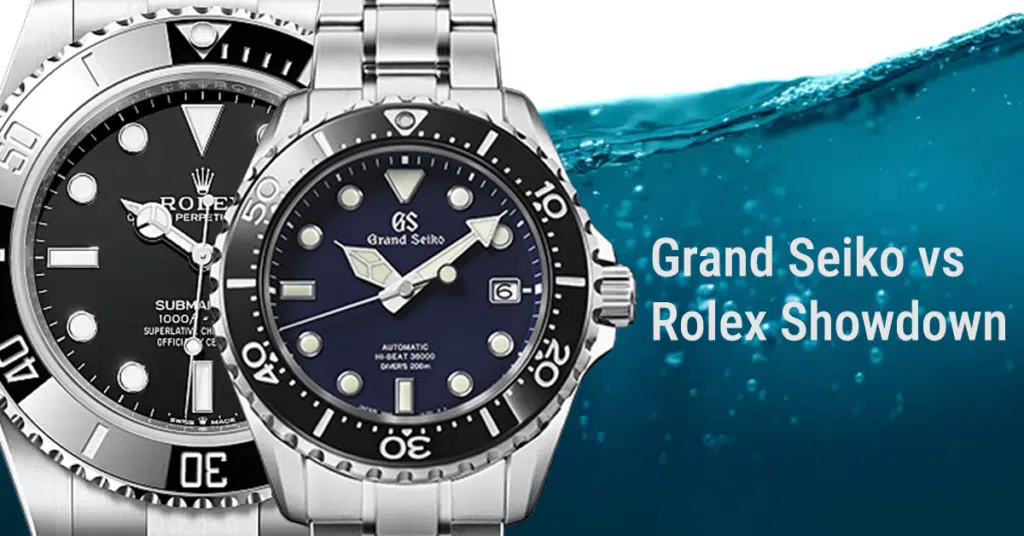
The Grand Seiko vs Rolex debate pops up naturally for anyone looking at luxury timepieces in the $5K-$10K range. These prestigious brands showcase different paths to horological excellence, with unique strengths that appeal to watch enthusiasts who can recognize quality.
Rolex stands as the gold standard for timepiece recognition, resale value, and engineering prowess in the luxury watch market. Many Rolex models like the Submariner, Daytona, and GMT-Master II sell above their retail value. Some Datejust models have seen over 300% appreciation in 15 years. The quality battle between grand seiko vs rolex shows the Japanese manufacturer’s edge in movement technology, dial artistry, and hand finishing at this price point. Rolex focuses on toughness and bulletproof engineering, while Grand Seiko puts accuracy, finishing, and refinement first.
The brands’ technological differences run deep. Grand Seiko’s Spring Drive, launched in 2004, merges a traditional mechanical mainspring with quartz-like precision. It achieves accuracy of ±1 second per day, beating Rolex’s Superlative Chronometer standard of ±2 seconds per day. Grand Seiko’s signature Zaratsu polishing technique takes artisans months to become skilled at. This creates a distinct esthetic that sets it apart from Rolex’s iconic styling.
This comparison will show how these watchmaking philosophies differ in craftsmanship, movement technology, design, and market position. You’ll see which brand matches your priorities and investment goals better.
Table of Contents
Craftsmanship and Finishing Quality
The rivalry between Grand Seiko and Rolex goes way beyond the reach and influence of brand recognition into pure craftsmanship. A close look at these timepieces shows two distinct philosophies about excellence in watchmaking.
Zaratsu Polishing vs Machine Finishing
Grand Seiko’s signature Zaratsu polishing creates flawless, mirror-flat surfaces that make these timepieces stand out. The term “Zaratsu” comes from the German “Sallaz” polishing machines that Seiko brought in during the 1950s. Traditional polishing uses the side of a rotating wheel, but Zaratsu uses the flat front surface to create pristine planes that meet with razor-thin edges. Artisans need months to become skilled at this demanding technique.
Rolex takes a different approach with machine-assisted finishing. Their watches show precision but lack the distinctive hand-finished quality you’ll find in Grand Seiko cases. The process involves sanding and buffing components with progressively finer abrasives for a smooth, glossy finish. Both methods deliver excellent results, yet Grand Seiko edges out Rolex in case and dial finishing at comparable prices.
Case Edges and Surface Reflection
Grand Seiko’s uniqueness shines especially when you have case edges and light reflection. The Zaratsu method keeps perfect geometries with clean transitions between finishes. Grand Seiko’s flat surfaces catch and reflect light in a natural way. Watch enthusiasts often describe this as a “very human” quality in the watch’s appearance.
Rolex cases showcase precision and focus on durability with esthetics. Direct comparisons show Grand Seiko’s edge in creating sharp, defined borders between mirrored and hairline surfaces. This attention to detail gives Grand Seiko watches their architectural character.
Dial Texture and Artistic Detailing
Japanese natural landscapes inspire Grand Seiko’s dials. The famous “Snowflake” dial captures the look of fresh snow in Shinshu, while the “White Birch” mirrors tree bark near Shizukuishi studio, and “Lake Suwa” reflects rippling water surfaces. These textured dials shift their appearance as daylight changes, adding remarkable depth.
Rolex dials showcase precise manufacturing but lean toward cleaner, simpler designs that highlight legibility and recognition. Watch enthusiasts often point out that Grand Seiko leads in artistic complexity and dial finishing, while Rolex dominates in brand recognition.
Each brand’s finishing techniques reflect their core values. Grand Seiko champions artisanal craftsmanship and artistic expression. Rolex stands for consistency, durability, and iconic design.
Movement Technology and Accuracy
Grand Seiko and Rolex have completely different ways of making watches tick. Their unique approaches show what each brand values most in watchmaking.
Spring Drive vs Superlative Chronometer
Grand Seiko created something special with Spring Drive in 2004. It’s one of watchmaking’s biggest innovations. The system works with a mainspring like mechanical watches, but uses a quartz-controlled regulator called the Tri-synchro system instead of traditional parts. Watch collectors love how this creates that smooth sweeping seconds hand.
Rolex took a different path. They focused on making traditional mechanical watches better and better. Their Superlative Chronometer standard shows this perfectly. Since 2015, their watches must be accurate to -2/+2 seconds per day after casing. This is a big deal as it means that the standard COSC chronometer requirements of -4/+6 seconds per day.
Power Reserve: 72 Hours vs 70 Hours
Grand Seiko’s movements can run for 72 hours. Rolex’s new-generation movements run for 70 hours. The manual-wind 9S64 movement from Grand Seiko runs 2 hours longer than Rolex’s 3230 movement, even though both tick at 4Hz.
Service Intervals: 3-4 Years vs 10 Years
These brands have different ideas about watch maintenance. Grand Seiko wants you to service your watch every 3-4 years, even their Spring Drive models. This fits with the Japanese omotenashi (hospitality) mindset – they like to catch problems early.
Rolex says their watches need service only once every ten years. This applies to all their watches and shows how much they trust their movements. It also helps Rolex manage their service centers better.
Accuracy: ±15 sec/month vs ±2 sec/day
Regular Spring Drive movements are accurate to ±15 seconds per month (about ±1 second per day). Rolex watches run at ±2 seconds per day. Grand Seiko’s 9R01 movement does even better at ±10 seconds per month (±0.5 second daily). Their newest Ultra Fine Accuracy caliber 9RB2 is amazing – it’s off by just ±20 seconds per year. No other mainspring-powered wristwatch comes close to this precision.
Traditional mechanical watch fans might prefer Grand Seiko’s 9S series. These movements are accurate to +5/-3 seconds daily when not moving. Good numbers, but not quite matching Rolex’s strict standards.
Bracelet Engineering and Wearability
The ownership experience between Grand Seiko and Rolex differs mainly in bracelet engineering and wearability, going well beyond just dial esthetics and movement technology.
Micro-Adjustment: Glidelock vs GS 3-Step Clasp
Rolex holds a clear edge over Grand Seiko when it comes to bracelet adjustment capabilities. The brand’s impressive Glidelock system lets wearers adjust their Submariner and Sea-Dweller models by 20mm without any tools, using precise 2mm increments. This clever engineering helps wearers find their perfect fit as their wrists naturally change size throughout the day.
Grand Seiko had no tool-free micro-adjustment options until 2025, a fact many watch enthusiasts pointed out. The company listened to feedback and launched a new three-step micro-adjustment clasp with their Evolution 9 Spring Drive UFA models. While this newer system offers 6mm of tool-free adjustment in 2mm increments, it still doesn’t match Rolex’s Glidelock features.
Material Comfort: Titanium vs 904L Steel
Material choice plays a huge role in how comfortable these watches feel over time. Grand Seiko’s titanium cases and bracelets weigh 40% less than stainless steel. Titanium watches feel much more comfortable when worn for long periods.
Titanium brings more benefits than just being lightweight. The metal stays at a temperature closer to your skin whether it’s hot or cold outside. People with nickel sensitivity appreciate its hypoallergenic properties. The material also resists corrosion better, particularly against salt water.
Rolex uses only their special 904L steel (now called “Oystersteel”) which fights corrosion well. Steel bracelets naturally weigh more, but enthusiasts note that good articulation and proper sizing help distribute this weight evenly across the wrist. Many collectors actually love this solid feel as part of their Rolex experience.
Case Thickness and Wrist Fit
Swiss watches tend to sit flatter on the wrist than Grand Seiko models. The Rolex Explorer II measures 42mm wide and 12.5mm thick, while Grand Seiko’s SBGM247 GMT comes in at 40.5mm wide but reaches 14.4mm in thickness.
These size differences affect daily wear quite noticeably. Rolex watches slip under shirt cuffs more easily thanks to their thinner profile. Grand Seiko’s extra thickness might feel less comfortable for people with smaller wrists or those who prefer watches that sit closer to their skin.
Grand Seiko’s exceptional case finishing can’t hide the fact that Rolex still leads in basic ergonomic elements like bracelet engineering and wearability when comparing these two brands.
Dial Design and Esthetic Appeal
The visual storytelling between Grand Seiko and Rolex reveals the clearest philosophical divide between these horological powerhouses. Each brand’s approach to dial design reflects deep values about what luxury watchmaking should represent.
Nature-Inspired Dials vs Iconic Rolex Motifs
Grand Seiko’s dials work as miniature landscapes that draw inspiration from Japan’s natural surroundings. The celebrated “Snowflake” dial captures the texture of freshly fallen snow in Shinshu through its form and feel. The “White Birch” dial mirrors the distinctive bark patterns of trees near the Shizukuishi studio and changes its appearance as daylight moves. The “Lake Suwa” dial brings to life the gentle rippling water surfaces of the lake near the brand’s workshop.
Rolex takes a more classical approach to luxury. Their dials showcase radiant sunburst finishes, contemporary lacquered surfaces, and exclusive motifs like Palm or Jubilee patterns that make them instantly recognizable. The brand’s focus on bold, memorable designs puts immediate recognition ahead of subtle artistry. The company has added meteorite and gemstone options to its collection.
Legibility: Contrast and Readability
Both manufacturers excel at readability through different approaches. Rolex focuses on high-contrast combinations with large markers and thick hands for instant legibility. This clarity-first philosophy explains why many dive watches pair white hands with black backgrounds.
Grand Seiko achieves excellent readability through precision craftsmanship. Their sharp, diamond-cut hands and indices create precise light reflection that stays visible in all lighting conditions. This approach values refinement over immediate boldness.
Color Variants and Material Options
The color choices reflect different philosophies between the brands. Grand Seiko’s dial colors bring natural scenes to life—soft blues that remind you of lakes, silver whites that suggest snow, and textured greens that capture forest scenes. These colors change with light subtly, creating what watch enthusiasts call “environments” rather than simple dials.
Rolex offers bolder, more consistent colors that keep their character in any light. Their expanding range now features vibrant options alongside the classic black, white, and champagne dials that have been the brand’s signature for decades.
When comparing Grand Seiko and Rolex quality, Grand Seiko stands out for its artistic complexity and finishing detail, while Rolex dominates in immediate recognition and bold visual impact.
Resale Value and Market Perception
Money plays a big role in choosing between Grand Seiko and Rolex. This choice often matters as much as looks or engineering.
Does Grand Seiko Hold Value?
Grand Seiko watches behave like most luxury items. Their pre-owned models usually sell below retail price. The brand was undervalued in the secondary market at first, but things started to change after it became independent in 2017. Some models like the “Snowflake” (SBGA211) and “White Birch” (SLGH005) have now gained cult status. Limited editions keep their value best. Some even gain value if kept perfect with all papers. While they can’t match Rolex’s resale performance, Grand Seiko’s future looks bright as more people recognize the brand worldwide.
Rolex as a Liquid Asset
Rolex stands alone in keeping its value better than almost any luxury watchmaker. These watches often sell for more than their retail price in the secondary market. This makes Rolex one of the few consumer items that works like “liquid cash” – easy to sell when needed. Look at the Datejust – it has gained over 300% in value in 15 years. Popular models like the Submariner, Daytona, and GMT-Master II sell for way above retail. This is a big deal as it means that they’re real investments, not just purchases.
Pre-Owned Market Trends
The secondary market tells two different stories. Rolex leads all luxury watch brands in keeping its value. Many collectors see buying a Rolex as risk-free money-wise. Grand Seiko offers great deals to smart buyers in the pre-owned market. You can find a lightly used Snowflake or White Birch for much less than retail, with the same quality and craftsmanship. Notwithstanding that, growing Western interest is pushing up pre-owned prices of popular Grand Seiko models.
Collector Sentiment and Brand Equity
Each brand’s collector community shows its market position clearly. Owning a Grand Seiko means joining a close group of fans who love finishing, accuracy, and subtle design more than investment returns. They talk about dial textures and smooth movements instead of resale values. Rolex collectors belong to a much bigger world where every model stays in demand and vintage pieces tell stories. People who value recognition, reliability, and financial security find Rolex offers unmatched confidence that their watch will keep both its status and value.
Comparison Table
|
Feature |
Grand Seiko |
Rolex |
|
Movement Accuracy |
±1 second per day (Spring Drive) |
±2 seconds per day (Superlative Chronometer) |
|
Power Reserve |
72 hours |
70 hours |
|
Service Interval |
3-4 years |
10 years |
|
Case Finishing |
Zaratsu polishing (hand-finished) |
Machine-assisted finishing |
|
Case Material Options |
Titanium and Steel |
904L Steel (Oystersteel) |
|
Bracelet Adjustment |
3-step micro-adjustment (6mm range) |
Glidelock system (20mm range) |
|
Dial Design |
Natural textures |
Bold, iconic motifs |
|
Case Thickness |
Thicker profile overall |
Slimmer profile overall |
|
Weight |
40% lighter (titanium models) |
Heavier (steel construction) |
|
Resale Value |
Prices typically below retail |
Prices exceed retail for many models |
|
Brand Recognition |
Increasing market presence |
Leading market position |
|
Primary Focus |
Accuracy, finishing, refinement |
Toughness, reliability, recognition |
Rolex and Grand Seiko took divergent paths to reach the pinnacle of watchmaking. Priced similarly, each brand appeals to a different philosophy.
In terms of finishing, Grand Seiko’s masterful Zaratsu polishing results in impeccable distortion-free mirror finishes that Rolex doesn’t offer at the same price point, even with machine polishing. When it comes to movement, Grand Seiko’s innovative Spring Drive caliber yields incredible accuracy of ±1sec/day which trounces Rolex’s already elite Superlative Chronometer certification of ±2sec/day.
In terms of everyday wearability though, Rolex watches have the advantage. Rolex’s Glidelock allows for 20mm of adjustment while Grand Seiko watch bands only offer 6mm of adjustment. Rolex watches are also more comfortable for everyday wear, despite their bulky steel construction. The brand is so confident in its builds that it allows for 10 years between service intervals, much longer than Grand Seiko’s recommended 3-4 years.
However, the biggest difference between these two watchmakers is their respective standing in the resale market. Grand Seiko manufactures watches that enthusiasts adore, filled with quiet artistry and technical wizardry. Rolex manufactures watches that can act as liquid investments. The statistics prove it: Rolex watches appreciate over time, while Grand Seiko watches depreciate like most luxury goods.
So which watch brand should you pick? If craftsmanship, innovative movement, and artistic design are most important to you, Grand Seiko offers the better value. If you care more about brand recognition, practical build, and investment value, go Rolex. Both are world-renowned manufacturers at the zenith of their game, and you can’t go wrong with either.
Enjoying our watch coverage? Get more of it in Google Search.