
Rolex Daytona Meteorite Dial
The Rolex Daytona meteorite dial is more than a chronograph: it is a slice of 4.5-billion-year-old Gibeon iron-nickel framed by the most collected sports watch in the world. Because every dial is cut from a different part of the meteorite, the Widmanstätten pattern on one watch exists on no other. Our meteorite Daytona selection spans the 2025 Oysterflex trio in white, yellow and Everose gold (126519LN, 126518LN, 126515LN) and the earlier white-gold 116509, 116519 and 116519LN — each one authenticated in New York before it ships.Browse and filter this collection

Ref. 126519LN-0007
Rolex Cosmograph Daytona 126519ln-0007 40mm Meteorite Dial Oysterflex Bracelet White Gold Watch
$125,000.00

Ref. 126515LN-0008
Rolex Cosmograph Daytona 126515LN-0008 Rose Gold Black Cerachrom Bezel Meteorite Dial Oysterflex Watch 2025
Price on request
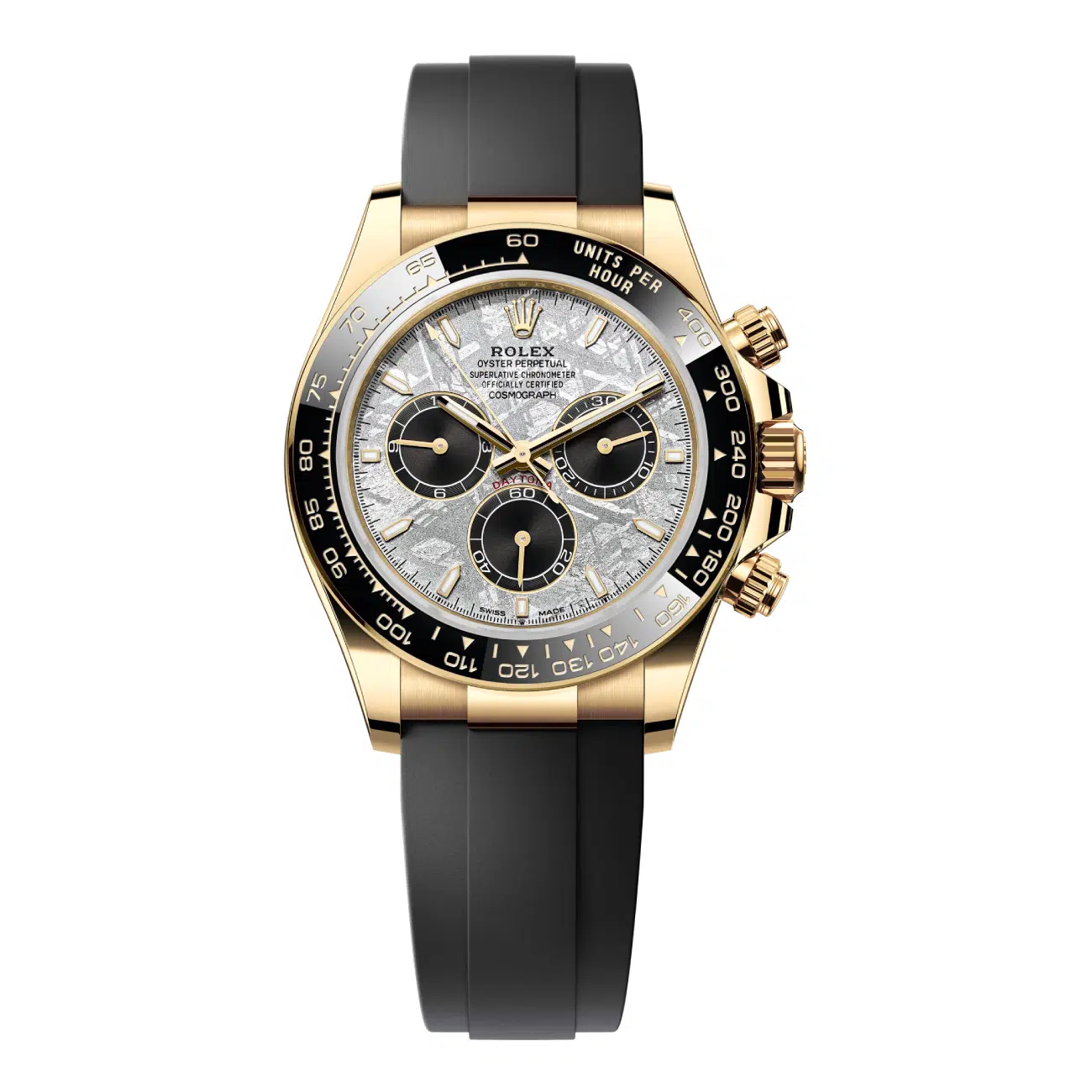
Ref. 126518LN-0016
Rolex Cosmograph Daytona 126518LN-0016 Yellow Gold Black Cerachrom Bezel Meteorite Dial Watch 2025
Price on request
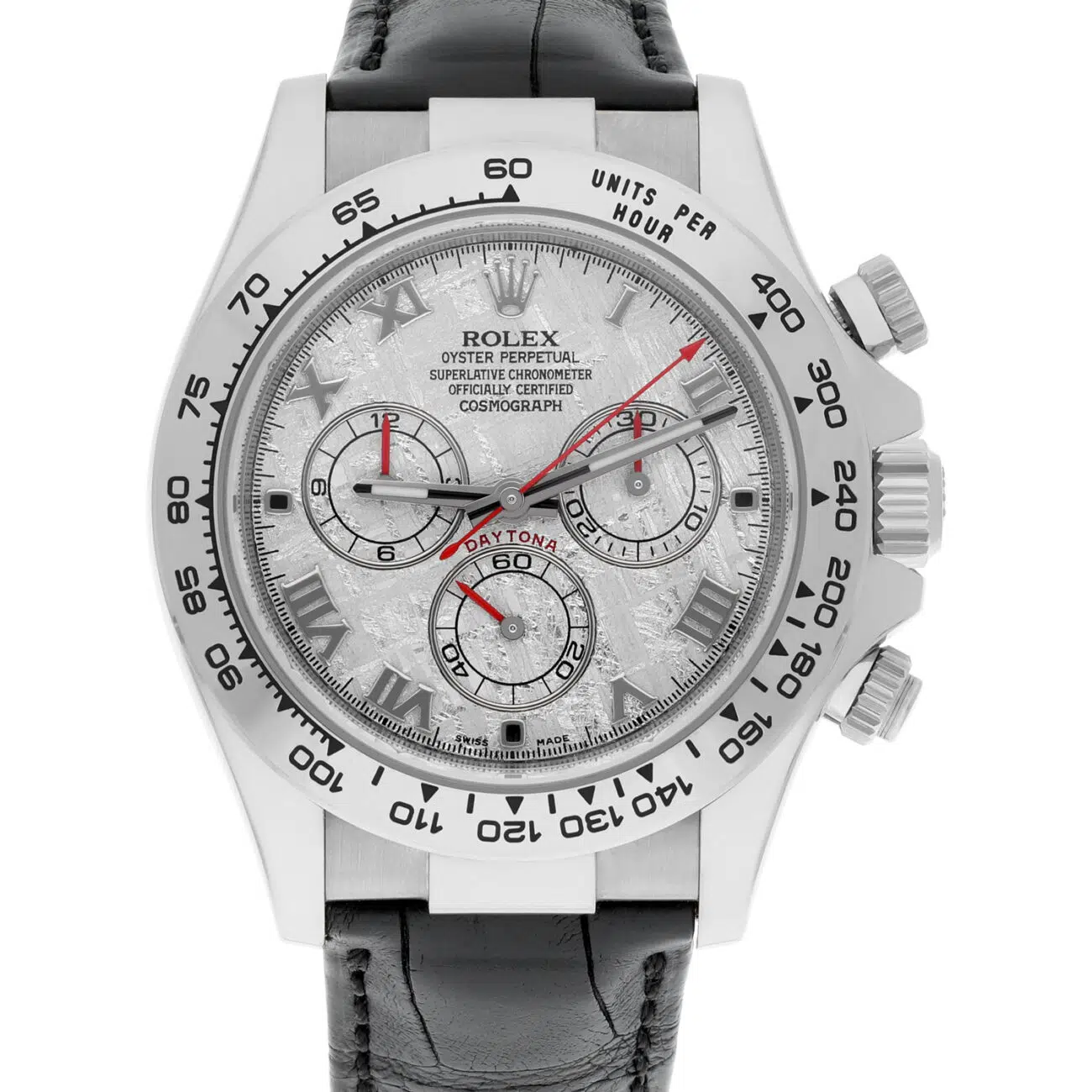
Ref. 116519
Rolex 116519 Cosmograph Daytona Meteorite Dial White Gold Men's Watch Complete
Sold — ask about similar
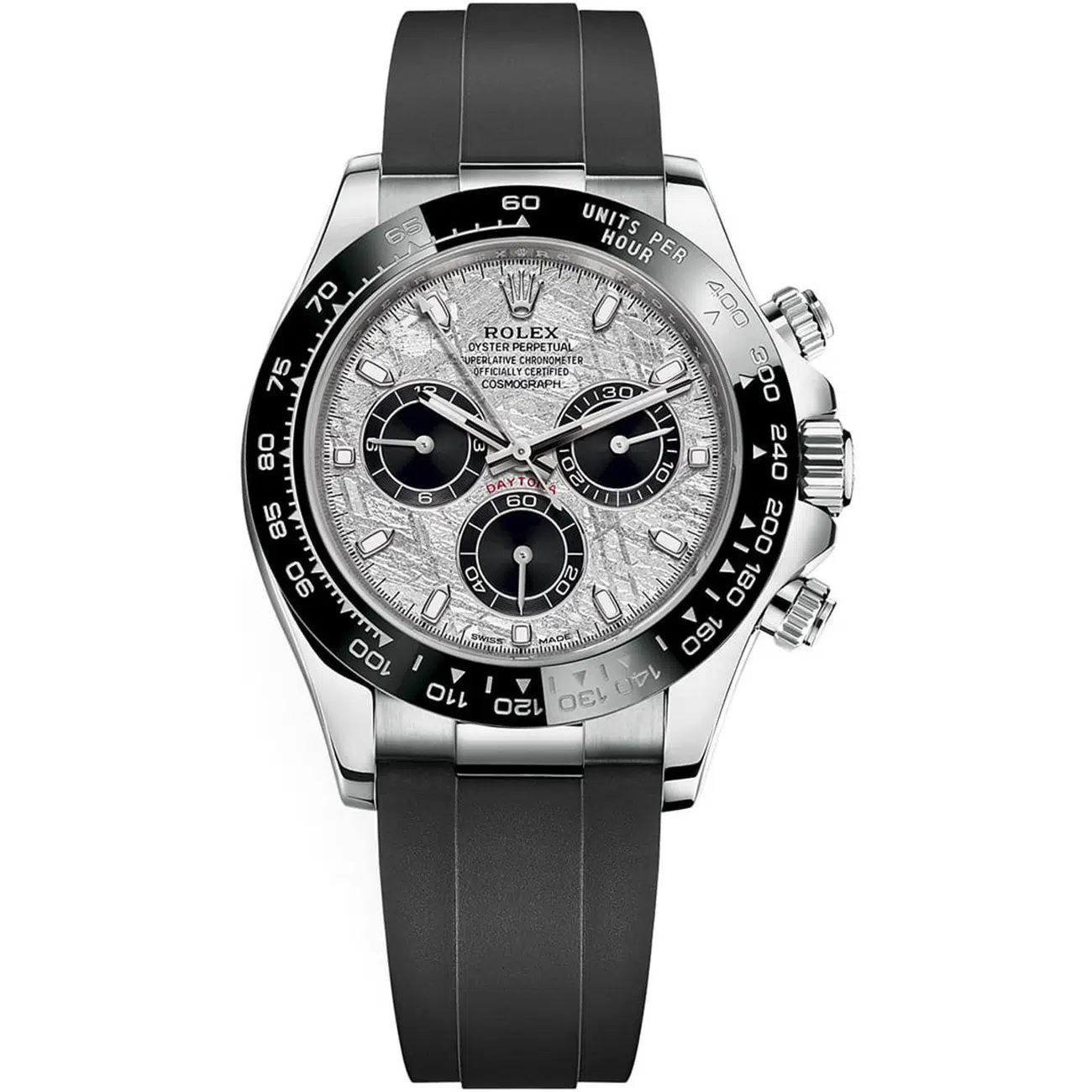
Ref. 116519LN
Rolex Cosmograph Daytona 40mm 116519LN White Gold with Black Dial Watch 2023
Sold — ask about similar

Ref. 116509
Rolex Cosmograph Daytona 40mm Oyster 116509 White Gold Watch Meteorite Roman Dial
Sold — ask about similar
Ref. 126519LN-0007
Rolex Daytona 126519ln-0007 40mm White Gold with Black Rubber Watch Meteorite Dial 2025
Sold — ask about similar
What Makes a Rolex Daytona Meteorite Dial Different
Every Rolex meteorite dial begins as a piece of the Gibeon meteorite, an iron-nickel mass that fell in prehistoric times near the town of Gibeon in Namibia and scattered more than 26,000 kilograms of material across the region. Radiometric dating places it at roughly 4.5 billion years old — older than the planet it landed on. Gibeon is classified as a group IVA fine octahedrite, and that classification is precisely why Rolex uses it. As the molten core of a shattered asteroid cooled over millions of years in the vacuum of space, its iron and nickel crystallised into interlocking bands only about 0.3 mm wide. Cut a slice, etch it with acid, and those crystals emerge as the Widmanstätten pattern — the silver latticework that gives a meteorite Daytona its face. Gibeon's bands are unusually fine, which is why the pattern reads as a dense texture across a 40 mm dial instead of a handful of coarse streaks. Because that pattern is a cross-section through a three-dimensional crystal structure, no two slices ever repeat. The Rolex Daytona meteorite dial on one watch cannot be reproduced on another, even from the same block of material.Rolex Daytona Meteorite Dial References
Rolex has only ever fitted meteorite dials to precious-metal cases, so a stainless steel meteorite Daytona has never existed. These are the references that carry the dial:| Reference | Case | Bezel & strap | Movement |
| 126519LN-0007 | 18 ct white gold | Black Cerachrom, Oysterflex | Calibre 4131 |
| 126518LN-0016 | 18 ct yellow gold | Black Cerachrom, Oysterflex | Calibre 4131 |
| 126515LN-0008 | 18 ct Everose gold | Black Cerachrom, Oysterflex | Calibre 4131 |
| 116519LN | 18 ct white gold | Black Cerachrom, Oysterflex | Calibre 4130 |
| 116509 | 18 ct white gold | Gold tachymeter, Oyster bracelet | Calibre 4130 |
| 116519 | 18 ct white gold | Gold tachymeter, leather strap | Calibre 4130 |
Calibre 4130 or 4131: Which Movement Is Inside?
The reference number tells you the movement. Every 126000-series meteorite Daytona runs the calibre 4131, introduced with the 2023 redesign — a vertical-clutch chronograph with a Chronergy escapement, Paraflex shock absorbers and a skeletonised rotor, rated as a Superlative Chronometer at −2/+2 seconds per day. The earlier 116509, 116519 and 116519LN run the calibre 4130, the movement that established the modern Daytona's reputation in 2000. Both hold a 72-hour power reserve and both are chronometer-certified; the 4131 is an evolution rather than a replacement, so a well-serviced 4130 is not the poor relation its reference date might suggest.Rolex Daytona Meteorite Price
A Rolex Daytona meteorite dial is a precious-metal chronograph with a dial material Rolex allocates in tiny volumes, and the price reflects both. Recent meteorite Daytona examples in our New York inventory have ranged from $54,450 to $125,000, with the spread driven by four things: case metal, whether the watch is on Oysterflex or a gold bracelet, condition, and whether the original box and papers are present. The 2025 Oysterflex references trade well above their authorised-dealer retail because allocation is effectively closed — you cannot walk into a boutique and buy one. Earlier white-gold references such as the 116509 and 116519 sit lower, which makes them the practical entry point into a meteorite Daytona for most buyers. Every price on this page is live, and every watch is authenticated before it ships.White, Yellow or Everose: Choosing a Meteorite Daytona
The meteorite slice is grey-silver, so the case metal decides the entire character of the watch. White gold is the quiet choice: the case reads as steel from a distance and lets the dial carry the watch, which is why the white gold meteorite Daytona is the most requested of the three. Yellow gold throws warm light back into the grey and produces the highest contrast of the trio. Everose sits between them, picking up the faint copper tones in the meteorite itself. Strap choice matters just as much. Oysterflex keeps the weight down on a solid-gold case and suits daily wear; a gold Oyster bracelet, as on the 116509, turns the same watch into something considerably more formal — and heavier.Rolex Daytona Meteorite FAQ
Which meteorite does Rolex use for its dials?
Rolex uses the Gibeon meteorite, a group IVA iron meteorite found in Namibia and dated to roughly 4.5 billion years old. Gibeon is prized for its exceptionally fine Widmanstätten pattern and for its stability — unlike some other meteorites used in watchmaking, it can be finished and polished without plating.Are any two Rolex meteorite dials identical?
No. The Widmanstätten pattern is a cross-section through a crystal structure that formed over millions of years, so each slice is unique. Two meteorite Daytonas of the same reference will have visibly different dials.Is there a stainless steel Daytona with a meteorite dial?
No. Rolex fits meteorite dials only to precious-metal cases, so every meteorite Daytona is white gold, yellow gold, Everose gold or platinum. Any steel Daytona presented as having a factory meteorite dial should be treated with suspicion.What movement is in the 2025 meteorite Daytona?
The 2025 references — 126519LN-0007, 126518LN-0016 and 126515LN-0008 — all use the in-house calibre 4131, with a 72-hour power reserve and Superlative Chronometer certification at −2/+2 seconds per day.How much is a Rolex Daytona with a meteorite dial?
Recent examples in our inventory have ranged from $54,450 to $125,000. Case metal, bracelet type, condition and the presence of original box and papers account for most of the difference; the 2025 Oysterflex references sit at the top of that range.Does a meteorite dial rust?
Gibeon is the most stable of the meteorites used for dials and is not prone to the rusting that affects other iron meteorites. Normal care for a precious-metal Rolex is sufficient; the dial is sealed behind a sapphire crystal in a case rated to 100 meters.Explore all Rolex meteorite dial watches, the Day-Date meteorite collection, or the wider Rolex Daytona range — including Daytona Oysterflex and white gold Daytona models. For background on how meteorite compares with Rolex's other unusual dial materials, read our guide to rare Rolex dials.