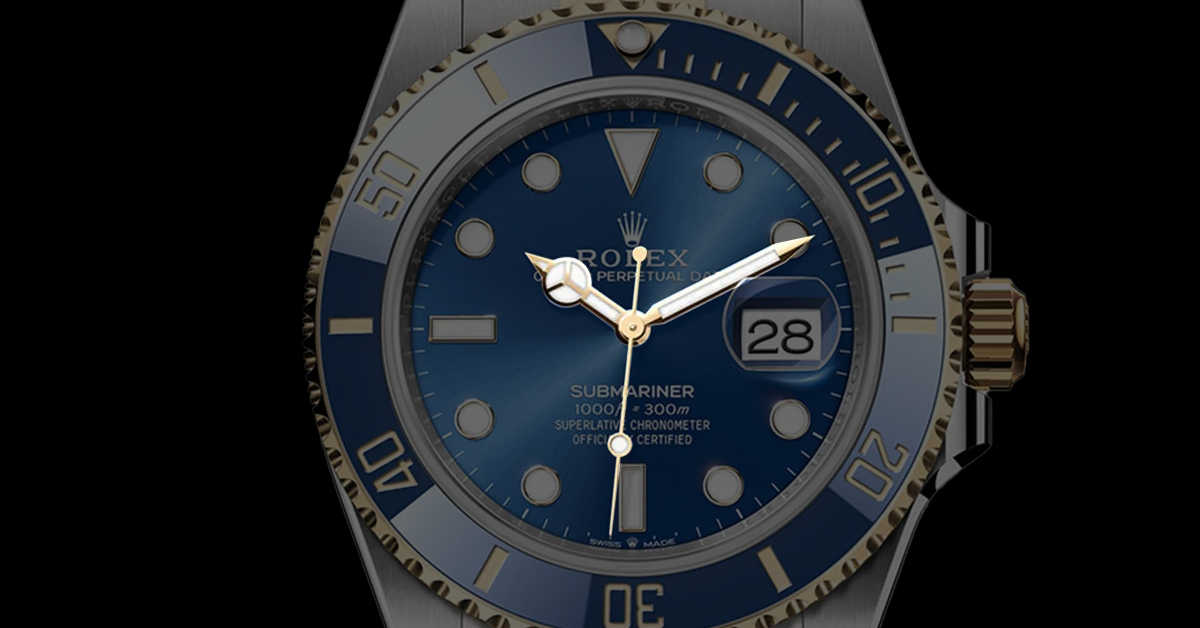
Rare Rolex dials are quickly becoming the holy grail for avid watch collectors in search of that special piece to complete their collection. There’s nothing more prestigious in 2025 than landing one of these elusive watches that never make it to the showroom floor.
Rare Rolex dials command top dollar due to their impeccable craftsmanship. Whether it’s the classic mother-of-pearl Datejust or bold ice-blue Daytona 116506, each rare Rolex dial has something to offer. Some are so limited that only a handful were ever made, such as the vintage Rolex dials from the GSPR collection, of which only 30 Submariners were produced.

This piece showcases 12 remarkable dials that continue to engage collectors, from the rare Datejust dials like the Tiger’s Eye (one of Rolex’s rarest watches) to the stunning Day Date dials. Each dial stands at the peak of horological exclusivity, and these authenticated pieces draw serious collectors who can’t help but chase after
them.
Table of Contents
Rare Rolex Dials
Mother of Pearl Dial

Image Source: Rolex
Mother of pearl dials are among the most stunning options in Rolex’s rare dial collection. These luminous creations turn organic nacre into masterpieces that catch light with a mesmerizing shimmer.
Mother of Pearl Dial Design
Mother of pearl, scientifically known as nacre, grows inside certain mollusk shells. The mollusk creates this organic substance by secreting layers of calcium carbonate to shield itself from irritants. The result sparkles with an iridescent glow that plays with light and color. Rolex never adds artificial colors to mother-of-pearl. The brand’s expertise lies in bringing out its natural beauty.
The creation process requires incredible precision. Expert craftsmen cut ultra-thin sheets of nacre just 0.2mm thick. This delicate work needs special equipment and safety measures because mother-of-pearl dust can be hazardous. A single dial takes up to 15 artisan steps and six weeks to complete.
Black Mother of Pearl shells from the Pacific Ocean, especially near Tahiti, provide Rolex with most of its raw material. The shells show different colors based on where they come from – you’ll see shades of pink, white, black, and yellow.
Mother of Pearl Dial Historical Significance
Rolex added mother-of-pearl dials to their collection in the 1980s. While this precious material has decorated luxury jewelry for thousands of years, Rolex’s decision to use it was a smart move. It raised their luxury status and gave collectors something truly special.
Many competitors use artificial colors, but Rolex stays true to nature. They preserve original colors through careful polishing, selective varnishing, and strategic lacquering. This approach gives each dial its authentic character and ensures it lasts.
Mother of Pearl Dial Collector Appeal
The most fascinating thing about mother-of-pearl dials is their uniqueness. Each dial has its own pattern and colors – like a fingerprint – making every watch one of a kind. This natural rarity makes collectors want them even more.
Light dances across these dials throughout the day, revealing new colors and depths as angles change. This living artwork creates an experience that regular dials simply can’t match.
These rare Rolex dials show great promise as investments. Datejust models have grown in value by 639% over 15 years. Collectors love seeing mother-of-pearl dials in prestigious models like the Datejust, Day-Date, Daytona, and Yacht-Master collections.
Prices start at $8,500 for a Lady-Datejust and reach $95,000 for a diamond-set Daytona. These timepieces blend exceptional craftsmanship with solid investment potential.
Meteorite Dial

Rolex’s meteorite dials stand out as remarkable features in their exclusive collection. These timepieces let you wear a piece of the cosmos on your wrist while showcasing excellence in watchmaking.
Meteorite Dial Design
The dials come from actual slices of the Gibeon meteorite that landed in Namibia between 13,000 and 30,000 years ago. This space material is about 4.5 billion years old and shows unique crystal patterns called Widmanstätten structures. These amazing patterns took millions of years to form as the meteorite cooled slowly in space.
Turning raw space rock into a luxury watch dial needs amazing craftsmanship. Rolex craftsmen carefully cut the meteorite into thin slices and treat them with acid to bring out their natural crystal patterns. They then stabilize the material to stop it from rusting. Each dial shows its own crystal pattern, making it unique.
These cosmic faces have a light, shimmering silver color that looks different as light hits it. While Rolex often adds diamond hour markers to these dials, you can also find versions with Roman numerals or glowing baton markers.
Meteorite Dial Historical Significance
Rolex led the way in bringing meteorite dials to luxury watches. These dials first appeared in Daytona and Day-Date collections before making their way to Datejust, Pearlmaster, and GMT-Master II lines.
A key moment came at Baselworld 2019 when Rolex showed the reference 126719 BLRO ‘Pepsi’ GMT-Master II in 18k white gold with a meteorite dial. This was the first time a GMT-Master watch featured a meteorite dial.
Rolex added three new Cosmograph Daytona versions with meteorite dials in April 2021. These included a white gold model with a black bezel on an Oysterflex bracelet, one in full yellow gold, and another in full Everose gold.
Meteorite Dial Collector Appeal
These dials are rare and special because:
Natural Scarcity: Namibian law now protects the Gibeon meteorite, so no more can be collected
Unique Patterns: Each dial has its own crystal pattern
Precious Metal Exclusivity: You’ll only find meteorite dials in precious metal cases
Limited Production: Rolex makes very few of these dials
New Rolex watches with meteorite dials cost between $52,389 and $232,840, depending on the model and diamond settings. Used watches start around $11,642.
The white gold GMT-Master II “Pepsi” at $41,600 and the Day-Date 40 in white gold starting at $49,550 are the most sought-after models. These watches often sell for twice their retail price in the secondary market, making them valuable both as timepieces and investments.
Ice Blue Dial
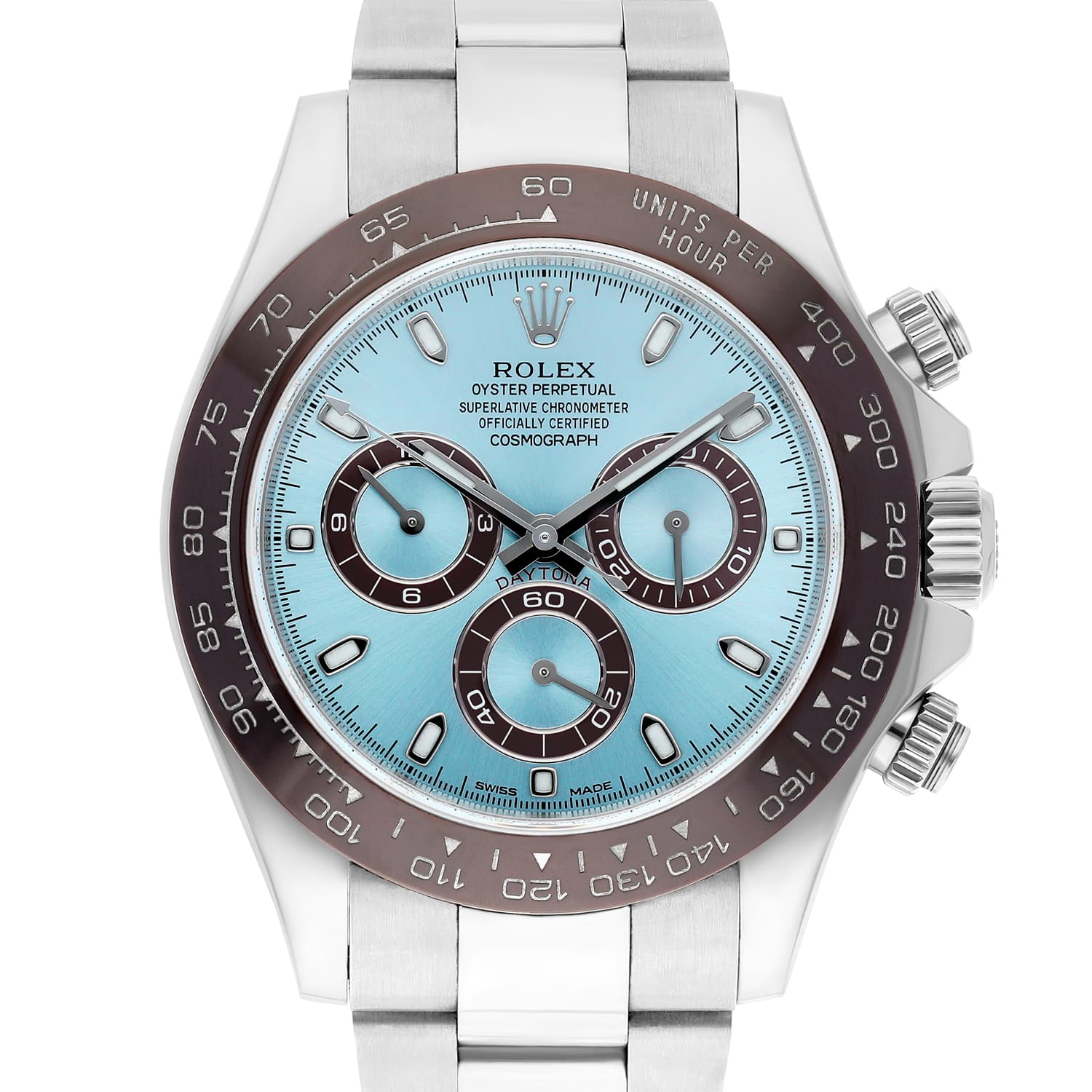
The ice blue dial stands out as one of Rolex’s most distinctive features. This unmistakable signature appears only on their platinum watches, marking these timepieces as truly exceptional in the world of fine watchmaking.
Ice Blue Dial Design
The dial captures the serene glow of a glacier with its ethereal shade. Its light, powder-like color creates a beautiful contrast against platinum’s brilliant surface. The design features Chromalight-filled markers and hands that make the watch easy to read, even when light is scarce.
The Cosmograph Daytona pairs this unique color with rich chestnut brown subdials in its classic tri-compax arrangement. Reference 116506 of the platinum Daytona shows off spray-coated counters and 18 kt gold applique hour markers that frame the ice blue background perfectly. The Day-Date models often feature Roman numerals that add to their refined character.
Ice Blue Dial Historical Significance
This special color became Rolex’s “discreet and exclusive signature of a platinum watch” over 70 years ago. Several prestigious models have featured this distinctive shade. Today’s collectors can find it in the Rolex Daytona and Day-Date 40, both crafted from platinum.
The ice blue dial once graced several models that are no longer in production. These include the Day-Date 36, Masterpiece collection, Pearlmaster, and Lady Datejust. These discontinued pieces remain highly coveted, proving the lasting appeal of this unique color. Modern collections feature this exclusive dial only in the Day-Date, Cosmograph Daytona, Perpetual 1908, and Land-Dweller lines.
Ice Blue Dial Collector Appeal
The magic of ice blue dials comes from their platinum exclusivity. Rolex states it simply: “Rolex uses platinum, the noblest of metals, for the finest of watches”. Platinum requires exceptional skill to work with, and its use shows an unwavering commitment to luxury.
These timepieces have shown remarkable value retention and appreciation through the years. The Cosmograph Daytona with its ice blue dial, which enthusiasts often call the “light blue Daytona Rolex,” has become particularly popular with collectors. Reference 116506 represents the peak of watchmaking excellence, bringing together platinum construction and the iconic ice blue dial.
Despite its delicate looks, models like the Cosmograph Daytona Ice Blue deliver outstanding performance along with their stunning appearance. This blend of beauty and function has made these models popular with collectors of all types, including many women enthusiasts.
Onyx Dial

Image Source: Analog:Shift
The Rolex onyx dial’s sleek, inky black surface creates a stunning contrast against precious metal cases. This represents Rolex’s skill at minimalist luxury. Collectors prize these rare dials for their sophisticated elegance. Classic models become coveted timepieces with this unique dial option.
Onyx Dial Design
Onyx, a semi-precious black gemstone, creates a unique depth on Rolex dials. The stone’s deep, rich black color works perfectly with precious metal elements. Most models pair it with 18k yellow gold cases to maximize visual appeal. Many designs skip hour markers to show off the onyx’s natural beauty. This creates a clean black surface with just the day-date windows, hands, and the iconic Rolex coronet.
Making these dials is incredibly complex because natural black onyx is so rare. The stone breaks easily, which makes it much harder to work with than metal dials. Each dial needs careful finishing to create a lacquer-like look that pairs beautifully with gold parts.
Onyx Dial Historical Significance
Rolex saved onyx dials for their most prestigious models. The Day-Date, nicknamed the “President’s watch,” leads the pack as the main model with this exclusive feature. The Datejust also got onyx dials, but they made very few of them.
The vintage Submariner reference 16618 stands out with its onyx hardstone dial. Stone dials first showed up on Datejust models before becoming a Day-Date staple in 1978.
The Rolex Day-Date Reference 18038, made from 1977 to 1988, was groundbreaking. It introduced the first Day-Date with single-quickset date function, powered by the Cal. 3055 movement.
Onyx Dial Collector Appeal
Collectors love onyx dials for good reasons. These watches look sophisticated yet work great with casual clothes, creating an interesting high-low mix. The black dial against gold cases makes them easy to spot from across the room.
Rarity plays a huge role since Rolex only made these dials for short periods. Stone dial collectors particularly value onyx versions above most others.
Today’s market has made these rare pieces even more desirable. Collectors want unique timepieces, and the need for stone dials – especially onyx – keeps growing. These watches have seen big price increases, making them both horological treasures and potential investments.
Tiger Eye Dial
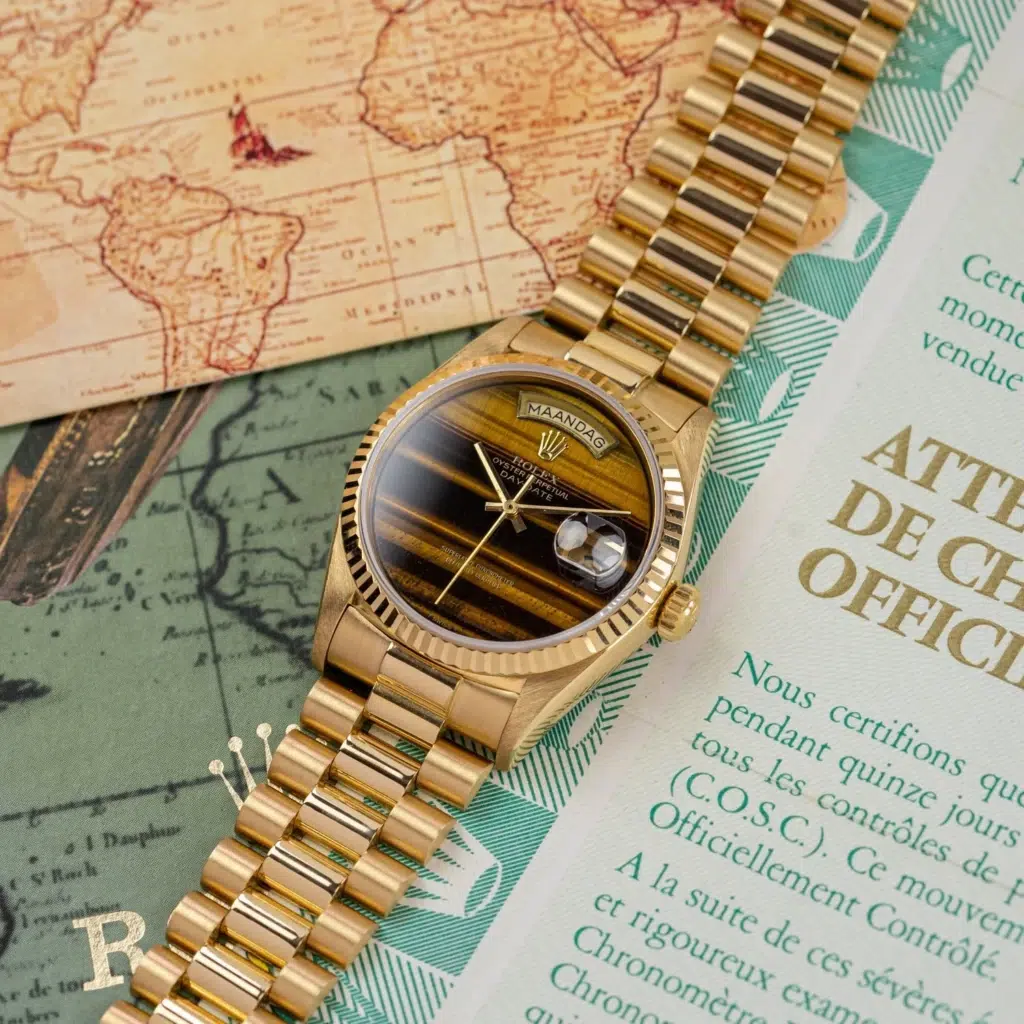
Image Source: Amsterdam Vintage
The Tiger Eye dial shows Rolex’s mastery of natural materials with its mesmerizing golden-brown striations. This rare gemstone dial creates a unique experience on the wrist by capturing light in remarkable ways.
Tiger Eye Dial Design
Rich layers of orange and brown hues create a captivating visual effect in the Tiger Eye dial. The natural stone displays chatoyancy—a silky, moving reflection that looks like a cat’s eye—which explains its name. Light dancing across its surface changes the material’s appearance dramatically and makes it seem to jump off the wrist.
Rolex lets the Tiger’s Eye stone’s natural beauty shine through by often skipping hour markers. The 2019 GMT-Master II uses “tiger’s iron”—a metamorphic rock that combines tiger’s eye, red jasper, and silvery hematite. The 116588TBR “Eye of the Tiger” Daytona showcases meticulous craftsmanship with its black lacquer application and 243 diamonds that form a tiger-stripe pattern.
Tiger Eye Dial Historical Significance
Rolex introduced Tiger Eye dials in 1980, designing them mainly for yellow gold timepieces. These dials were produced in limited numbers to avoid competing with their flagship Day-Date models. They soon became symbols of exclusivity and prestige.
These special dials appeared mostly in:
Datejust models (especially reference 16018 from around 1980)
Day-Date “President” watches (reference 18078)
Select GMT-Master models known as “Tiger Eye”
Tiger Eye Dial Collector Appeal
Few Tiger Eye dials are available. Datejusts in gold are rare enough but throw in a Tiger’s Eye dial that is becoming rarer each year and you have a VERY desirable watch.
These watches now command premium prices. Tiger Eye dial Day-Dates have doubled in value from about $25,000 to almost $50,000 over the last several years. Datejust models with these dials now sell between $25,000 and the mid-$30,000 range.
Collectors value these dials because each one is unique, just like fingerprints. This exclusivity combines perfectly with the warm esthetic of yellow gold cases. The result is irresistible to serious collectors who want distinctive pieces that stand out from common Rolex models.
Lapis Lazuli Dial

Image Source : Christie’s
Lapis lazuli dials are among the most beautiful options in Rolex’s stone dial collection. This semi-precious stone has been cherished since ancient times. Its rich blue color and golden flecks turn these timepieces into wearable art that collectors eagerly seek.
Lapis Lazuli Dial Design
The stone shows a deep royal blue color with golden pyrite inclusions that look like stars in a night sky. Creating a watch dial from this natural stone demands exceptional skill. Rolex’s artisans must cut very thin slices from the hard rock that meet strict quality standards. Making these dials isn’t easy – mining explosives often crack the stones, making them useless for dial production.
These dials become more impressive up close. You might mistake them for regular blue dials from far away, but their true beauty shines through as you get closer. The natural variations in color and pyrite patterns become clear. Real lapis dials have natural pyrite patterns – this helps spot fakes, which usually show uniform gold specks.
Lapis Lazuli Dial Historical Significance
Rolex have been featuring lapis lazuli in watches for many years. Yellow gold Datejust and Day-Date models are by far the most prevalent. Most of these dials incorporated diamond hour markers which offered incredible contrast with the blue background. Rare examples of Submariners and Daytonas have featured the stone as well.
The gold Submariner reference 16618 with lapis lazuli dial stands out as a remarkable piece. Collectors call it “breathtaking” and consider it a “grail” timepiece. The discontinued Pearlmaster line also had beautiful lapis lazuli dials, usually in smaller 29mm cases.
Lapis Lazuli Dial Collector Appeal
These dials are highly sought after for several reasons:
Exceptional Rarity: Rolex makes very few of these dials
Historic Value: Ancient Egyptians used lapis lazuli in their pharaohs’ jewelry, and it appeared in Renaissance art
Unique Characteristics: No two dials look exactly alike
Yellow gold cases typically house these magnificent blue dials, while white gold versions are much harder to find. The current market reflects their rarity – a Day-Date or Datejust with lapis lazuli dial costs between
$30,000 and $60,000. The rarest pieces, like the Submariner 16618 with lapis lazuli dial, can reach six-figure prices.
Wood Dial
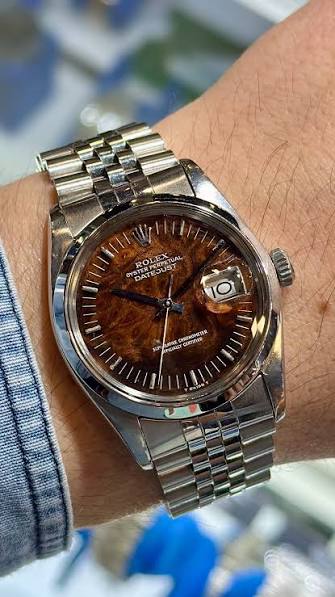
Image Source: Instagram
Wooden dials first appeared in Rolex watches during the 1970s. These exclusive timepieces showed how Rolex welcomed organic materials. The rare dials add warmth and character that no other material in the brand’s collection can match.
Wood Dial Design
Rolex selects wood from burls because they grow on trees where the wood is stressed and have attractive grain formations. Rolex uses multiple types of woods. These range from walnut burl which is dark brown with flame configurations, lighter oak burl which has tight swirls to birch (which is the lightest grain), madrone, and African mahogany. The wood is then selected by artisans and stabilized with resin so it will not warp. The wood is cut to the right thickness, hand polished, and sealed to remain water-proof.
Wood Dial Historical Significance
Rolex first introduced wooden dials on 4-digit Day-Date watches in the early 70s. Original straight-grain wood dials are rare and are prone to cracking. By 1979, Rolex included wooden dials on Datejust watches. Later produced 5-digit Day-Date watches featured burlwood dials which are less prone to cracking. The Oysterquartz Day-Date reference 19018 with its birchwood dial stands out as an innovation that combined quartz precision with organic beauty. Wooden dials stayed in Rolex’s catalog until the early 2000s.
Wood Dial Collector Appeal
Wood dials from the 1970s-80s are highly sought after today because of their limited production and unique stabilization methods. These dials are rare since Rolex only installed them when customers asked. Day-Date models remain the most valuable, with the white gold reference 18239’s birchwood dial being especially prized. While stone dials get more attention, wooden dials keep growing in value as collectors notice their lack and unique organic character.
Malachite Dial

Image Source: Instagram
Rolex’s most exclusive timepieces showcase nature’s artistry through mesmerizing green waves of malachite dials. These rare dials feature one of the most fascinating yet challenging materials in watchmaking.
Malachite Dial Design
Fans of natural banded patterns have ample swirled greens to choose from, whether you’re looking for deep green forest patterns or lighter gems that band with bright lime green strokes. Mineral striations within each stone ensure that no two dials will ever look exactly alike. To cut the stone, it must be sliced into sections less than a millimeter thick. After polishing, stabilizing, and strengthening each slice, they are mounted onto metal plates. Because the precious stone breaks easily from even minor errors in the process, waste is high, and rarity becomes unparalleled.
Malachite Dial Historical Significance
Malachite was first used in Rolex watches during the 1970s on Day-Date and Datejust models. Rolex has experimented with different dial materials throughout the years but reserved malachite for Day-Date and Datejust timepieces. This exclusivity has helped to increase the allure of the watches in Rolex’s collection. Experts speculate that the unique green wave background pattern you see in most Rolex retail watches displays was inspired by the malachite dial.
Malachite Dial Collector Appeal
Collectors value malachite dials and with good reason too. The dials often break during production or later in the watch’s life, which drives up both manufacturing costs and collector interest. Each dial shows its own unique geological fingerprint. Day-Date’s recent popularity surge has put these rare stone dials in the spotlight. They now command between 50-75K USD – a price level that only red jasper matches among rare Rolex day date dials.
Coral Dial

Image Source: European Watch Company
Serious collectors around the world chase after coral dials. These timepieces represent one of the most mysterious chapters in Rolex’s journey with exotic materials. The combination of vibrant colors and rich history makes these pieces rare and sought-after.
Coral Dial Design
The authentic coral dials display amazing colors from soft peach to bright pink or bold red, and each one shows nature’s unique veining patterns. Rolex selected actual coral pieces with bright colors to craft these dials. The material proved too fragile and made production a real challenge. Craftsmen struggled to cut thin enough sections needed for dial making. The 2021 Oyster Perpetual showcases this legacy with its bright coral red that stands out against silver-tone hour markers.
Coral Dial Historical Significance
The story of coral stone dials began in the late 1970s when they appeared with the famous “Stella” lacquered dials. Rolex made these dials mostly for Middle Eastern and Asian markets, but sales didn’t take off. The company destroyed several remaining batches in the late 1980s, which left very few pieces in circulation. One famous owner, Austrian pianist Friedrich Gulda, had a coral dial Day-Date that people called the “Tangerine Dream”. The coral red made a brief comeback in the 2021 Oyster Perpetual series before Rolex discontinued it again in 2022.
Coral Dial Collector Appeal
Orange-red coral dials are extremely rare and stand among the most collectible Rolex variations. Experts call coral the rarest of all standard production Rolex stone dials. Collectors need to be careful though – many pieces show cracks due to the coral’s natural fragility. Market prices reflect this scarcity. New coral red Oyster Perpetuals sell for $9,000-$14,000. Vintage pieces that once cost $50,000 now fetch around $200,000.
Sodalite Dial

Image Source: Reddit
Rolex’s expertise in working with rare natural materials became evident when experts found Sodalite in Greenland in 1811. This semi-precious blue stone makes a bold statement that serious collectors pursue actively.
Sodalite Dial Design
Sodalite comes in many shades of blue from pale powder colors to deeper richer tones. Sodalite is often confused with lapis lazuli. Lapis does not have yellow or golden pyrite flecks running through it. Sodalite has pronounced white streaks and black flecks throughout the stone that give it extraordinary texture and depth. The Mohs hardness of 5.5 to 6 is hard enough that sodalite is used in watch dials. The stone is however quite difficult to cut and shape. No two sodalite dials are alike giving each watch its own natural fingerprint.
Sodalite Dial Historical Significance
Rolex used sodalite in several prestigious collections. The neo-vintage Datejust reference 16234, made from 1988 to the early 2000s, paired this stunning blue stone with diamond hour markers. The sporty Daytona chronograph reference 16519 “Zenith” (1997-2000) also featured this magnificent material. The white gold Daytona with a sodalite dial made a bold statement in the late ’90s.
Sodalite Dial Collector Appeal
Their appeal comes from exclusivity and rarity. Few of these dials were produced. The hypnotic midnight blue of sodalite allows a perceived depth not seen in traditional dials. Many are found in luxurious configurations, white gold cases with diamond indices are not uncommon. These watches are real timepieces of horological excellence. Rolex’s Datejust with sodalite dial is one of the rarest of them all.
Marble Dial

Image Source: RolexPassionMarket
Marble dials stand out with their elegant veining patterns and represent a subtle yet sophisticated choice among rare Rolex offerings. These pristine white canvases with dark, organic lines represent horological exclusivity at its best.
Marble Dial Design
The rare Rolex dials use Howlite—a borate mineral that looks similar to white Carrara marble but is substantially easier to process. Making these dials comes with unique challenges since craftsmen must carefully drill the material to fit metal elements. The dark veins create an engaging contrast against the white background. Each stone’s individual characteristics give every dial its own fingerprint-like pattern. This natural asymmetry creates a visual depth that regular dials can’t match.
Marble Dial Historical Significance
Yellow gold Day-Date models with marble dials have become iconic in Rolex’s collection. Notable examples include the Reference 18038 from 1992 and the 18238 from 1990. These watches usually feature Roman hour markers that enhance their classical look. Rolex reserved marble for their most prestigious collections, which makes these variants special to serious collectors.
Marble Dial Collector Appeal
Marble dial Day-Dates are often referred to as magical by watch collectors. Because each marble dial is individually veined no two watches will be exactly alike. Watch collectors prize each configuration for their subtle elegance and unique personality. These limited editions are masterpieces that transcend mere wristwatch collecting and still fascinate even the most discriminating Rolex collectors.
Bloodstone Dial

Image Source: Instagram
Rolex’s bloodstone dial stands at the peak of dial rarity. These dials are incredibly hard to find, especially in white precious metals where less than 10 pieces exist worldwide. This remarkable material makes regular timepieces into horological treasures that collectors chase after.
Bloodstone Dial Design
Bloodstone is green heliotrope chalcedony with splashes of red iron hematite. While most stone dials are patterned regularly, the relative abundance of red spots in bloodstone results in unique optical fingerprints. Gold script is applied to yellow gold models; naturally there are script and aperture ring surrounds in precious metal for white gold examples.
Bloodstone Dial Historical Significance
Rolex brought these eye-catching dials to market in the 1970s and 1980s. Yellow gold Day-Date and Datejust references featured most bloodstone dials during this time. Records show just one platinum example (reference 18206) exists. This is a big deal as it means that these dials are harder to find than famous pieces like the Qaboos Dial Daytona or Explorer Dial Milsub.
Bloodstone Dial Collector Appeal
Bloodstone’s extreme rarity shows in its market value. Flawless white gold examples sell for about $344,000, but pieces with tiny hairline cracks still fetch near $100,000. Collectors really want:
Pieces with lots of red inclusions
Dials without the cracks that often show up in these delicate stone faces
White metal versions, which many call “the ultimate Day-Date spec”
Yellow gold bloodstone models are still highly sought after and show up more often at top auctions like Christie’s.
Comparison Table
|
Dial Type |
Primary Material |
Notable Design Features |
Historical Introduction |
Notable Models |
Market Value (USD) |
|
Mother of Pearl |
Natural nacre from Pacific Ocean shells |
Iridescent surface, 0.2mm thickness, unique patterns |
1980s |
Datejust, Day-Date, Daytona, Yacht-Master |
8,500 – 95,000 |
|
Meteorite |
Gibeon meteorite from Namibia |
Widmanstätten crystalline patterns, silver-gray tone |
N/A |
GMT-Master II, Day-Date, Daytona |
52,389 – 232,840 |
|
Ice Blue |
Exclusive platinum signature color |
Chromalight-filled markers, ethereal shade |
N/A |
Day-Date 40, Cosmograph Daytona, Perpetual 1908 |
Not mentioned |
|
Onyx |
Semi-precious black gemstone |
Deep black hue, clean design without hour markers |
1977-1988 (earliest mentioned) |
Day-Date, Datejust, Submariner 16618 |
Not mentioned |
|
Tiger Eye |
Natural tiger’s eye stone |
Orange-brown striations, chatoyancy effect |
1980 |
Datejust 16018, Day-Date 18078, GMT-Master |
25,000 – 50,000 |
|
Lapis Lazuli |
Natural blue stone |
Deep blue with gold pyrite inclusions |
N/A |
Day-Date, Datejust, Submariner |
30,000 – 60,000 |
|
Wood |
Various burl woods (walnut, oak, birch) |
Natural grain patterns, resin-stabilized |
Early 1970s |
Day-Date, Datejust, Oysterquartz |
Not mentioned |
|
Malachite |
Natural green stone |
Swirling green patterns, banded structure |
1970s |
Day-Date, Datejust |
50,000 – 75,000 |
|
Coral |
Natural coral material |
Peach to vivid pink/red hues, natural veining |
Late 1970s |
Day-Date, Oyster Perpetual |
9,000 – 200,000 |
|
Sodalite |
Semi-precious blue stone |
Rich blue with white streaks, no pyrite |
Late 1980s |
Datejust 16234, Daytona 16519 |
Not mentioned |
|
Marble |
Howlite mineral |
White background with dark veining |
1990s |
Day-Date 18038, 18238 |
Not mentioned |
|
Bloodstone |
Green heliotrope chalcedony |
Green base with red iron spots |
1970s-1980s |
Day-Date, Datejust |
100,000 – 344,000 |
Final Comments
When it comes to watches with personality dial rarity is king. Rolex is responsible for some of the most sought-after watch dials on the market. Pushing beyond standard-issue production runs, these exclusive timepieces exemplify Rolex’s commitment to artistry and luxury. Though each dial varies wildly by origin – ancient space rock, precious gems, or natural resources – they all have one thing in common.
Collectors around the world are neck-deep in their search for these horological marvels. Buyers are clearly paying attention, as watches adorned with bloodstone dials are selling at upwards of $300k. Even otherwise-entry mother-of-pearl variants have seen a 639% increase in price over the past 15 years.
Nature herself imparts character into each timepiece. Unique to the stone itself are tell-tale signs of geological history. Crystalline structure varieties exist from watch to watch for meteorite based dials, and even the grains of wood vary from piece to piece. This quality guarantees that your next luxury timepiece will double as a conversation-starting piece of art.
Rolex’s rarity doesn’t stop there. Some colors are produced so infrequently because Rolex takes time to contemplate their production run. Ice blue dials are only seen on platinum wrist watches, and other colors were produced in such limited quantities they’ve since been retired. Displaying one of these bad boys on your wrist is sure to impress, not only for its style but also your appreciation for the art of watchmaking.
So next time you spot one of these exotic dials, take a moment to remember the process these watches endure to get from rock to wrist. Every one of these watches tells a story that goes beyond mere status. From the beauty of nature to the passion of the artisan, these timepieces celebrate the perfection of astronomy, geology and engineering. Whether you’re a fan of space stone, mysterious onyx or psychedelic coral, these rare Rolex watches are sure to capture your heart.
Enjoying our watch coverage? Get more of it in Google Search.