The Rolex Sea-Dweller and Submariner stand as two legendary watches with unique capabilities and distinct differences. These timepieces might look alike at first glance, but each serves a different purpose. Rolex introduced the Submariner in 1953, which became a horological icon with water resistance up to 300 meters (1,000 feet). The Sea-Dweller came later in 1967, built for professional saturation divers and can handle depths up to 1,220 meters (4,000 feet).
Table of Contents
These watches have more differences than just their depth ratings. The Sea-Dweller comes equipped with a helium escape valve that lets trapped gas escape during decompression – a vital feature for professional divers. The Sea-Dweller’s ability to reach depths three times deeper than the Submariner makes it Rolex’s ultimate tool watch for underwater exploration. The Submariner strikes a perfect balance between toughness and style that works great for daily wear. Both watches carry the Rolex name, but your choice depends on your needs, wrist size, and budget. Let’s explore everything you should know to pick the right Rolex diver for your wrist in 2025.
The Origins of Rolex Dive Watches
Rolex’s dive watches came about as people started exploring deeper waters. These timepieces changed the game with breakthroughs that made diving safer and more capable.
Submariner: Born in 1953 for recreational diving
The early 1950s changed everything for underwater exploration. Diving became available to more than just scientists and military personnel. Rolex saw this opportunity and launched the Submariner in 1953, which became the life-blood of diving watches. The Submariner made its mark as the first watch that could stay water-resistant up to 100 meters.
The original reference 6204 Submariner showed amazing foresight in its design. It had a rotating bezel to time dives, an easy-to-read black dial, and hands filled with glowing material you could see underwater. The watch stayed water-tight thanks to Rolex’s screw-down winding crown and thick acrylic crystal. Though it only lasted a year in production, the reference 6204 laid the groundwork for what many consider the most iconic dive watch ever made.
Sea-Dweller: Introduced in 1967 for saturation divers
The Sea-Dweller took a different path from the Submariner’s recreational focus. It met the needs of professional deep-sea explorers. Saturation diving techniques improved by a lot in the 1960s. Divers could now stay at extreme depths much longer. They lived in pressurized spaces breathing mostly helium.
Rolex launched the Sea-Dweller in 1967 with a depth rating of 610 meters—three times what the Submariner could handle. This watch was built specifically for tough commercial diving jobs, not casual use. The first Sea-Dweller prototypes went only to professional diving companies before becoming available to everyone in 1971.
Role of COMEX and the invention of the Helium Escape Valve
Rolex’s partnership with COMEX (Compagnie Maritime d’Expertises) pushed dive watch technology forward. COMEX divers faced a big issue in the late 1960s—their watch crystals popped off during decompression. This happened because tiny helium atoms could sneak into watch cases during deep-sea operations.
The breakthrough came through teamwork. US Navy diver Robert A. Barth, a pioneer in saturation diving, came up with the one-way valve idea. Rolex filed a patent for the helium escape valve on November 6, 1967, and got approval on June 15, 1970. This clever device opens automatically when pressure builds up inside, letting trapped helium escape safely.
Dr. Ralph Werner Brauer tested the first watches with this technology during Physalie dives at the COMEX Hyperbaric Center in Marseille. The valve made the Sea-Dweller essential for professional saturation divers and set it apart from the Submariner in both design and purpose.
Design and Size: Sea-Dweller vs Submariner Thickness and Fit
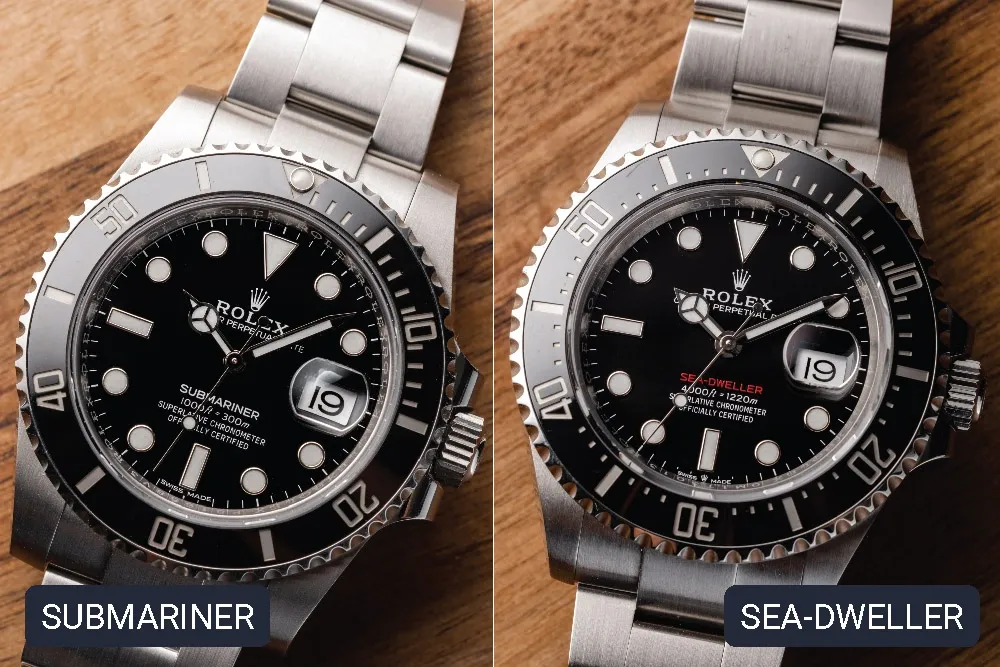
The Sea-Dweller and Submariner show their biggest differences in physical dimensions. These two iconic divers create unique wearing experiences that go beyond their technical capabilities.
Case Dimensions: 43mm vs 41mm
The Sea-Dweller today comes with a 43mm case diameter, while the Submariner has a more modest 41mm profile. A 2mm difference might not seem much on paper, but it creates a big visual effect on your wrist. The size gap between these watches used to be even bigger – the previous Submariner was 40mm, making it 3mm smaller than its bigger brother.
Put these watches side by side and you’ll see the Sea-Dweller looks bulkier and more serious. The larger size isn’t just for show – it helps the watch work better at extreme depths. The Submariner, maybe more stylish with its sleeker look, works great as an everyday watch.
Thickness: 15.1mm vs 12mm
The thickness difference stands out even more than the diameter. The Sea-Dweller stands tall at 15.1mm, while the Submariner keeps a slimmer 12mm profile. You’ll notice this 3.1mm difference right away during daily wear.
The Sea-Dweller’s extra height makes room for better pressure handling and its helium escape valve. This thickness also gives the watch a substantial presence on your wrist – it’s impossible to forget you’re wearing it.
Wrist Presence and Comfort for Daily Wear
These size differences create two distinct experiences on the wrist. The Submariner hits a sweet spot between presence and comfort. At 41mm wide and 12mm thick, it feels solid without being too heavy. The Submariner fits well on wrists of all sizes, but it looks best on wrists around 6.5 inches and up.
The Sea-Dweller demands attention with its bigger size and heavier weight – 194g compared to the Submariner’s 157g. Some watch lovers enjoy this bold presence, while others find it too much for everyday use.
The Submariner’s slimmer design lets it slip easily under shirt cuffs, making it great for formal occasions. The Sea-Dweller’s thickness rules this out, placing it firmly in the tool watch category despite its luxury status.
Your wrist size and what you like will help you pick the better fit. Larger wrists might find the Sea-Dweller’s size just right, while others might prefer the Submariner’s more versatile dimensions.
Diving Capabilities and Technical Features
The Sea-Dweller and Submariner Rolex models stand apart not just in size. Their technical diving features show they’re built for very different kinds of divers.
Water Resistance: 1,220m vs 300m
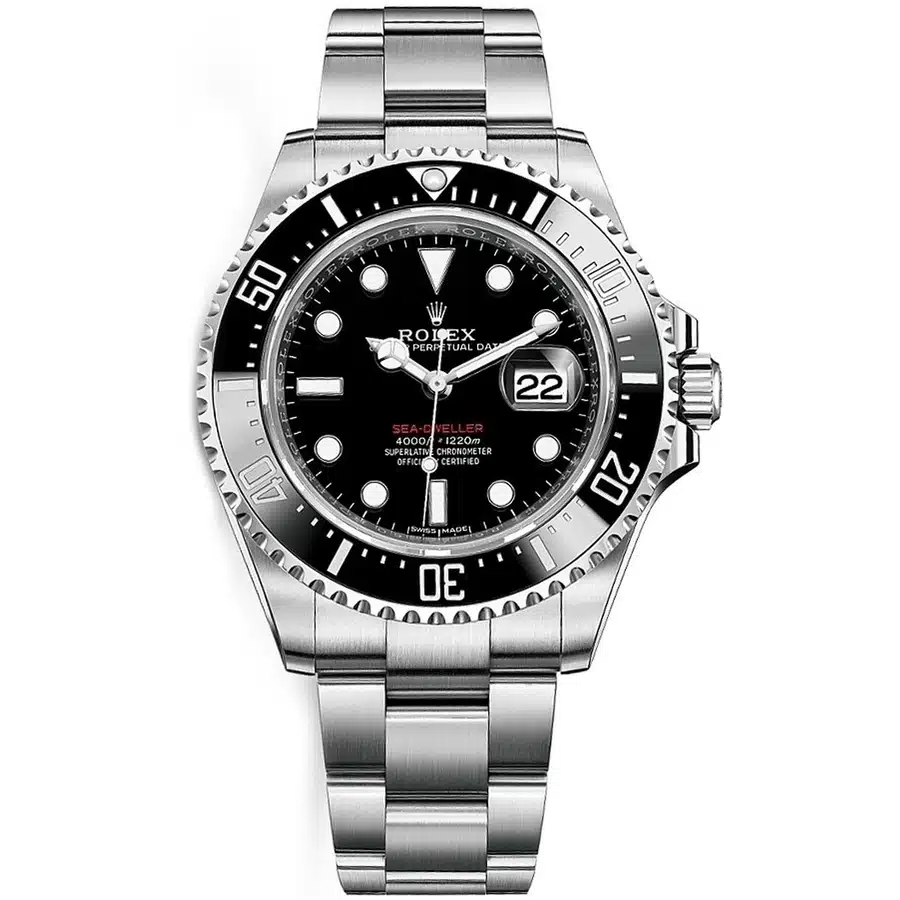
These watches differ most in their depth rating. The Sea-Dweller can handle depths of 1,220 meters (4,000 feet), which beats the Submariner’s 300 meters (1,000 feet) by four times. This huge gap makes sense – Rolex built the Sea-Dweller for professional saturation divers who work in deep waters, while the Submariner serves recreational divers.
The Sea-Dweller must resist about 1,800 PSI of pressure to reach these depths. This calls for some serious engineering in its case design. The Submariner’s 300-meter rating is way beyond what most recreational divers will ever use.
Helium Escape Valve: Exclusive to Sea-Dweller
The most important technical feature that sets these watches apart is the Sea-Dweller’s helium escape valve (HEV). This one-way valve with a spring load plays a crucial role in saturation diving where divers use helium-rich gas mixtures in pressurized settings.
The biggest problem comes during decompression. Tiny helium molecules can sneak into the watch case. Without a way to release this gas, pressure builds up inside and can damage the watch. Sometimes it can even pop the crystal right off. The HEV opens up automatically when pressure hits 3-5 bars to let the helium escape safely.
The valve doesn’t affect the watch’s water resistance at all. It stays shut whenever the watch goes underwater.
Bezel and Dial Differences for Dive Timing
Both models come with Cerachrom (ceramic) unidirectional rotating bezels. The Sea-Dweller’s bezel has minute markings all the way around, while the Submariner stops after 15 minutes. This makes sense since professional divers need more precise timing for their longer decompression stops.
On top of that, the bezels only turn counterclockwise. This safety feature means any accidental bumps will make the dive time shorter, so divers surface early rather than dangerously late.
Movement and Build Quality
The same mechanical heart beats inside these prestigious divers, showing Rolex’s steadfast dedication to technical excellence whatever the model.
Caliber 3235 in Both Models

The Sea-Dweller and Submariner Date share similar mechanical foundations with Rolex’s in-house Caliber 3235 automatic movement. This next-generation movement made its debut at Baselworld 2017. It brought a major upgrade from its predecessor, with about 90% of components either replaced or renewed. The Caliber 3235 features 14 patents including the revolutionary Chronergy escapement. This innovation boosts energy efficiency by 15% through better utilization of the pallet fork.
The movement delivers exceptional accuracy with Rolex’s Superlative Chronometer certification that guarantees timekeeping precision of -2/+2 seconds per day. A paramagnetic blue Parachrom hairspring provides great resistance to magnetic fields and temperature changes. The Paraflex shock absorbers ensure durability in demanding conditions.
Power Reserve: 70 Hours
The Caliber 3235’s most important advancement is its extended power reserve. Yes, it is true – both watches now run for about 70 hours when fully wound. This marks a big improvement over the 48-hour reserve in previous generation movements. Your watch will keep accurate time even after spending a weekend off your wrist.
Bracelet Systems: Glidelock vs Glidelock + Fliplock
The bracelet systems reveal a key functional difference between these models despite their shared movements. Each timepiece comes with Rolex’s three-link Oyster bracelet and Glidelock extension system. This allows for about 20mm of adjustment in 2mm increments without tools.
This feature is a great way to get the perfect fit during daily wear. The Sea-Dweller adds a Fliplock extension link that provides an extra 26mm of length. This specialized extension fits over diving suits and reinforces the Sea-Dweller’s role as a professional tool watch. The Rolesor (two-tone) Sea-Dweller model comes without this Fliplock extension, making it more of a luxury piece than a technical diving instrument.
Price, Availability, and Resale Value
Rolex divers showcase unique market strategies that go beyond their technical features, with each model positioned differently in the market.

Retail Pricing: Submariner vs Sea-Dweller
A quick look at retail prices shows a significant gap between these professional divers. The stainless steel Submariner Date (126610LN) costs $10,250, while its no-date variant sells for $9,100. The standard Sea-Dweller (126600) comes with a $13,250 price tag. This $3,000 difference makes sense given the Sea-Dweller’s advanced engineering and professional capabilities.
Precious metal variants tell a similar story:
- Submariner with green bezel: $10,800
- Rolesor (two-tone) Submariner: $15,600
- Rolesor Sea-Dweller: $18,000
- Gold Submariner models: $39,000-$42,000 (yellow and white gold)
Pre-Owned Market Trends
Getting either watch from an authorized dealer remains tough due to waiting lists. Rolex waiting times have improved since 2022. The Submariner now takes about 60 days compared to 105 days in 2023, while GMT models dropped from 180 to 90 days.
Secondary market prices have found their balance after the ups and downs of 2020-2022. Rolex’s market share on Chrono24 reached its peak at 43.9% in early 2022 but has settled at 34.2%. This shift points to a market that’s returning to normal after the luxury watch boom during the pandemic.
Sea-Dweller vs Submariner Resale Value Comparison
These models prove their worth as solid investments. Pre-owned stainless steel versions typically sell between $10,000-$15,000. The Sea-Dweller’s longer market presence means its prices now match the newer Submariner models.
The Submariner stands out as the more popular choice thanks to its iconic status and versatility. Vintage Submariners attract more buyers than their Sea-Dweller counterparts. Buyers looking for long-term value often gravitate toward the Submariner’s prestigious history and timeless appeal.
Some collectors prefer the Sea-Dweller precisely because fewer people own one, making it a more distinctive choice on the wrist.
Comparison Table
| Feature | Rolex Sea-Dweller | Rolex Submariner |
|---|---|---|
| Case Diameter | 43mm | 41mm |
| Case Thickness | 15.1mm | 12mm |
| Water Resistance | 1,220m (4,000 feet) | 300m (1,000 feet) |
| Helium Escape Valve | Yes | No |
| Movement | Caliber 3235 | Caliber 3235 |
| Power Reserve | 70 hours | 70 hours |
| Year Introduced | 1967 | 1953 |
| Bezel Features | Full minute markings | First 15 minutes marked |
| Bracelet System | Glidelock + Fliplock | Glidelock only |
| Weight | 194g | 157g |
| Retail Price (Steel) | $13,250 | $10,250 (Date version) |
| Main Purpose | Deep-sea saturation diving | Recreational diving |
| Extension Range | 20mm + 26mm (Fliplock) | 20mm |
| Intended User | Professional deep-sea divers | Everyday wear and recreational diving |
Conclusion
Your choice between the Sea-Dweller and Submariner ended up depending on your specific needs, priorities, and wrist size. Both watches show Rolex’s steadfast dedication to exceptional engineering and timeless design, though they serve different purposes.
The Submariner is the quintessential luxury dive watch with its modest 41mm case size and 12mm thickness. This iconic timepiece balances functionality and elegance perfectly. You can wear it for diving adventures and formal occasions. Its 300-meter water resistance is more than enough for most recreational divers, and its slimmer profile slides easily under shirt cuffs.
The Sea-Dweller stands as Rolex’s ultimate professional diving instrument. The watch’s larger 43mm case, substantial 15.1mm thickness, and helium escape valve make it perfect for serious underwater explorers. Its impressive 1,220-meter water resistance and specialized bracelet extensions prove that this watch was built for extreme conditions rather than everyday wear.
The $3,000 price difference between these models shows their market positioning. The Submariner has broader appeal and stronger heritage, which helps maintain excellent resale value across generations. The Sea-Dweller provides greater exclusivity, advanced technical capabilities, and a commanding wrist presence that many enthusiasts love.
Without doubt, both watches deliver exceptional timekeeping through similar Caliber 3235 movements with impressive 70-hour power reserves. We focused on size priorities, intended use, and esthetic considerations rather than technical performance.
The Submariner might suit you better if you value versatility, comfort, and Rolex’s most recognizable dive watch’s iconic status. The Sea-Dweller deserves a look if you appreciate technical diving heritage, want something less common, or simply like larger watches with substantial wrist presence.
Whatever diver you choose, both timepieces are horological excellence that will serve faithfully for generations – whether you tuck into ocean depths or navigate daily life.
FAQs
Which watch is more suitable for everyday wear, the Sea-Dweller or the Submariner?
The Submariner is generally considered more suitable for everyday wear due to its smaller size (41mm) and slimmer profile (12mm thick). It’s more versatile and can easily transition from casual to formal settings. The Sea-Dweller, being larger and thicker, is more of a statement piece and might be less comfortable for daily use.
How do the water resistance capabilities differ between the Sea-Dweller and Submariner?
The Sea-Dweller offers significantly higher water resistance at 1,220 meters (4,000 feet) compared to the Submariner’s 300 meters (1,000 feet). This makes the Sea-Dweller more suitable for professional deep-sea diving, while the Submariner is more than adequate for recreational diving and water activities.
Is there a significant difference in value retention between the Sea-Dweller and Submariner?
Both watches generally retain their value well. The Submariner, being more iconic and versatile, tends to have broader appeal and strong demand in the pre-owned market. The Sea-Dweller, while less common, also holds its value due to its professional diving capabilities and relative exclusivity.
What are the key features that distinguish the Sea-Dweller from the Submariner?
The Sea-Dweller’s distinguishing features include its larger case size (43mm vs 41mm), greater thickness (15.1mm vs 12mm), higher water resistance (1,220m vs 300m), and the presence of a helium escape valve. It also has a Fliplock extension on the bracelet for use over diving suits, which the Submariner lacks.
Are there any differences in the movements between the Sea-Dweller and Submariner?
No, both the current Sea-Dweller and Submariner models use the same Rolex Caliber 3235 movement. This movement offers excellent accuracy, a 70-hour power reserve, and features Rolex’s advanced Chronergy escapement for improved efficiency.
Enjoying our watch coverage? Get more of it in Google Search.