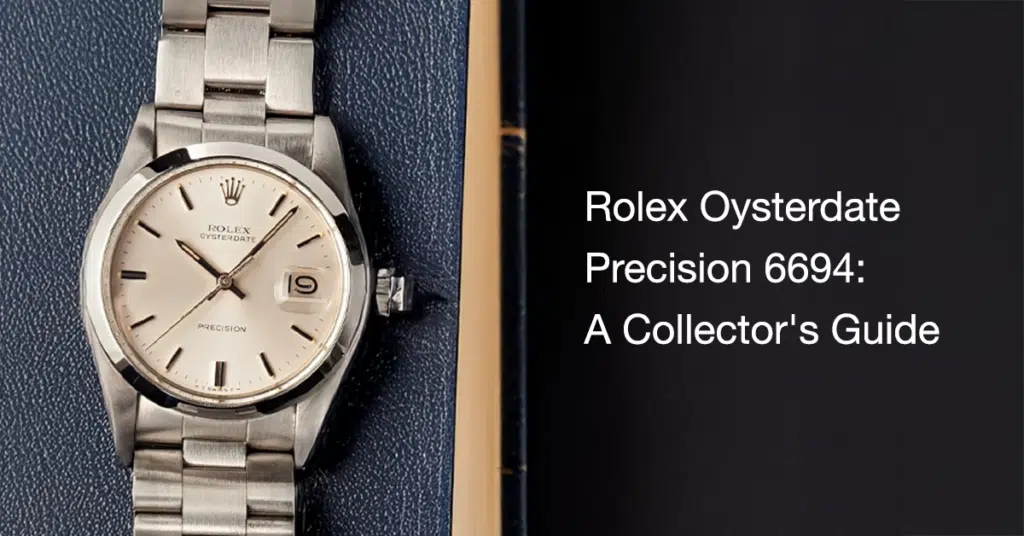
Rolex Oysterdate Precision 6694 is ideal for those who are new to Rolex and want to get into it without hassle. Dating back to the mid-1900’s, this watch has a vintage history. Rolex was dominating the market for high-quality luxury watches back then. It’s also noteworthy that the 66 94 was the last three-handed Rolex with a hand-wound movement.
Rolex made the Oysterdate Precision from the early 1960s until the late 1980s. This long production run was something of a sensation lasting nearly 30 years! Featuring a case diameter of 34mm makes it ideal as a unisex watch. Available in stainless steel, two-tone and perhaps even 18k yellow gold. Each feature a timeless style with an acrylic crystal and date magnifier at 3 hours. Prices on the vintage Rolex market range from roughly $1,400 to $2,000, although there are occasional bargains to be had. We will cover every aspect of this subtle yet significant piece of Rolex history.
Table of Contents
A Brief History of the Rolex Oysterdate Precision 6694
The Rolex Oysterdate Precision 6694 carved out a special place in the brand’s catalog over nearly three decades. This timepiece stayed remarkably consistent while the watchmaking world changed around it. The watch’s story through Rolex’s history tells us a lot about how the brand approached watchmaking traditions.
Origins in the 1960s
The story of the Rolex Oysterdate Precision 6694 goes back to the early 1950s with the birth of the Oysterdate line. The ref. 6094 kicked things off around 1953 and featured sword-like hands and the signature Oyster case. Rolex then brought out the ref. 6294, which made things sleeker by switching to straight baton hands instead of the elegant dauphine style.
The brand added their now-iconic Cyclops magnifier to some 6294 models during these early days – a feature that would become standard later on. The ref. 6494 came next and brought more dial colors into the mix.
Rolex settled on its fourth and final version – the reference 6694 – in 1958. This watch packed some serious technical upgrades, including a Breguet overcoil hairspring. The movement got better too, with the frequency jumping from 18,000 bph to 21,600 bph. These improvements made the watch perform better while keeping its price reasonable.
Production timeline until 1989
The Rolex Oysterdate Precision 6694 did something pretty unusual from the early 1960s to late 1980s – it barely changed at all. Other Rolex models kept getting updates and redesigns, but the 6694 stayed pretty much the same for about 30 years.
European watch lovers really took to this model, and it became a key part of Rolex’s lineup there. American buyers didn’t see it quite the same way, often going for sportier options like the Submariner and GMT-Master instead.
Rolex offered the 6694 in several flavors:
Stainless steel (most common)
Two-tone steel and gold
18-karat yellow gold editions (hard to find and valuable)
The dial options grew beyond basic black and silver sunburst. You could get vibrant colors like green, blue, yellow, and pink – details that collectors now love about this otherwise modest watch.
Role in Rolex’s manual-wind legacy
The Rolex Oysterdate Precision 6694 stands out as Rolex’s last manually-wound watch outside their Cellini dress watch line. This makes the 6694 pretty special in Rolex’s story.
Inside the 6694, you’d find either the caliber 1210 or the later caliber 1225, depending on when it was made. These movements didn’t have the fancy COSC chronometer certification most Rolex watches got. That’s why the dials just say “Precision” instead of the usual “Superlative Chronometer Officially Certified” text.
The story gets even more interesting when you think about Rolex – the company that created the Perpetual self-winding movement – keeping this watch manual-wind right through its production. They stuck with this choice even in the late 1980s when almost every other Rolex wound itself automatically.
This steadfast dedication to old-school watchmaking left quite a legacy. The 6694 connects us to an earlier time in watchmaking when winding your watch was a daily ritual. Collectors really appreciate this unique piece of Rolex history, which has helped make it something of a cult favorite.
Design and Build: What Makes the 6694 Stand Out
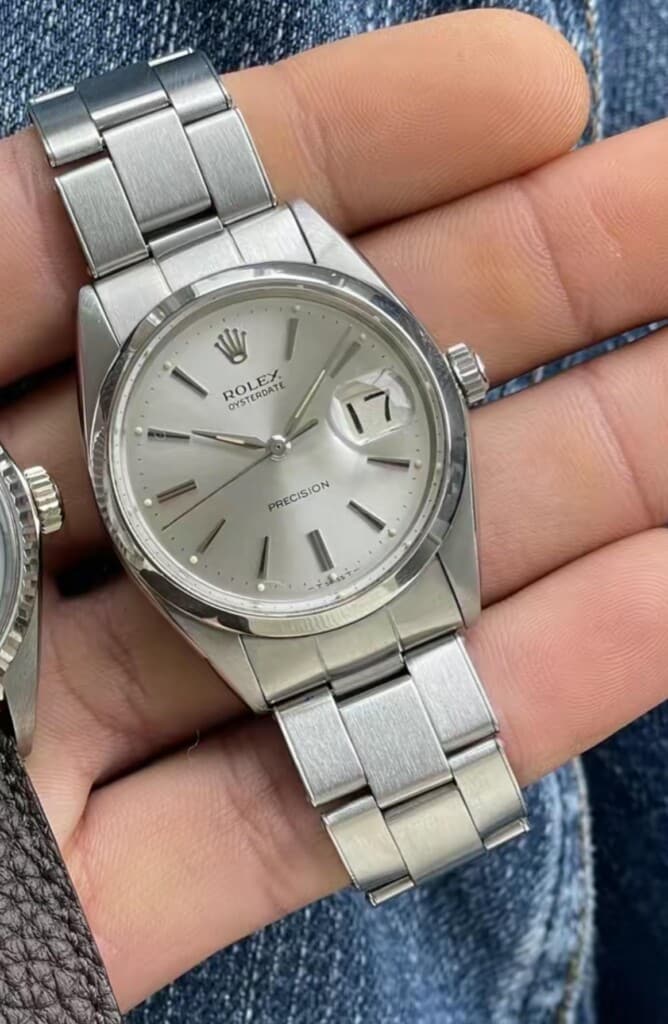
Image source: Reddit
The Rolex Oysterdate Precision 6694 draws collectors with its clean lines and detailed craftsmanship. This model proves that true quality shines through simplicity. A design stripped to basics leaves no room for flaws – each element needs perfect proportions and placement to create lasting harmony.
Case size and materials
The Rolex 6694’s 34mm diameter might look modest by today’s standards. This size choice creates a versatile profile that adds to the watch’s lasting appeal. The Oysterdate Precision looks bigger on the wrist than its numbers suggest – many owners say it wears like a 35-36mm piece. Light-colored dial options, a well-sized crown, and the solid Oyster bracelet all make it look more prominent.
The 6694’s materials show Rolex’s dedication to strength and versatility. We mostly see stainless steel models, though they made two-tone versions and some rare pieces in 18-karat yellow gold for luxury seekers. The Oyster case – Rolex’s breakthrough from the 1920s – keeps water out and protects the movement from moisture and dust. Its three-piece design uses a screw-down back and crown system with rubber gaskets, making it water-resistant to 100 meters (330 feet).
One unique variant pairs stainless steel parts with gold hands and applied gold logo and baton markers on the dial. This creates an eye-catching two-tone look without using gold in the case.
Dial variations and markers
The dials make the Rolex Oysterdate Precision a collector’s dream, with many finishes throughout production. Common options included:
Silver, black, and blue sunburst dials (most common)
Champagne metallic finishes
Rare special editions in green, pink, and yellow
The dials come in different textures – sunburst, matte, and linen patterns. These surfaces play with light in unique ways that photos can’t quite capture.
Most hour markers are applied batons, though some models feature Roman or Arabic numerals. Early 1960s models had Rolex’s unique dauphine-sword hands, which later changed to modern pointed stick hands. Many pieces matched gold-colored hands and indices with steel cases – a subtle touch that makes reading easier while staying refined.
The dial text stays minimal with just the Rolex name and “Precision” on the lower half. This clean approach gives collectors a more honest feel compared to modern watches.
Cyclops lens and acrylic crystal
The acrylic crystal stands out on the Rolex Oysterdate Precision 6694. Unlike modern scratch-resistant sapphire, this vintage “Plexiglas” crystal sits noticeably above the bezel. While it scratches more easily, collectors love how it gains character over time and takes well to polishing.
The Cyclops lens at 3 o’clock magnifies the date display by 2.5x. This feature became standard on the 6694 after appearing in earlier Oysterdate models and remains one of Rolex’s signature elements. Watch fans debate about the Cyclops lens, but many feel it adds a nice break to the 6694’s clean dial.
These design choices create a watch that feels both unique and understated. It’s a perfect example of Rolex’s mid-century approach that still appeals to collectors who value authenticity over flash.
Inside the Watch: Rolex 6694 Movement Explained
The Rolex Oysterdate Precision 6694’s elegant exterior houses a remarkable piece of Rolex’s mechanical heritage. This timepiece contains one of the brand’s last manual-wind movements that connects its wearer to traditional watchmaking from a different era.
Caliber 1210 vs 1225
Two main movements powered the Rolex 6694 during its production run—the original Caliber 1210 and the enhanced Caliber 1225. These movements share basic architecture but separate themselves in several ways.
The Caliber 1210 powers earlier 6694 models and runs at 18,000 vibrations per hour (5 beats per second). The upgraded Caliber 1225 runs faster at 21,600 vibrations per hour (6 beats per second). This results in smoother second hand movement and better timekeeping accuracy.
From a technical standpoint, the Caliber 1225 is a Caliber 1220 with an added date function. The base Caliber 1220 came from the rise of the 1210. It featured the higher beat rate but removed the Breguet overcoil hairspring found in some earlier versions. Rolex’s continuous refinement shows in this progression:
Caliber 1210: Base movement, 18,000 vph
Caliber 1220: Upgraded movement, 21,600 vph, no date
Caliber 1225: Caliber 1220 with date module added
The date module increased the movement’s thickness from 4.27mm (Caliber 1220) to 5.07mm (Caliber 1225). Both versions use 17 jewels to reduce friction. Serviceability and reliability were the main goals behind their design.
Manual winding experience
Without doubt, the Rolex 6694’s most distinctive feature is its manual winding mechanism. The Oysterdate Precision managed to keep its hand-wound nature throughout production, even though Rolex was prominent for its trailblazing automatic movements through Perpetual technology.
This deliberate design creates a special bond between the watch and its wearer. The morning ritual of winding the crown builds a personal connection to the timepiece. The winding action gives feedback that automatic watch owners never experience—you can feel “a solid, well-built feel”.
Watch enthusiasts often describe this daily interaction as meditative. It encourages a deeper appreciation for the mechanical marvel on their wrist. Many collectors value this trait because it separates the 6694 from almost every other modern Rolex timepiece.
The non-quickset date function needs a practical mention. You must manually advance the time past midnight to change the date, move back to 9:00, and repeat until you reach the desired date. Modern standards might call this inconvenient, but many owners see it as part of the watch’s vintage appeal.
Power reserve and performance
The 1210 and 1225 calibers deliver impressive results despite their age and design. These movements provide a substantial power reserve of approximately 44-58 hours when fully wound. Your watch will likely still run even after a day without wear.
Neither movement carries the prestigious COSC chronometer certification found in most Rolex watches. The dial shows “Precision” instead of “Superlative Chronometer Officially Certified” text seen on other models.
Notwithstanding that, Rolex designed the 1225 caliber to keep excellent time within vintage watch standards. The 21,600 vph rate in later models “must have been quite accurate when it was introduced”. Many owners still report impressive accuracy decades after manufacture.
The movement’s strength shows in its 30-plus years of production with minimal changes. This consistency proves the caliber’s reliability and Rolex’s faith in its design. Regular maintenance every 5-7 years helps these movements work perfectly for generations. The 6694 serves as both a collector’s piece and a reliable daily companion.
How the 6694 Compares to Other Rolex Models
The Oysterdate Precision 6694 stands out as an interesting oddity in Rolex’s legendary lineup. Most people know about other iconic Rolex models, but this watch gives collectors something unique from the usual Rolex experience.
Differences from Datejust and Oyster Perpetual
You might mistake the Rolex Oysterdate Precision 6694 for its more famous relatives—the Datejust and Oyster Perpetual. A closer look reveals some basic differences. The name itself tells a story – there’s no “Perpetual” in it because this watch has a manual-wind movement instead of a self-winding one.
The 6694’s case is 34mm wide, smaller than the Datejust’s 36mm. The watch looks bigger on the wrist thanks to its clean bezel design and dial proportions.
The 6694 lacks several features its siblings have:
No quickset date function (you need to move the time forward to change dates)
No hack functionality (you can’t stop the seconds hand for precise time setting)
No midnight rapid date change mechanism like the Datejust has
These simpler features made the 6694 more available in Rolex’s lineup. It became the starting point for anyone wanting to wear the crown.
Why it’s not a chronometer
Look at the dial and you’ll notice something missing—the usual “Superlative Chronometer Officially Certified” text found on most Rolex watches. The word “Precision” sits there instead.
The difference exists because the 6694’s movement never went through testing at the Swiss Chronometer Testing Institute (COSC). A watch must keep time within -4/+6 seconds daily to earn chronometer status. Rolex made this choice to improve efficiency and positioning for this model.
The watch’s accuracy doesn’t suffer without chronometer certification. Many owners say their 6694s keep excellent time, especially with the later Caliber 1225 movement running at 21,600 beats per hour. Yes, it is worth noting that the dial looks cleaner and more balanced without the extra text.
Unique appeal of the 6694
The Rolex Oysterdate Precision 6694’s character sets it apart from other watches. It gives you the purest connection to traditional watchmaking in Rolex’s modern lineup. Winding your watch each day creates a special bond that automatic watches can’t match.
The 6694 works well in many situations. Its modest size and clean design suit both men’s and women’s wrists. You can wear it with jeans or a suit—it fits right in either way.
Collectors value the 6694 for its authenticity. Modern luxury watches keep getting bigger and more complex, but this model stays true to mid-century watchmaking principles. Its design “barely gets above a whisper,” and that’s exactly what makes enthusiasts love it.
The Rolex Oysterdate Precision 6694 gives you something rare—a genuine Rolex experience without showing off. It captures what one collector calls “the understated nature of having a Rolex that does not overtly advertise that it is a Rolex”. That might be the ultimate luxury today, when logos are everywhere.
Rolex Oysterdate Precision 6694 Price and Market Value
The Rolex Oysterdate Precision 6694 gives watch enthusiasts a chance to own a Rolex without paying premium prices for automatic models. This vintage timepiece combines accessibility with the potential to grow in value.
Current price range
You can find the Rolex Oysterdate Precision 6694 on the secondary market between USD 3,500 and USD 4,000 for stainless steel models in good condition. This makes it one of the most affordable ways to own a genuine Rolex. Recent market data shows varying prices based on different configurations:
|
Configuration |
Approximate Price |
|
Stainless steel with silver dial | Prices at a Glance: Oysterdate Precision 6694 Price (approx.) |
|
Stainless steel with black dial |
USD 4,595 |
|
Gold with white dial | Prices at a Glance: Oysterdate Precision 6694 Price (approx.) |
|
Stainless steel with orange dial | Prices at a Glance: Oysterdate Precision 6694 Price (approx.) |
|
Two-tone with black dial | Prices at a Glance: Oysterdate Precision 6694 Price (approx.) |
Special editions featuring pink dials and diamond indices can reach USD 3,500. Rare pieces that come with their original box and papers or are in exceptional condition can sell for USD 5,000 to USD 7,000.
Factors affecting value
The Rolex Oysterdate Precision 6694’s market value depends on several elements. Dial variations are the most important factor—exotic colors like orange, blue, and pink usually cost more than standard silver or black options.
The watch’s condition is a vital determinant. Models with well-preserved cases and original dials bring higher prices than those with noticeable wear or service replacement parts. Price variations also depend on:
Production era (earlier models from the 1960s often carry vintage premiums)
Bracelet type (original Oyster rivet bracelets add value)
Provenance documentation (box and papers can boost value)
Service history (properly maintained examples sell for more)
Complete examples with original parts in excellent condition will always be worth more than those with replacement components or excessive wear.
Price trends over time
The Rolex Oysterdate Precision 6694’s investment performance shows stability and growth. Market data reveals a 6.8% increase in value over the year ending January 2026. This is a big deal as it means that it performed better than both the overall Rolex brand index (+5.0%) and the general watch market (+5.0%) during that time.
The long-term performance looks even better. The 6694 has grown 12.7% over five years, outperforming both the broader Rolex index (+1.4%) and the overall watch market (+8.3%).
Different configurations show varying growth rates. To cite an instance, orange dial models have grown approximately 17.6% over two years (from USD 3,400 to USD 4,000). This suggests rarer dial variants might offer better investment potential.
The discontinued status of this model helps maintain market stability. The fixed supply combined with growing interest in vintage Rolex creates a strong market position. The Oysterdate Precision 6694 attracts both collectors and investors with its blend of affordability, authentic Rolex heritage, and proven value retention.
Buying a Vintage Rolex 6694: What to Look For
Buying a vintage Rolex Oysterdate Precision 6694 needs your full attention since these timepieces haven’t been made for decades. These watches show big differences in condition, originality, and value due to their 30-year manufacturing history. Let me walk you through what you should know before investing.
Condition and originality
Original parts are vital when you’re looking at a Rolex 6694. You’ll want to find pieces that still have their original dial, hands, and bracelet. Many of these vintage watches needed service over time, and replacement parts can affect their collector value.
Take a close look at the case condition. Too much polishing usually means someone heavily restored the watch. This might have damaged the sharp edges and precise details that make genuine Rolex craftsmanship stand out. The dial should show clean, crisp markers with perfect logo placement.
The dial variations are worth thinking about too. The 6694 came in several colors – blue, silver, and black are the most common. Some rare options like champagne-colored dials give you a two-tone look without paying extra for steel-and-gold models. These variations directly affect how desirable the watch is and what price it commands.
Box and papers
Having complete documentation is a big deal as it means that both authenticity and market value get a boost. A “full set” Rolex has the original box (outer box and presentation box), Certificate of Authenticity, Certificate of Origin, warranty card, and user manual.
Watches with box and papers sell for more – usually at least $250 more. The original paperwork tells you the watch’s full story too. Since the 6694 is how many collectors start their collection, having complete documentation helps prove where the watch came from.
Common red flags
You should watch out for certain warning signs before buying. Old Rolex watches often turn into “Franken watches” rather than complete fakes. These are pieces put together from different sources, making it hard to tell what’s real and what isn’t.
Be wary of:
Refinished dials (they look too perfect for old watches)
Aftermarket crystals (real Rolex crystals for this model are hard to find now)
Cases with rounded edges from too much polishing
Movements that don’t run smoothly or consistently
Cyclops lens that’s not lined up right or doesn’t magnify clearly
Here’s a good rule to remember – if a vintage watch looks too new and fresh, it’s probably not all original. Real vintage pieces should show some age and patina.
Buying from dealers you can trust gives you extra protection. Since you can only get this discontinued model on the secondary market, look for sellers who get their watches certified by third parties.
How to Authenticate a Rolex Oysterdate Precision 6694
You need to pay close attention to specific details when authenticating your vintage Rolex Oysterdate Precision 6694. Counterfeiters often can’t copy these elements perfectly. The market has many fake watches, so knowing these key authentication points will give you confidence in your investment.
Serial and model number locations
A Rolex 6694’s serial number is its unique identifier that reveals vital production date information. You’ll find this number engraved between the lugs at the 6 o’clock position, but you’ll need to remove the bracelet to see it. Early models have this 4-8 digit number hand-stamped, while newer ones show more precise machine engraving.
The model (reference) number sits between the lugs at the 12 o’clock position, opposite to the serial number. The Oysterdate Precision’s reference number should read “6694” with specific material codes. Both numbers need consistent engraving depth and should be free of rough edges or uneven spacing.
Movement inspection
The movement inside tells the real story when you open the caseback. Real Rolex Oysterdate Precision 6694 watches use either the caliber 1210 or the later 1225 movement. These non-chronometer movements should show excellent craftsmanship throughout.
Real movements have components that line up perfectly with even spacing and proper Rolex markings. What’s interesting about authentic movements is how they keep their exceptional quality over decades—showing clean work without excess wear marks or signs of amateur repairs.
Dial and case quality checks
The dial shows several signs of authenticity. The original inspection starts with print quality—text should be sharp with perfectly placed markers. The Rolex crown logo needs extra attention since it must show exact details without any bleeding or uneven edges.
The date magnification through the cyclops lens should be crystal clear at 2.5x magnification. The case must have sharp edges and exact details, especially where the bracelet meets the lugs. Watch out for cases with amateur polishing signs, which often show rounded edges or uneven finishing.
Maintaining and Servicing Your Rolex 6694
Your Rolex Oysterdate Precision 6694 needs proper care to remain more than just a timepiece – it’s a legacy. This watch responds exceptionally well to regular maintenance because of its manual movement and classic construction.
Recommended service intervals
The caliber 1225 movement in your Rolex 6694 needs professional attention periodically. Most experts suggest servicing every 5-7 years. This is different from Rolex’s current official guidance of approximately 10 years for modern watches. Your wearing patterns will determine the actual service frequency – daily wear usually needs more frequent maintenance than occasional use.
You can prevent lubricant deterioration and catch potential problems early with regular servicing. The manual-winding mechanism especially needs routine inspection since it experiences direct interaction through the crown.
Water resistance considerations
Your vintage Oysterdate comes with a 100-meter water resistance rating, but it needs careful handling around moisture. The watch’s signature Oyster case features:
Three-piece construction with screw-down back
Twinlock or Triplock crown system
Rubber gaskets at crown and caseback
You should get your vintage 6694’s pressure resistance tested professionally before exposing it to water. Original seals can deteriorate as these timepieces age and compromise water protection. Remember that “waterproof” means something quite different for a decades-old watch than it did when new.
Finding a trusted watchmaker
Your Rolex 6694’s maintenance ended up requiring a skilled professional. The movement’s simplicity makes it relatively straightforward to service, but expertise still matters. You have two main options:
Official Rolex Service Centers—they provide manufacturer-certified work with original parts
Independent watchmakers—they can give more individual-specific service at lower cost
Make sure to check your chosen watchmaker’s experience with vintage Rolex models before you hand over your timepiece.
Final Thoughts
Rolex Oysterdate Precision Ref. 66/94 Is Proof That Sometimes Less Is More… Ever wonder what a true Rolex feels like without bezels, chronographs, and elaborate features? Look no further than the humble Rolex Oysterdate Precision Reference 66/94.
Rolex 66/94 is special because of how unique it is. Of course, the obvious reason collectors appreciate this watch is that it was Rolex’s final manually wound watch model produced outside of the Cellini collection. Additionally, it allows watch aficionados the ability to own a legitimate Rolex at a price that doesn’t break the bank.
Despite having a small 34mm case, the watch really stands out on your wrist. Whether you’re dressing to the nines or throwing on a T-shirt and jeans, this watch goes with everything. Don’t be afraid to personalize your watch with a bold blue dial.
One of the best features of this watch is the ability to wind it at night. There’s something truly special about connecting with your watch by manually winding it. An automatic watch will simply never be the same. When you’re winding your watch each night, take note of how the crown fits snugly into your hand. It’s the little things.
I think we will all see continue to see values rise on this watch. Watches with unusual dials and complete sets of papers have been selling for high premiums. However, if you’re buying this watch to turn it for a profit, you’re missing out on the reason why this watch is so great.
The Rolex Oysterdate Precision is a watch everyone should consider, whether you are looking for your first Rolex or an adjunct to a growing collection. This watch offers rarity, history, and amazing Rolex mechanicals at a very reasonable price point. Something this high-quality and accessible won’t stay on the market for long… Get it while you can!
Enjoying our watch coverage? Get more of it in Google Search.