Rolex watches with arabic dials are some of the rarest and most sought-after watches in the luxury watch world. Originally produced by Rolex with Eastern Arabic numerals for sale in the Middle East starting in the 1950s, Rolex stopped producing watches with Arabic numerals in the 1970s. Because of this short production window, original Rolex arabic dial watches are few and far between. Resale price premiums on some references like the Day-Date 40 can reach anywhere from 30% to 60% over MSRP. That is significant when watches on vintage carry prices of over $92k.
Serious collectors need to understand these timepieces, whether you’re interested in the rolex day date arabic dial, rolex datejust arabic dial, or rolex daytona arabic dial variations. In this piece, I’ll walk you through rolex’s history with arabic numerals, notable models and current price trends. You’ll also learn where to find authentic arabic dial watch options in today’s market.

Table of Contents
What is a Rolex Arabic Dial Watch?
A rolex watch arabic dial features Eastern Arabic numerals (٠ ١ ٢ ٣ ٤ ٥ ٦ ٧ ٨ ٩) displayed on the dial face instead of the more common Western Arabic numerals, Roman numerals, or index markers. These symbols descended from the Hindu-Arabic numeral system, invented approximately 1600 years ago by Indian mathematicians. Arabs adopted these numerals over time, and they spread westward and evolved into two distinct forms we see in the watch world.
Eastern Arabic Numerals vs Western Arabic Numerals
The difference between Eastern and Western Arabic numerals traces back centuries. Western Arabic numerals are the familiar 1-12 format used on most watches around the world. Eastern Arabic numerals follow a distinct script that’s widely used across Arabic-speaking regions, especially in the wealthy oil-producing countries of the Arabian Gulf. These numerals are read from left to right, just as they are in English. Both numbering systems originated from Indian decimal systems, but they began to diverge around the 9th century AD.
Key Features of Arabic Dial Configurations
Rolex offers arabic dial watch options in multiple collections like the Datejust, Day-Date, Daytona, and Sky-Dweller. Each rolex watch arabic numerals configuration showcases meticulous craftsmanship. The numerals are applied to maintain perfect proportions and optimal legibility while adhering to Rolex’s quality standards. Various in-house calibers certified as Superlative Chronometers power these timepieces. The Datejust collection uses the caliber 3235 and offers a 70-hour power reserve, while Day-Date models feature the caliber 3255 and the Daytona houses the caliber 4130 chronograph movement. Cases range from 904L stainless steel to precious metals like yellow gold and Everose gold.
Arabic Day and Date Disks Explained
Certain configurations include Arabic date wheels and Arabic day disks beyond the hour markers, creating a fully localized dial layout. These versions were produced for Middle Eastern markets, which explains their limited global availability. The integration of Arabic day and date complications represents some of the first Arabic number dials with matching Arabic script calendar functions that the Swiss watch industry ever produced.
The History and Evolution of Rolex Arabic Dials
Origins in the 1950s Middle Eastern Market
The rolex arabic dial story needs context from post-World War II economic changes. The 1950s brought automobile and commercial aviation expansion. This created unprecedented demand for oil. Oil-rich Middle Eastern countries acquired new prominence on the international stage. Many became very wealthy in a short period.
Rolex identified a chance to enter this emerging luxury market. The brand began producing limited edition watches for the Middle East in the 1950s. These watches featured Eastern Arabic numerals for the hours. Eric Ku, a vintage Rolex specialist, explains that Rolex’s willingness to tailor watches to specific client needs wanted to increase sales to this growing market. The region discovered oil first in 1908 in modern-day Iran. British colonial influence introduced Rolex to Middle Eastern buyers.
Production Through the 1960s and 1970s
The earliest Day-Dates with Arabic script appeared on refs. 6611 and 6612 in the late 1950s. These initially featured only Arabic day disks. The ref. 6612B “Lone Star” included both day and date in Arabic script with a platinum case and bracelet. This made it acceptable under Islamic culture, which prohibits men from wearing gold.
The next generation Day-Dates (refs. 1802, 1803, 1804) arrived by 1961 with more complete Arabic dial options. The remarkable ref. 1804 “Scheherazade” from 1960 featured Arabic day, date, and hour markers in platinum with diamonds. Production continued through the late 1970s or early 1980s before being discontinued.
The 2016 Revival at Baselworld
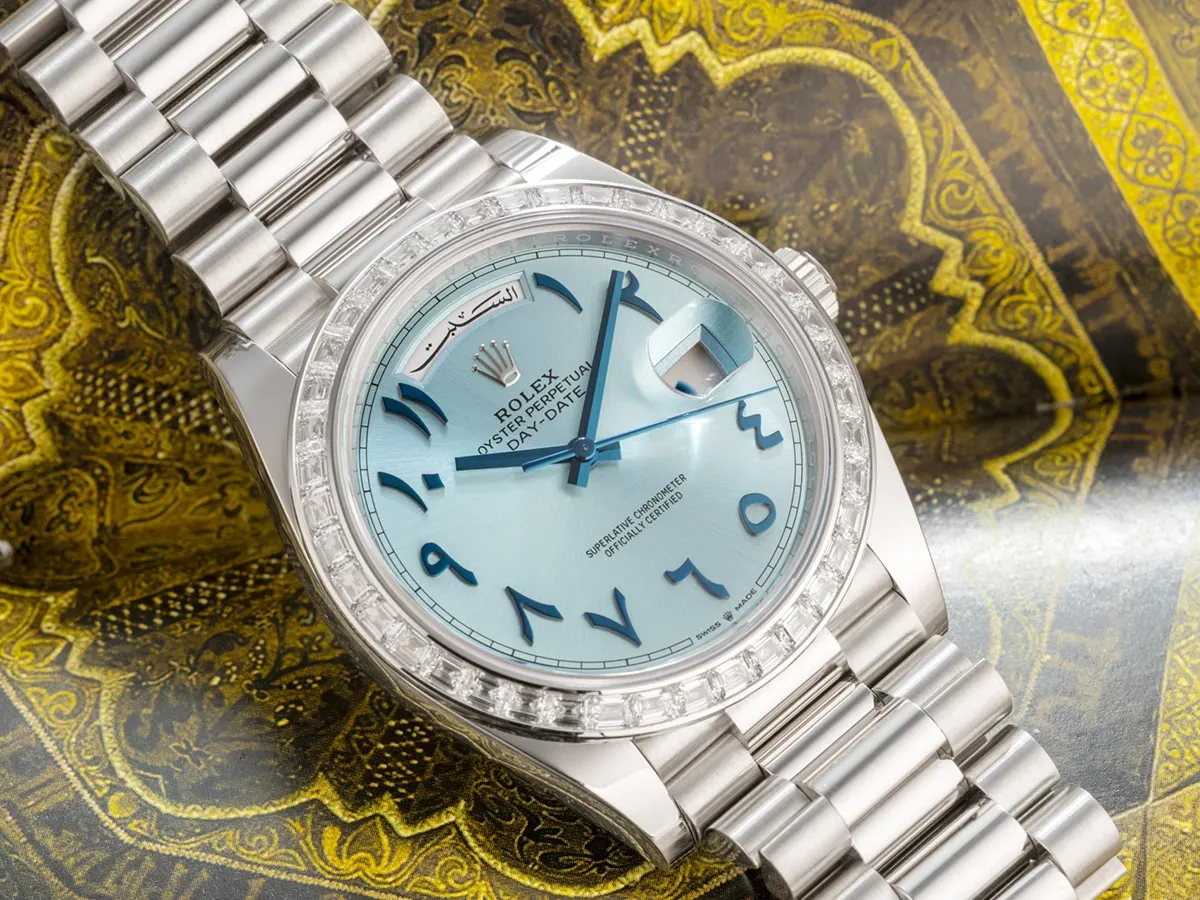
Rolex revived the rolex day date arabic dial at Baselworld 2016. The brand premiered the ice blue dial iteration. The new ref. M228206-0025 Day-Date 40 in platinum paid tribute to vintage models with similar font and alignment.
Limited Distribution Strategy
Distribution remains very limited. The watch is available only at select authorized dealers in Kuwait, Saudi Arabia and the United Arab Emirates.
Notable Rolex Arabic Dial Models and References
Rolex Day-Date 40 Arabic Dial (Reference 228206)
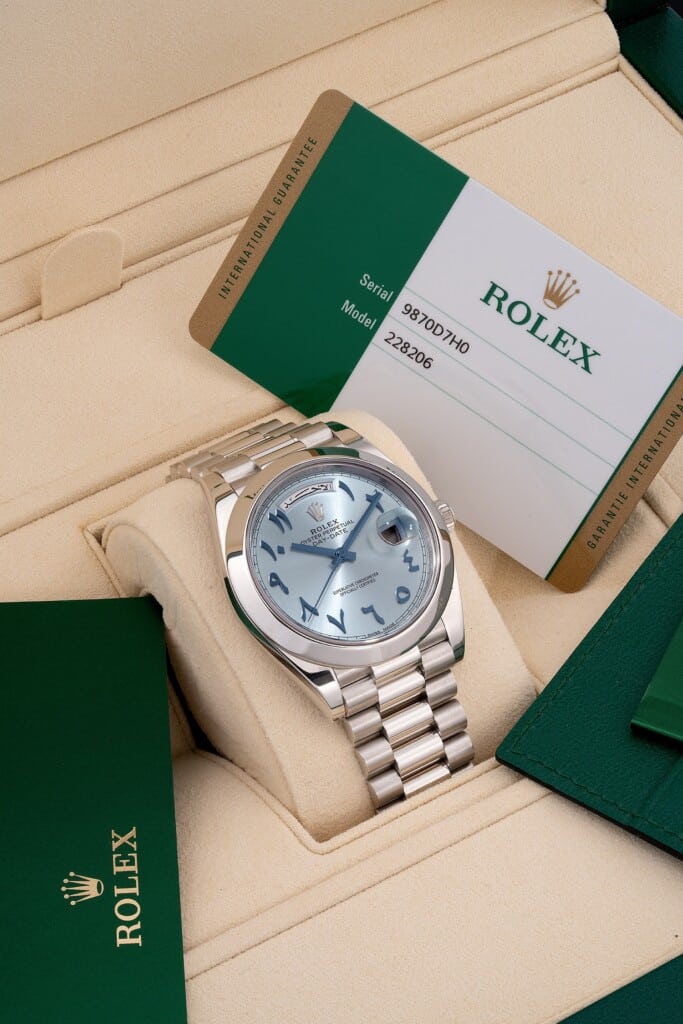
The platinum reference 228206 is probably the most well known modern day rolex day date arabic dial configuration. The 40mm sports 950 platinum with an ice blue sunburst dial exclusive to Rolex platinum day dates. The smooth bezel provides a clean look that lets the watch speak for itself. Large applied Arabic numbers give the watch a modern look. We love how Rolex positions the traditional day display at 12 o’clock and places the date window at 3 o’clock. As usual Rolex includes a Cyclops lens to magnify the date for easy reading.
Rolex Day-Date Arabic Dial in Everose Gold
The Everose gold reference 228235 is another popular configuration of the Day-Date 40. This watch features Everose gold with unique applied Arabic numbers. Previous iterations such as ref. 118206 came available in Arabic as well. If you’re interested in a vintage Arabic dial you should look into ones with Arabic day and date disks. Rolex featured a beautiful rose gold tone with applied Arabic numerals on the President Day-Date ref. 118235.
Vintage Arabic Dial References (1803, 1804, 6611)
Vintage arabic dial watch models command exceptional prices due to their lack. The reference 1804 “Scheherazade” from 1960 remains unique with Arabic day, date, and hour markers in platinum with diamonds. References 1803 and 6611 from the early 1960s laid the foundation to produce Arabic dials.
Rolex Daytona Arabic Dial Variations
The rolex daytona arabic dial variants represent a rare intersection of sporting heritage and cultural refinement. Reference 116509 showcases Arabic numerals against chronograph displays. Reference 116519 incorporates Arabic numerals into precious metal variants. The platinum reference 116506 has an ice blue dial with Arabic numerals.
Rolex Datejust Arabic Dial Options
The rolex datejust arabic dial collection has notable configurations like reference 16233 with a Jubilee band featuring diamonds. A 36mm Datejust variant covered in diamonds represents one of the most opulent pieces Rolex has produced.
Pricing, Availability, and Investment Potential
Current Market Prices for Arabic Dial Models
Pre-owned rolex arabic dial price ranges vary by a lot based on model and condition. Older Datejust models fall between $2,000 to $5,000. Datejust and Oyster Perpetual references with Arabic dials that are well-maintained range from $5,000 to $7,000. Newer Datejust models and select Day-Date references occupy the $7,000 to $10,000 bracket. Modern Datejust 41 and select Daytona models with Arabic dials command $10,000 to $15,000. Precious metal Day-Date and Daytona references sit between $15,000 to $20,000. The most exclusive category has rare Daytona references and precious metal Sky-Dweller models exceeding $20,000. Certain exceptional pieces sell for approximately $100,000 or more.
Why Arabic Dial Watches Command Premium Prices
Rolex produces a limited number of watches with Arabic dials. This creates an exceptional lack of supply. More than that, distribution stays restricted to select authorized dealers in Kuwait, Qatar, Saudi Arabia and the United Arab Emirates. Vintage models with Arabic dials appear at auction rarely and often command high prices. Limited production combined with cultural significance drives sustained collector demand.
Factors Affecting Rolex Arabic Dial Price
Material composition affects value in a direct way. Platinum commands the highest prices, followed by gold and stainless steel. The model and serial number determine rarity and desirability. Condition matters a lot since deep scratches or damage reduce value. Market demand fluctuates based on collector interest and availability. References like the platinum Day-Date 228206 or Everose gold 228235 often trade well above retail depending on dial color and condition.
Where to Buy Authentic Arabic Dial Watches
Authentic rolex watch arabic dial models are available through reputable luxury watch dealers specializing in pre-owned timepieces. Collectors pursuing these valuable references need to verify authenticity through trusted sources.
Conclusion
Investing in a rolex arabic dial is a fantastic opportunity for any watch enthusiast. Not only are they deeply rooted in tradition this watch exudes rarity. Whether you are going after an vintage reference or perhaps a new Day-Date will be a great addition to your collection. Due to their limited availability they will always be in demand. Be sure to do your homework before taking the plunge. Ensure you are buying from a reputable source and know the watches value. You will be sure to enjoy your new Rolex and watch it appreciate with the correct Arabic dial.
Enjoying our watch coverage? Get more of it in Google Search.