Royal Oak Selfwinding is Audemars Piguet’s core collection — the spiritual successor to Gérald Genta’s legendary design from 1972. AP has discretely evolved it twice in the past decade on two different case sizes, with very little changes to the silhouette. The resulting list of reference numbers all look deceptively similar on a watch listing page but represent meaningful changes to movement, proportions, and price.
In this guide I break down Audemars Piguet’s entire modern Selfwinding lineup in one place: every reference, how they differ between generations, and which is right for you. If you’re only interested in comparing two specific references, head to the table for your case size.
How to read the references: the modern time-and-date Royal Oak Selfwinding comes in two main sizes — 41mm (15400 → 15500 → 15510) and 37mm (15450 → 15550). Each size went through a movement upgrade and a dial clean-up around AP’s 50th anniversary (2022).
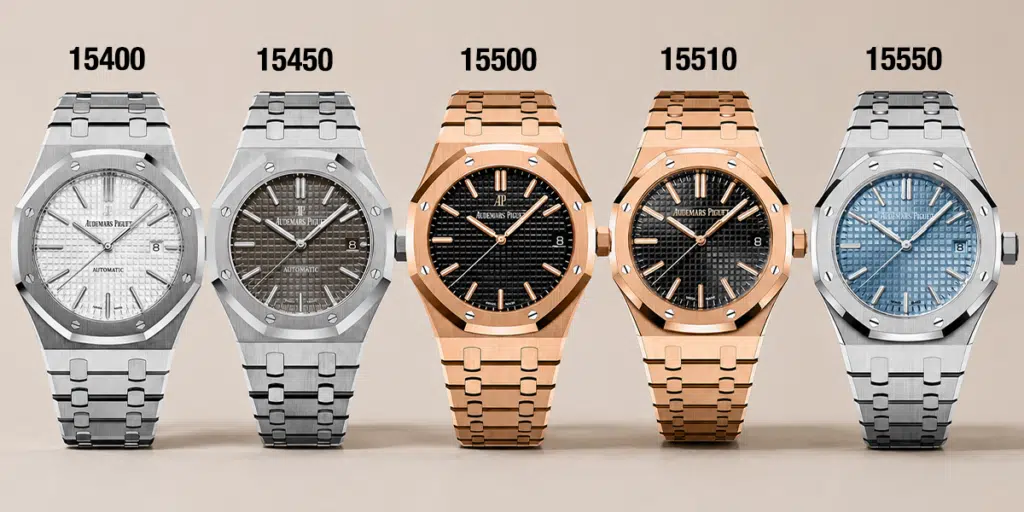
Table of Contents
The 41mm Royal Oak Selfwinding line
| 15400ST | 15500ST | 15510ST | |
|---|---|---|---|
| Image Ref: |

| 
| 
|
| Years | 2012–2017 | 2019–2022 | 2022– |
| Case diameter | 41 mm | 41 mm | 41 mm |
| Case thickness | 9.8 mm | 10.4 mm | 10.4 mm |
| Movement | Cal. 3120 | Cal. 4302 | Cal. 4302 |
| Beat rate | 21,600 vph (3 Hz) | 28,800 vph (4 Hz) | 28,800 vph (4 Hz) |
| Power reserve | 60 h | 70 h | 70 h |
| Parts / jewels | 278 / 40 | 257 / 32 | 257 / 32 |
| Dial text | “Automatic” present | “Automatic” removed | “Audemars Piguet” only (no AP logo) |
| Date window | nearer dial centre, baton marker at 3 | full 3 o’clock position, no baton | full 3 o’clock position |
| Minute track | on the tapisserie | satin-finished outer zone | full-dial Grande Tapisserie, no separate track |
| Bracelet | — | bolder profile | thinner, lighter (Jumbo-like wrist feel) |
Audemars Piguet 15400 vs 15500

15400 → 15500 (the big jump). This is the generational change that matters most. AP retired the long-serving Caliber 3120 for the newer Caliber 4302 (first seen in Code 11.59): the beat rate climbs from 21,600 to 28,800 vph and the power reserve grows from 60 to 70 hours. The trade-off is 0.6 mm of extra thickness (9.8 → 10.4 mm) to house the larger movement. On the dial, AP fixed the detail purists complained about — the date window moved fully to 3 o’clock, eliminating the cramped baton marker — and dropped the “Automatic” text for a cleaner read.
Audemars Piguet 15500 vs 15510
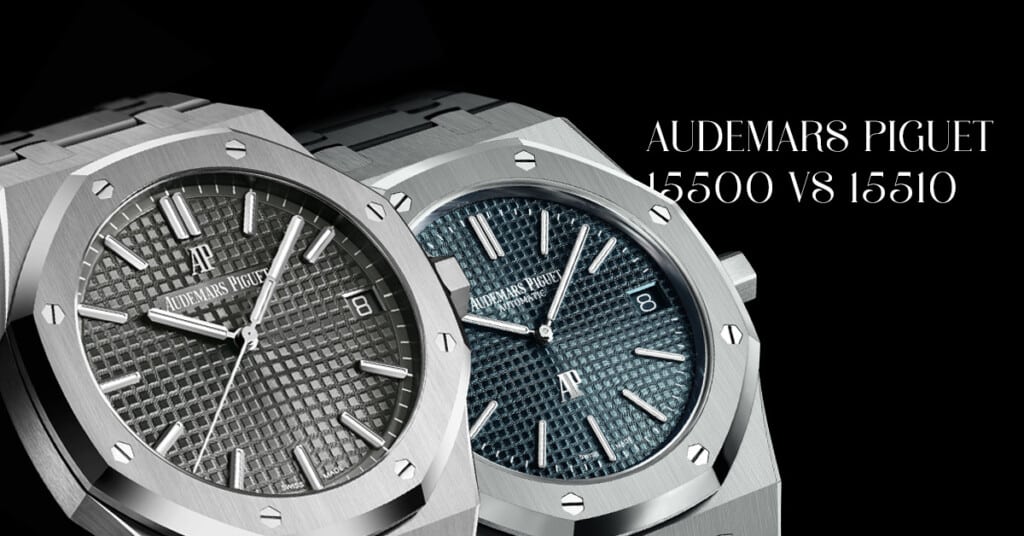
15500 → 15510 (a refinement, not a re-engineering). Same 41mm case, same Caliber 4302, same 70-hour reserve. The changes are proportional: the 15510 carries the Grande Tapisserie pattern across the entire dial (no separate minute track), uses thinner/longer hour markers, drops the “AP” logo in favour of the “Audemars Piguet” wordmark, and — most noticeably on the wrist — runs a slimmer bracelet that makes the watch wear closer to the coveted Royal Oak “Jumbo.” 2022 examples carry a “50 Years” engraving on the rotor, visible through the caseback.
The 37mm Royal Oak Selfwinding line
| 15450ST | 15550ST | |
|---|---|---|
| Image Ref: | 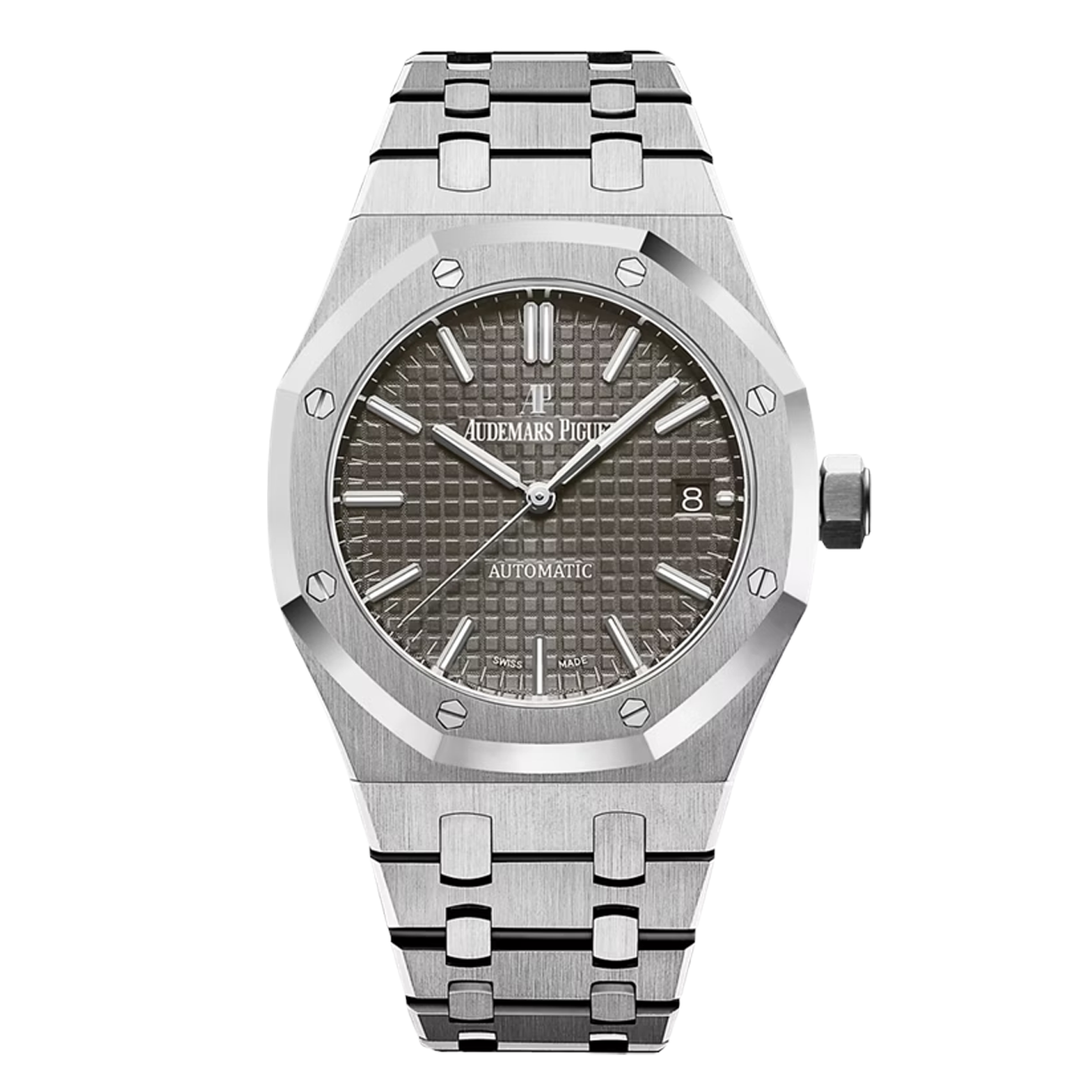
|  |
| Years | (prev. generation) | 2022– |
| Case diameter | 37 mm | 37 mm |
| Case thickness | 9.8 mm | 9.1 mm |
| Movement | Cal. 3120 (4.26 mm) | Cal. 5900 (3.9 mm) |
| Beat rate | 21,600 vph (3 Hz) | 28,800 vph (4 Hz) |
| Power reserve | 60 h | 60 h |
| Parts / jewels | — | 188 / 29 |
| Bracelet | parallel links | trapezoidal first four links (more taper) |
| Dial | printed AP monogram, “Automatic” text | applied gold AP signature, no “Automatic” |
| Retail (steel) | $24,100 | $24,100 |
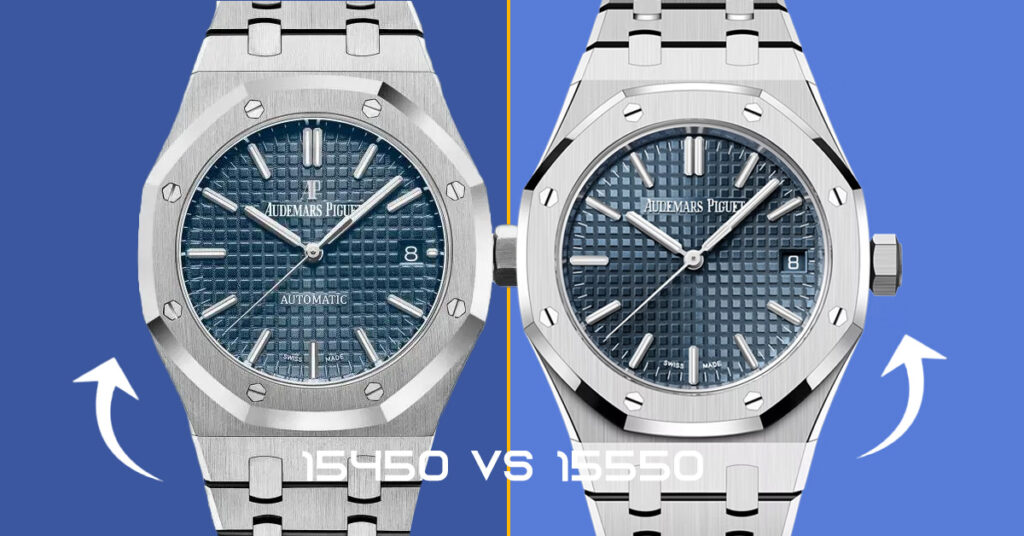
Audemars Piguet 1540 vs 1550
15450 → 15550. The 37mm line got its own movement upgrade — the Caliber 5900 (produced for AP by specialist Vaucher) — running at 4 Hz versus the old 3120’s 3 Hz, while keeping the 60-hour reserve in a thinner 3.9 mm package. That lets the whole watch slim down from 9.8 mm to 9.1 mm. AP also reworked the bracelet (trapezoidal first links for a stronger taper), switched to an applied solid-gold signature, and expanded the colour/material range (steel, pink gold, two-tone, diamond-set; dials including Bleu Nuit Nuage 50, light blue, silver, ruthenium grey, and a pink-gold-only dark green). Retail held at $24,100, which makes the 15550 more watch for the same money.
Which Royal Oak Selfwinding should you buy?
- Want the latest spec and the cleanest dial? The current references — 15510 (41mm) and 15550 (37mm) — give you the faster movements, the refined dials, and the anniversary detailing.
- Prefer a slimmer 41mm and don’t mind the older movement? The 15400 is the thinnest 41mm of the three (9.8 mm) and appeals to collectors who like the “Automatic”-text dial and its status as the first modern 41mm Royal Oak.
- Buying 37mm? The 15550 is the clear pick on specs and value; consider a 15450 only if you find one at a meaningful discount or prefer its dial.
- Bold vs. refined wrist presence (41mm)? The 15500 wears heavier and bolder; the 15510 wears lighter and closer to the Jumbo despite the identical case.

Market notes
Secondary-market prices fluctuate daily, so consider numbers as a guide only and not a recommendation. At the time this was written, the 41mm 15,400 had been hovering around the high-$20,000 mark while the 15,500 hovered around the low-$30,000 mark; 15510 models carried a significant premium over retail due to the anniversary engraving and bracelet adjustment. The 37mm 15450/15550 models retail for $24,100 USD steel. Verify the price with your dealer and confirm reference, year, and box/papers prior to buying.
Frequently asked questions
What’s the biggest difference between the 15400 and 15500?
The movement. The 15500’s Caliber 4302 runs at 28,800 vph with a 70-hour power reserve, versus the 15400’s Caliber 3120 at 21,600 vph and 60 hours. The 15500 is also 0.6 mm thicker and has a cleaner dial (date fully at 3 o’clock, “Automatic” text removed).
Do the 15500 and 15510 use the same movement?
Yes — both use the in-house Caliber 4302 (28,800 vph, 70-hour reserve). The differences between them are the dial layout, hour markers, branding, and bracelet thickness, not the engine.
Why do these references look so similar but cost different amounts?
Generation (movement and dial updates), case size, materials, and current market demand. The anniversary-era references (15510, 15550) tend to command the strongest premiums.
Enjoying our watch coverage? Get more of it in Google Search.