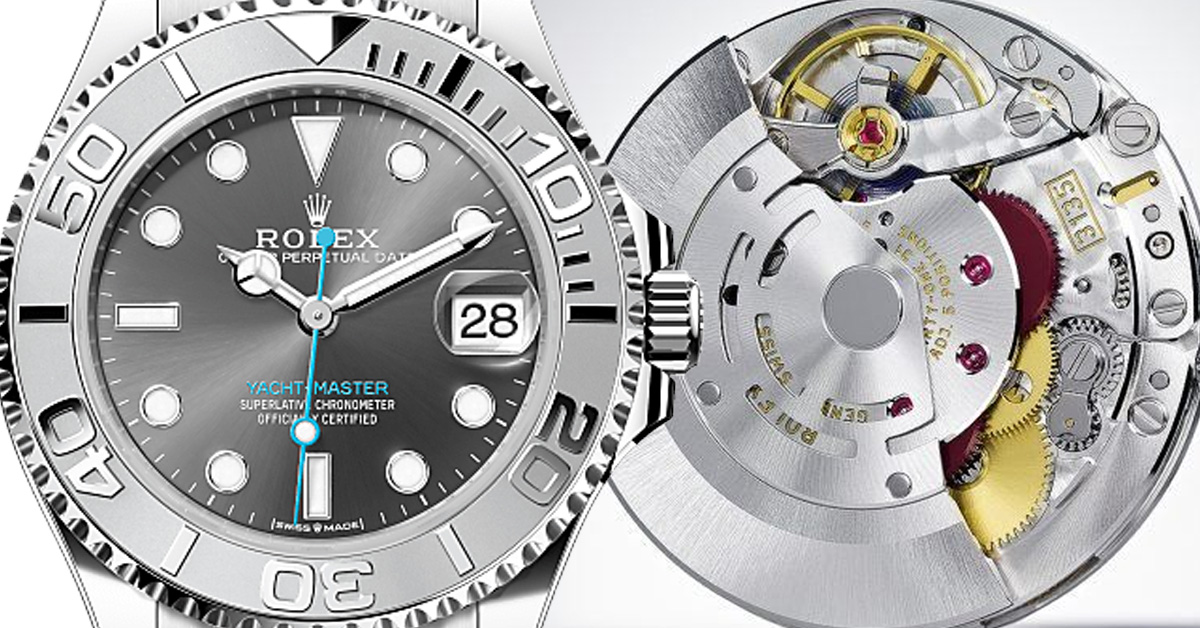
Introduced in 1992, the Yacht-Master was Rolex’s first entirely-new model since the Daytona back in 1964. Since then, two families have made up its modern line: the Rolesium 40mm references (steel-and-platinum 16622 and 11-6622), and the Everose gold 40mm references with ceramic bezel and Oysterflex bracelet (11-6655 and 12-6655). For both families, each successive generation looks near identical on a parts list page, but vary by movement, materials, bracelet, and price.
This guide breaks all four references out in one place. See what changed between generations of each model, and learn how to decide between them. If you already know which two references you’re deciding between, click the table for that family below.
How to read the references: the four references split into two pairs. The Rolesium 40mm line runs 16622 → 116622 (904L steel + 950 platinum). The Everose 40mm line runs 116655 → 126655 (18k Everose gold, matte black Cerachrom bezel, Oysterflex bracelet). Each pair represents one generational step.
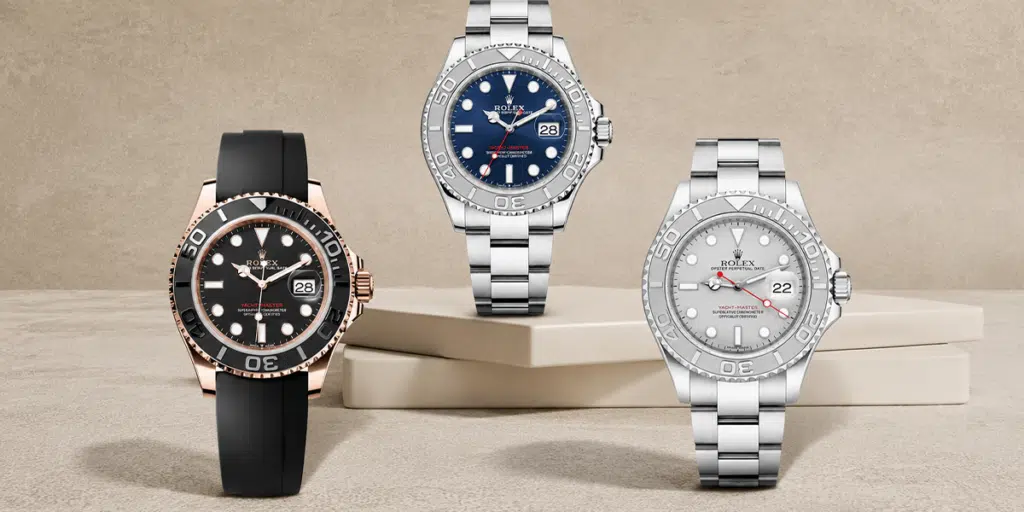
Table of Contents
At-a-glance: all four references
| 16622 | 116622 | 116655 | 126655 | |
|---|---|---|---|---|
| Image Ref |

|

|

|

|
| Family | Rolesium | Rolesium | Everose | Everose |
| Release year | 1999 | 2012 [baselworld] | 2015 | 2019 |
| Case diameter | 40 mm | 40 mm | 40 mm | 40 mm |
| Case thickness | ~11.5 mm | ~11.5 mm | 11.5 mm | 11.5 mm |
| Case material | Rolesium (904L steel + 950 platinum) | Rolesium (904L steel + 950 platinum) | 18k Everose gold | 18k Everose gold |
| Bezel | Sandblasted platinum, raised glossy numerals, tension-spring action | Platinum, ratcheted action with secure locking | Matte black Cerachrom, raised numerals | Matte black Cerachrom, raised numerals |
| Movement | Caliber 3135 | Caliber 3135 (w/ Parachrom hairspring) | Caliber 3135 (w/ Parachrom hairspring) | Caliber 3235 |
| Power reserve | 48 h | 48 h | 48 h | 70 h |
| Bracelet | Hollow center links | Solid center links | Oysterflex (titanium-nickel core) | Oysterflex (titanium-nickel core) |
| Clasp | Standard clasp | Oysterlock w/ 5mm Easylink | Oysterlock w/ 5mm Easylink | Oysterlock w/ Glidelock (up to 15mm) |
| Lume | Super-LumiNova | Chromalight (blue glow) | Chromalight | Chromalight |
| Water resistance | 100 m / 330 ft | 100 m / 330 ft | 100 m / 330 ft | 100 m / 330 ft |
| Status | Discontinued | Discontinued | Discontinued (2019) | Current production |
| Market (secondary) | ~$8,590 | ~$11,479 | premium / collector | ~$26,629 (retail ~$33,000) |
The Rolesium 40mm line (16622 → 116622)
Introduced on the 16622 in 1999, Rolesium is Rolex’s patented blend of 904L stainless steel and 950 platinum — it gives both watches their signature look and their extra weight relative to all-steel sports models. Both share the 40mm case and run the Caliber 3135, Rolex’s self-winding workhorse since 1988 (28,800 vph, 31 jewels, Microstella regulation, 48-hour reserve, Superlative Chronometer certification).
16622 → 116622 (the upgrade that matters). The 116622 introduced Rolex’s paramagnetic blue Parachrom hairspring — absent on the 16622 — for better resistance to magnetic fields and improved stability across temperature changes. Visually and structurally:
- Bezel. The 16622’s sandblasted platinum bezel uses a standard tension-spring mechanism; the 116622 moves to a ratcheted action that locks firmly.
- Dial. Early 16622 dials (pre-2007 especially) have a coarse-grain texture in a darker gray that collectors prize for its depth and sparkle. The 116622 adopts an ultra-fine, lighter, more understated finish, plus the Maxi dial (larger markers, wider hands) and a switch from Super-LumiNova to Chromalight (blue glow vs. the older green).
- Bracelet. The 116622 replaced hollow center links with solid center links, added the Oysterlock clasp with 5mm Easylink extension, and gave it end links that sit flush with the case (the 16622’s extend past the lugs).
- Wrist feel. The 16622 wears thinner and dressier; the 116622’s solid construction gives it more presence and a sportier character.
The 116622 inherited Rolex’s tightened Superlative Chronometer standard introduced in 2015 (–2/+2 seconds per day).
The Everose 40mm line (116655 → 126655)
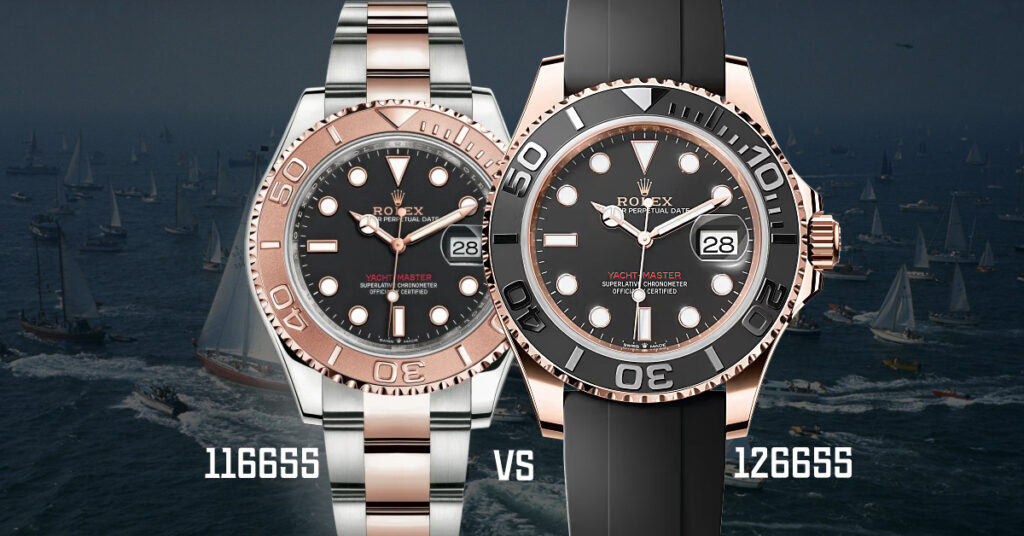
The 116655 launched in 2015 as a milestone: the first Yacht-Master with both the Oysterflex bracelet and a matte black ceramic (Cerachrom) bezel. Both Everose references share an 18k Everose gold case (Rolex’s gold-copper-platinum blend that resists fading), 40mm × 11.5mm, with the Oyster monobloc middle case, screw-down case back, and Triplock system rated to 100m.
Both share the same defining design: matte black Cerachrom bezel with high-polish raised numerals against a sandblasted background, bidirectional 60-minute graduated; a matte black dial with red “Yacht-Master” text at 6 o’clock; Chromalight display; and the Oysterflex bracelet (flexible titanium-nickel alloy blade core sheathed in black elastomer, with an internal longitudinal cushion system).
116655 → 126655 (a movement generation). The single biggest change is the engine. The 116655 uses the Caliber 3135 (with Parachrom hairspring); the 126655 moves to the next-generation Caliber 3235 — over 90% new components, 14 patents — bringing:
- Power reserve up from 48 to 70 hours.
- The Chronergy escapement (pierced escape wheel, ~15% efficiency gain).
- A redesigned barrel with thinner walls and a longer mainspring, and Paraflex shock absorbers replacing the older KIF system.
The other meaningful upgrade is the clasp: the 116655’s 5mm Easylink gives way to the 126655’s Glidelock system, allowing tool-free micro-adjustment up to 15mm in 2.5mm steps. Neither Oysterflex can be sized by adding or removing links — Rolex supplies different strap sizes at purchase — so the Glidelock notably improves on-the-fly fit.
Which Yacht-Master should you buy?
- Want the latest spec and longest power reserve? The 126655 (Everose) is the only one of the four with the Caliber 3235 and 70-hour reserve, plus the Glidelock clasp. It is the current-production model.
- Want the Everose look with collector upside? The discontinued 116655 is the pioneer — first Yacht-Master with Oysterflex and a ceramic bezel — and is often viewed as the more collectible of the Everose pair despite the older movement.
- Want the steel-and-platinum Rolesium look, dressier and thinner? The 16622 wears slimmer and more formally; pre-2007 examples with the coarse-grain platinum dial have a cult following and remain one of the few Rolex sports watches available under ~$10,000.
- Want Rolesium with the modern refinements? The 116622 adds the Parachrom hairspring, solid center links, Oysterlock/Easylink clasp, Maxi dial, and Chromalight — a sportier, more substantial wrist presence.
Market notes
Prices in the secondary market fluctuate daily. Consider this as indicative pricing, not financial guidance. (This was linked to when the original article was written, but as of now: the 16622 is around $8,590 ($5,000 starting retail, reached upward of ~$12,000 during COVID-era craziness, and now hovers around $10,000), the 116622 is around $11,479, and the 126655 is around $26,629 or about 19.3% off its retail price of ~$33,000. The 116655 has been discontinued for some time and can often fetch a collector premium.) Between all four models, having the original box and papers can net you another 10–20% on top of that. As always, verify the price with the seller and double check that you have the correct reference/year and box/papers before buying.
Frequently asked questions
What’s the biggest difference between the 16622 and 116622?
The 116622 adds Rolex’s paramagnetic blue Parachrom hairspring (the 16622 lacks it), plus solid center links, the Oysterlock clasp with Easylink, the Maxi dial, and Chromalight lume. Both use the Caliber 3135 with a 48-hour reserve. The 16622 wears thinner and dressier; the 116622 wears more substantial.
What’s the biggest difference between the 116655 and 126655?
The movement. The 126655’s Caliber 3235 delivers a 70-hour power reserve versus 48 hours for the 116655’s Caliber 3135, and adds the Chronergy escapement and Paraflex shock absorbers. The 126655 also upgrades to the Glidelock clasp (up to 15mm of tool-free micro-adjustment) versus the 116655’s 5mm Easylink.
Are the two Everose models visually different?
Barely. Both have the 40mm Everose gold case, matte black Cerachrom bezel with raised numerals, and black Oysterflex bracelet. The most visible difference is the clasp.
Which references are more collectible?
The discontinued ones tend to draw collector interest: pre-2007 16622 dials for their coarse-grain platinum character, and the 116655 as the first Yacht-Master to combine the Oysterflex bracelet with a ceramic bezel.
Why do these references look so similar but cost different amounts?
Generation (movement and dial updates), case material (Rolesium vs. Everose gold), production status, and current demand. The Everose references cost substantially more than the Rolesium pair because of the solid 18k gold case.
Enjoying our watch coverage? Get more of it in Google Search.