Select a Shape
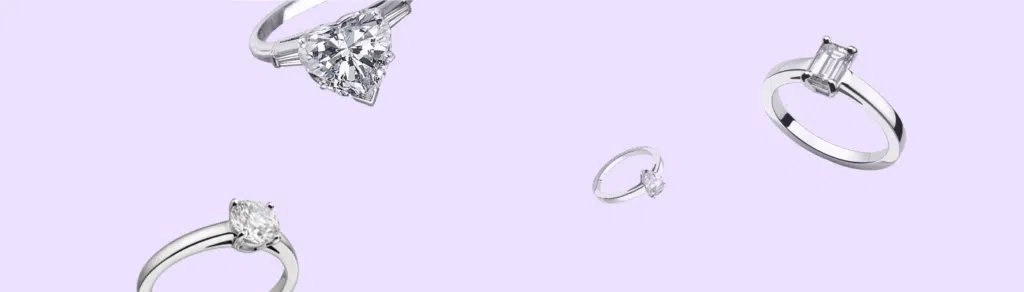
Selecting the right shape should be your first and foremost priority when looking at the variety of diamonds. Take a sneak peek at the various shapes available including emerald, princes and oval cuts.
Round Diamonds
Choosing the shape may be the first priority for everyone when selecting a diamond, but it can become a nightmare for many who find the previous design as good as the next one. To make the decision a little easier, it is stated that round diamonds are the most chosen diamonds and accumulate 3/4 of all diamond purchases. Their fame is mainly attributed to their awesome sparkle, fiery complexion and incredible brilliance.
Fancy Shapes
Next to round diamonds in terms of popularity are Princess diamonds. These are extremely beautiful diamonds and pack a delicate & elegant look. Their geometric isometry makes them an excellent choice next to round brilliant diamonds.
Cushion diamonds are best for those who have a nostalgic relation with vintage era diamonds. The diamonds are radiant and offer a stunning alternative to cushion and princes diamonds for people more attached to the rectangular shape.
Emerald and Asscher diamonds have a unique property, i.e. step-cut.
This makes them all the more, sleek yet attractive. The diamonds are less radiant and fiery but in retrospect, more transparent.
There are a few shapes that have been specifically designed to form a visual illusion. These include oval, marquise and pear-shaped diamonds which have an elongated appearance to make one’s fingers look longer.
For romantics on the extreme scale, there are heart shaped diamonds which express one’s emotions as clear as possible.
Taking the world of commerce in account, it has been found that choosing a non-round diamond variant will save you up to 40%! For inquiries about more shapes such as baguettes, trillions and half-moons, contact us.

Round

Cushion

Emerald

Assher

Marquise

Pearl

Oval

Heart
Choose a Size
After selecting the diamond’s shape, the final decision rests upon two parameters:
- Size of the gem
- Quality
Budget is one of the most influential factor in the world, no matter what you’re buying. Mapping out as to how much you can spend is the best way to determine these parameters. Your final choice should strike a balance between quality and size.
Start off with size for instance. Size is greatly important as for most people, “bigger is better”.
The carat will serve perfectly in helping you select the proper size even though it is a unit of weight. Taking the face-up measurements in account is also a great way to be sure of the size you’re after.
Learn About Quality
Cut
When choosing a round brilliant diamond, the most vital characteristic of all is the “cut”. This is what determines the level of fire, brilliance and gleam, the diamond will ultimately have. If the cut or make of the diamond is substandard then it will lose all its life and luminosity. Round brilliant diamonds usually have their cuts graded by international labs which means there’s very little chance you’ll get ripped off.
For diamonds other than round shaped ones, the cuts are much more established. Round brilliant diamonds are best as engagement rings as their cut grade is very much ideal, given the diamond is certified. A high cut grade is the best way to make the most out of a diamond and enhance its beauty.
These are the cuts available:
1. Fair
These diamonds reflect a partial amount of light while the main focus is on their weight.
2. Good
This is the premium quality of cuts that strikes a balance between the size and quality, reflecting more light compared to the fair cut.
3. Very Good
This is a higher quality cut that can reflect almost as much light as an ideal cut, but for a lower price tag.
4. Ideal
Combining fire, brilliance and weight at the same time, this is an exquisite cut that absorbs minimal amount of light, reflecting most of it.
5. Super Ideal
The highest standard possible, the Super Ideal cut is stated as “excellent” or “ideal” on diamond certificates. The diamonds also have a “hearts and arrows” pattern and are the most desirable ones, reflecting maximum possible light.
Color
Next up is the color of the diamond that decides its worth. This is a flexible property as people tend to have varying sense of sight. However, majority of people prefer a colorless diamond, or at least one that is closest to the white color. The F-11 color & clarity is the most chosen one for engagement rings.
- J – color can be detected, slightly.
- I – very slightly detectable color.
- H – near colorless compared to previous grades.
- G – color noticeable compared to higher grades.
- F – color can only be detected by a gemologist.
- E – colorless, with minute specs.
- D – the most expensive and rare grade. This is completely colorless or in other words, icy white.
Clarity
This property is evaluated at the very end as it has a very little influence over the appearance of a diamond. They have a separate standard of grading. Diamonds labelled Sl2 or Sl1 have very few irregularities, and even if there is one visible from the naked eye, we will personally contact you. The VS2 and Sl1 standard is the most common one, especially as an engagement ring but in search of greater clarity, many customers tend to look towards IF and VVS grades.
- Sl2 – also known as slightly included 2, the irregularities are visible when put under a microscope or looked at with great attention.
- Sl1 – also known as slightly included 1, the inclusions are very hard to notice with the naked eye.
- VS2 – also known as very slightly included 2, the inclusions cannot be seen with the naked eye.
- VS1 – also known as very slightly included 1, the inclusions are hard to see under 10x magnification.
- VVS2 – very very slightly included 2, the inclusions are almost invisible.
- VVS1 – very very slightly included 1, the grade is an upped version of VVS2.
- IF – internally flawless, i.e. there is no detectable flaw.
- FL – completely flawless, extremely rare and also very expensive.

The Four Cs
Cut
You may be tempted to believe that “cut” means the way a diamond has been molded into a shape, etc. but in reality, cut means the balance of proportion, polish and symmetry that has been obtained by the cutter of the raw diamond. A diamond’s cut is something that has a great influence over its visual quality and is a direct marker of its beauty. If a diamond isn’t cut properly then it won’t reflect light properly which will majorly impact its beauty. Diamond cutters have established a few major factors that control the way light is reflected & refracted. Understanding these will help you make a better choice when selecting a diamond ring.
A total of 3 different reflections make up a diamond’s cut grade.
Brilliance
Also called brightness by many diamond cutters, the brilliance is the amount of white light that gets reflected from the diamond. Light enters a diamond from the top and gets broken down into different wavelengths. It is then reflected back and forth within the diamond and makes its way out through the table in the form of white light.
Dispersion
The rainbow of colors reflected to the observer is called dispersion. In a diamond, light enters from the top and gets broken down into its constituent colors. After bouncing back and forth from facets within the diamond it makes its way out of the crown. It never combines which means specks of colors are seen, known as dispersion.
Scintillation
This is the charade that light puts up as the diamond is moved at an angle. Sparkling is the most common phenomenon associated with this movement. All diamonds are analyzed and graded on their abilities to reflect & refract light.
Cut is the most significant characteristic of a diamond. You can imagine its resourcefulness by the size of a well-cut diamond. A diamond that is well-cut will appear bigger while a substandard cut will make it appear smaller, even than its carat weight. In addition, a well-cut diamond has a much more pleasing color and clarity associated to it.
The quality of a diamond’s cut is calculated by evaluating the polish, symmetry and proportionality of the diamond; on top of this, a perfect balance between these three qualities is absolutely necessary. There are many proportion factors that drastically change the diamond’s ability to reflect & refract light. A diamond’s table size as well as its depth changes the amount of light that returns from it.
A diamond that is well cut has been proportioned so that the maximum amount of light that enters, makes its way back to the top. As a result, the brilliance and dispersion are perfectly balanced. On the other hand, a poorly cut diamond that has facets cut at irregular angles will have light leaving it from unexpected places. This not only reduces brightness but actively adds a gloomy feeling to the diamond as light is supposed to get out of the top of the stone.
Striking a balance however isn’t easy so diamond cutters tend not to deviate from the tested grades in order to make best cut diamonds. The grading scale is based on the properties of reflection and require very accurate calculations. Simply looking at the grade will tell you the whole story instead of looking for each and every property.
1. Fair
These diamonds reflect a partial amount of light while the main focus is on their weight.
2. Good
This is the premium quality of cuts that strikes a balance between the size and quality, reflecting more light compared to the fair cut.
3. Very Good
This is a higher quality cut that can reflect almost as much light as an ideal cut, but for a lower price tag.
4. Ideal
Combining fire, brilliance and weight at the same time, this is an exquisite cut that absorbs minimal amount of light, reflecting most of it.
5. Super Ideal
The highest standard possible, the Super Ideal cut is stated as “excellent” or “ideal” on diamond certificates. The diamonds also have a “hearts and arrows” pattern and are the most desirable ones, reflecting maximum possible light.
Diamond Characteristics
Crown
Starting from the girdle, ending all the way up to the table, this is called the top of the diamond.
Pavilion
The lower portion, which starts from the girdle and ends at the culet.
Culet
This is the facet at the bottom of the pavilion.
Girdle
This is the narrow rim at the widest part and acts as a barrier between the crown and the pavilion. When a diamond is used in jewelry, the girdle is called the setting edge.
Depth
The total height from the culet to the table. The depth is expressed as a percentage with respect to the diameter of the diamond.
Color
As you may know by now, diamond reflects specks or flash of colors as white light splits inside it. The color of a diamond however is something entirely different. Color is something that a diamond holds right from the mine. Most diamonds are of brown, yellow or gray color. The root cause of such colors is varying percentage of nitrogen within the diamond that exists within the earth’s crust. The more transparent a diamond, the more expensive it is. Color is next to cut in terms of value and is very vital, given its visible nature.
Diamonds that are near-transparent allow more light to pass and are thus more brilliant.
Think of a diamond as a prism that splits up light into several shades and reflects these shades in the form of flashes. Just as colored glass has diminished ability to reflect a colorful spectrum, a diamond’s ability to reflect the spectrum is also dependent on its transparency.
A diamond of a higher color grade, i.e. more transparent will have a more powerful fire.
There is an international color scale that governs the transparency of a diamond. The scale begins with a D for colorless and makes its way down to Y, with D being the whitest and Y begin light yellow or brown in color.
- D – called “icy white”, a diamond of D color grade is absolutely colorless and very rare.
- E – minute traces of color are detectable by a gemologist.
- F – also colorless but can be detected by an expert.
- G – H – almost colorless, diamonds within this range have a color that is noticeable.
- I – J – color is more detectable compared to G – H grades.
- K – Y – the color is obvious, e.g. light yellow or brown.
Clarity
Clarity means the amount of cleanliness that can be attributed to a diamond. A diamond has a multitude of microscopic particles that can affect its appearance. These particles can get impact the diamond while it is nurturing. Characteristics limited to the inside are called inclusions while irregularities on the outside are called blemishes.
Examples of inclusions are foreign materials, cracks, or whitish marks. Quite often, inclusions are absorbed within the diamond, however there are some that remain till the very end and their orientation, location and color very much effect the diamond’s quality.
Diamonds that are certified of holding absolutely no inclusions are extremely rare and hold a high value.
Gemologists inspect diamonds for clarity under 10x magnified vision and analyze it while its face up. If an inclusion is not visible, then the diamond cannot be used as a standard for the clarity grade. Gemologists use hand held magnifying glasses to determine the magnitude and position of these inclusions.
Graders often build diamond plots to mark the exact locations of inclusions under 10x magnification. The plots can be thought of as maps which tell the reader exactly where the diamond lacks clarity. It is a well-established fact that no two diamonds have the same internal plot, just as everyone’s fingerprints are unique.
The clarity grades are as follows:
- Sl2 – also known as slightly included 2, the irregularities are visible when put under a microscope or looked at with great attention.
- Sl1 – also known as slightly included 1, the inclusions are very hard to notice with the naked eye.
- VS2 – also known as very slightly included 2, the inclusions cannot be seen with the naked eye.
- VS1 – also known as very slightly included 1, the inclusions are hard to see under 10x magnification.
- VVS2 – very very slightly included 2, the inclusions are almost invisible.
- VVS1 – very very slightly included 1, the grade is an upped version of VVS2.
- IF – internally flawless, i.e. there is no detectable flaw.
- FL – completely flawless, extremely rare and also very expensive.
Carat
Carat or ct. is unit for weight measurement and is limited to use in gems & diamonds. Carat is often thought of as something that has to do with the size of the gem whereas it is just for weight measurement. The weight varies depending on the type and shape of the gemstone. For instance, a 1 carat round diamond is different from a 1 carat round sapphire as they have different measurements, 6.5mm and 6.0mm, respectively. The reason behind this change is simple: varying densities.
Once grades for color, cut and clarity have been found, the weight of the diamond in carats can be devised to fit within a certain price range. As the diamond’s largeness increases, so does its rarity, which is why they are much more expensive then smaller diamonds, if the prices are compared on the basis of linearity. A 1 carat diamond will have a larger price tag compared to 2x, 0.5 carat diamonds. A general rule for diamonds is that a diamond costs for 4 times more as its weight doubles.
There is also a cutoff weight and if a diamond exists below this line then it’s called an “under-sized” diamond. These diamonds have a greater value as well. These diamonds are also a rarity in nature and it’s very difficult for the diamond cutter to strike a balance between beauty and weight. The cutoff weights are also called “magic number”, and include 0.5, 0.75, 0.9, 1.0, 1.5 & 2.0 carats.
There’s also another phrase, known as total carat weight, which is the sum of individual weights of all diamonds or gemstones when jewelry is being designed. Examples of jewelry where total carat weight is used include diamond solitaire earrings.
Certification
We go to unprecedented lengths to make sure our diamonds are certified for their features and origin.
An independent gemology lab is employed to get a comprehensive diamond grading report that gives us the complete picture from A-Z regarding a diamond. Gemologists have special equipment that can accurately determine the clarity, cut and color of the diamond. Feel free to contact us any time for an e-copy of our diamonds’ grading reports.

Enjoying our watch coverage? Get more of it in Google Search.