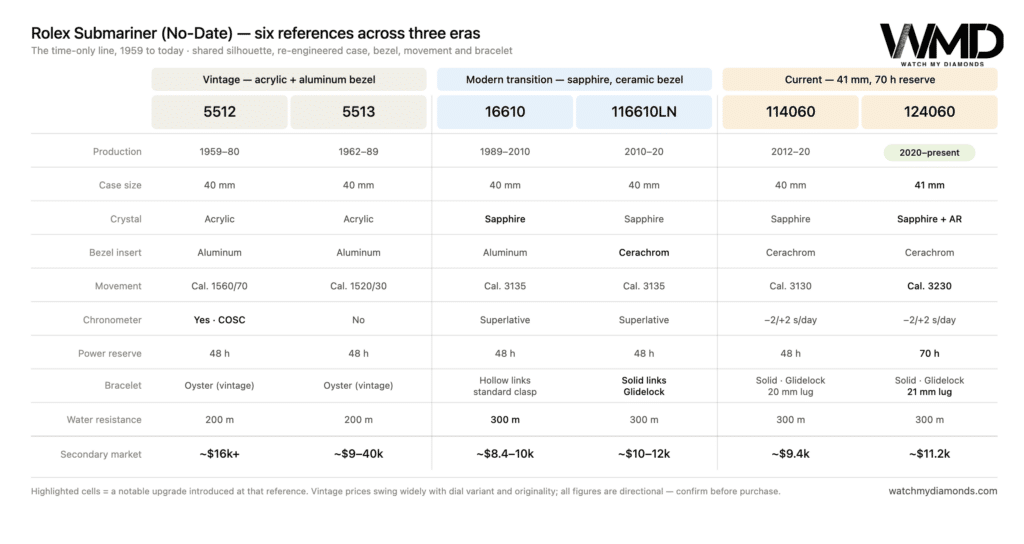
The Submariner is Rolex’s most recognizable tool watch, and the time-only (no-date) line traces a straight evolutionary path from the late-1950s vintage references to today’s current model. Across six decades the silhouette barely changed, but the case profile, bezel material, movement, and bracelet were re-engineered several times. The result is a set of reference numbers that look almost identical in a listing photo yet differ meaningfully in materials, mechanics, proportions, and price.
This guide maps the no-date Submariner line in one place — vintage, the modern transitions, and the current model — so you can see what actually changed between any two references and choose accordingly. If you’re comparing two specific references, jump to the table and then to that pairing’s section.
How to read the references: the no-date Submariner runs vintage 5512 / 5513 (1959–1989, acrylic crystal, aluminum bezel) → the neo-vintage/modern transition 16610 → 116610LN (aluminum to ceramic, 40mm) → the current 114060 → 124060 (40mm to 41mm, Caliber 3230). Date and “Hulk/Kermit/Starbucks” colorway questions are covered separately — see the internal-link notes below.
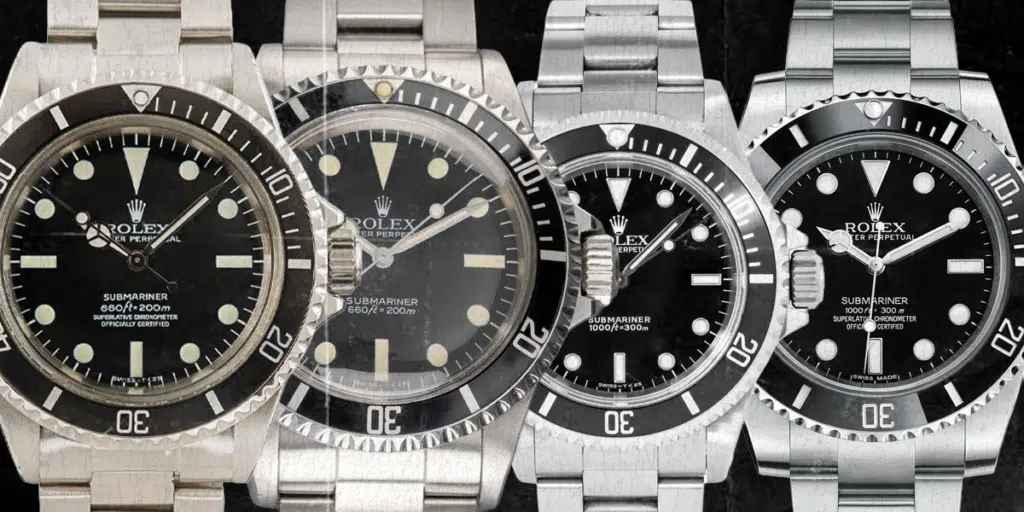
Table of Contents
At-a-glance: the no-date Submariner across generations
| 5512 | 5513 | 16610 | 116610LN | 114060 | 124060 | |
|---|---|---|---|---|---|---|
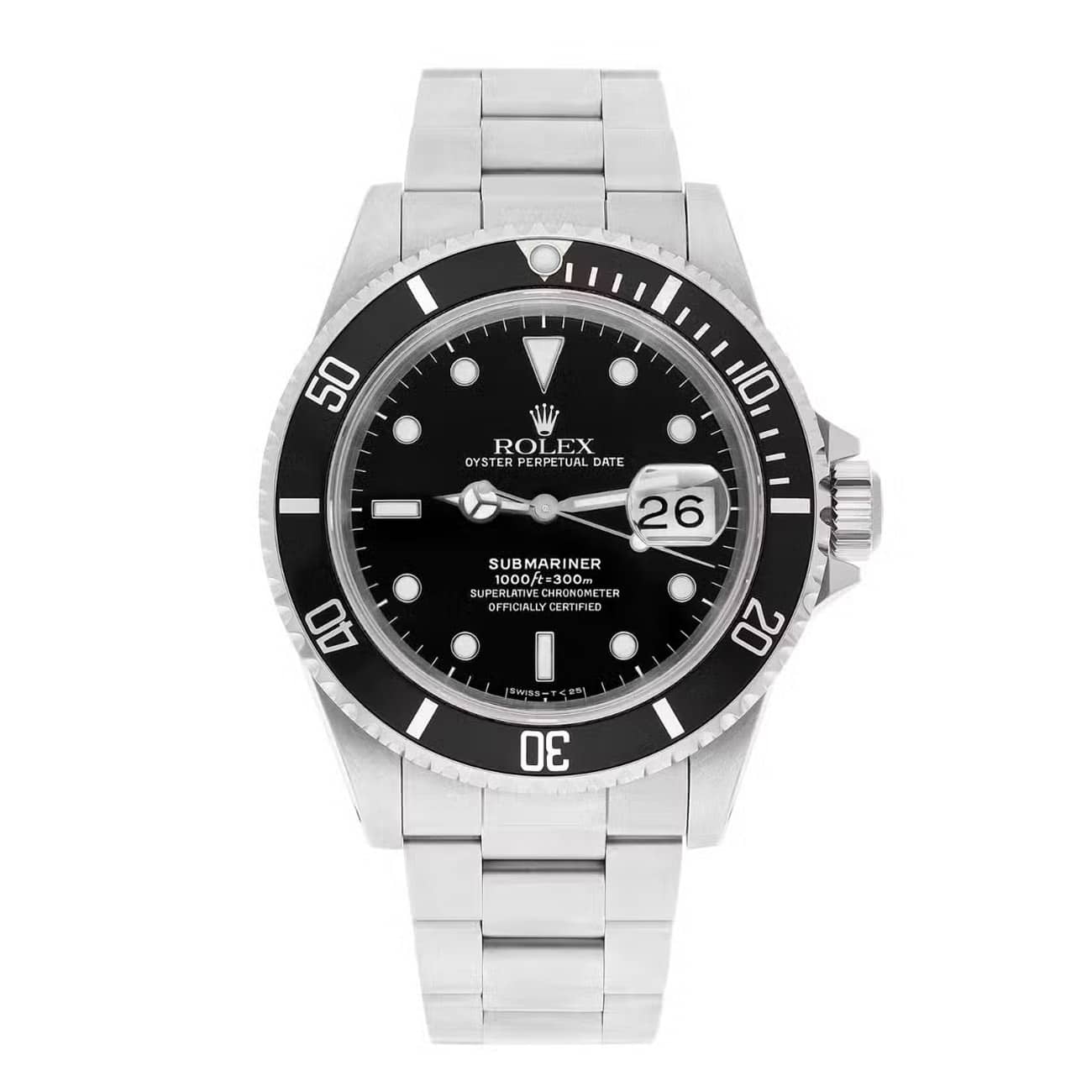
| Image Ref: |

|
| 
| 
|  | |
| Era | Vintage | Vintage | Neo-vintage | Modern transition | Previous current | Current |
| Production | 1959–1980 | 1962–1989 | 1989–2010 | 2010–2020 | 2012–2020 | 2020–present |
| Case diameter | 40 mm | 40 mm | 40 mm | 40 mm (“Super Case”) | 40 mm (40.2 mm actual) | 41 mm (40.6 mm actual) |
| Thickness | ~14 mm | ~14 mm | 12.7 mm | 12.5 to 13 mm | ~12.5 mm | ~12.5 mm |
| Lug-to-lug | 47 mm | 47 mm | 47 mm | 48 mm | 48 mm | 48 mm |
| Crystal | Acrylic | Acrylic | Sapphire | Sapphire | Sapphire | Sapphire + inner AR coating |
| Bezel insert | Aluminum | Aluminum | Aluminum | Cerachrom (ceramic) | Cerachrom | Cerachrom |
| Bezel mechanism | Bidirectional | — | Single click-spring | Four click-springs | — | — |
| Movement | Cal. 1530 / 1560 / 1570 | Cal. 1530 / 1520 | Cal. 3135 | Cal. 3135 + Parachrom Bleu | Cal. 3130 | Cal. 3230 |
| Chronometer cert. | Yes (COSC, after 1962) | No | Superlative Chronometer | Superlative Chronometer | Superlative Chronometer (−2/+2 s/day) | Superlative Chronometer (−2/+2 s/day) |
| Beat rate | 19,800 vph (2.75 Hz) | 19,800 vph (2.75 Hz) | 28,800 vph (4 Hz) | 28,800 vph (4 Hz) | 28,800 vph (4 Hz) | 28,800 vph (4 Hz) |
| Power reserve | 48 h | 48 h | 48 h | 48 h | 48 h | 70 h |
| Bracelet | Oyster (vintage) | Oyster (vintage) | Hollow center links, standard clasp | Solid links, Glidelock | Solid links, Glidelock, 20 mm lug | Solid links, Glidelock, 21 mm lug |
| Dial / lume | Gilt → matte; tritium | Two-line; tritium | Classic → Maxi; Super-LumiNova | Maxi; Chromalight | Maxi dial; Chromalight | Refined indices; Chromalight |
| Water resistance | 200 m | 200 m | 300 m | 300 m | 300 m | 300 m |
Vintage no-date: 5512 vs 5513
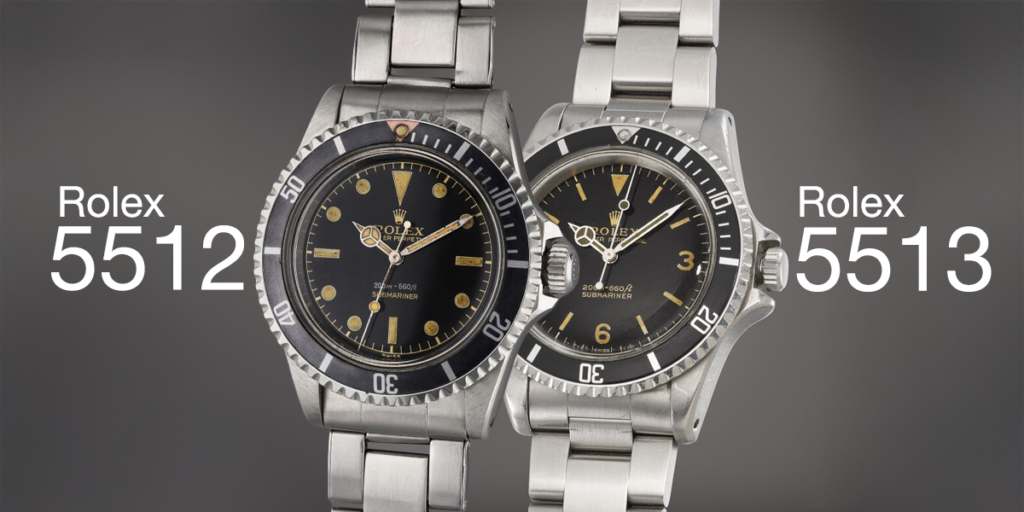
The 5512 and 5513 look nearly identical and ran side by side for almost two decades, but the defining difference is chronometer certification. The 5512 carried COSC-certified movements; the 5513 never did and served as the more economical alternative. That distinction shaped both the dial text and the price gap that persists today.
Dial text. Chronometer certification gave the 5512 the extra two lines — “Superlative Chronometer Officially Certified” — for a four-line dial (early 5512s were two-line before certification). The 5513 kept a two-line dial (“Submariner” plus the depth rating) throughout its run.
Movements. The earliest 5512 used the non-chronometer Caliber 1530, then the chronometer-rated Caliber 1560 (to 1965) and Caliber 1570 (1965–1980), with hacking seconds added to the 1570 in 1972. The 5513 ran Caliber 1530 and later Caliber 1520, both non-chronometer throughout.
Shared case. Both measure 40 mm diameter, 47 mm lug-to-lug, ~14 mm thick, with acrylic crystals and 200 m water resistance (dials read “200m=660ft,” later reversed to “660ft=200m” around 1969/70 for the US market). The 5512 introduced crown guards to the Submariner in 1959 — the first Rolex with the feature — evolving from square (~100 known) to “eagle beak” (<30 known, 1959–63 pointed) to rounded (1963–1980). The 5512 also used a larger 7 mm crown.
Collectible dial variants. 5512 dials moved from gilt (1959–1966) to matte black (1967–1980); gilt dials carry premiums for their shorter run and reflective look. “Meters first” (200m=660ft) matte dials predate “feet first.” The rare Mk. 3 Maxi dial and even rarer Explorer-dial 5512s (mostly UK market) are top-tier collectibles. The 5513’s notable exception is the MilSub — roughly 1,200 made for the British Royal Navy with sword hands, an encircled “T,” 60-minute bezel and fixed bar lugs (~300 known today).
Rarity & market. Rolex made 17,338 5512s versus 151,449 5513s. Pricing is directional: late glossy 5513s start around $10,000; 1970s–80s matte dials $9,000–$15,000; 1960s gilt $25,000–$40,000+; MilSubs reach six figures. 5512s start above $16,000 for 1970s rounded-guard matte-dial examples, with a square-crown-guard 5512 selling over $200,000 (2013) and a rare Explorer-dial 5512 at $250,000 (2020). Originality is decisive — pristine all-original examples sell for 15–30% more than altered ones, and service-replaced parts reduce collectability even when they improve appearance.
The modern transition: 16610 → 116610LN

The 16610 (1989–2010) and its successor 116610LN (2010–2020) share the same Caliber 3135 — one of Rolex’s most reliable and serviceable movements (31 jewels, 48-hour reserve, 28,800 vph, hacking seconds, date quickset) — but almost everything around it was upgraded. Both are 40 mm.
Bezel: aluminum → Cerachrom. The biggest change. The 16610’s anodized aluminum insert scratches, dents, and fades to a prized gray “ghost” patina over time; many owners replace the insert (around $200) after a few years of hard wear. The 116610 introduced the near-indestructible Cerachrom ceramic insert that resists scratches and holds color for decades — though ceramic can chip on a hard enough impact, and repairs cost more than an aluminum swap.
Bezel mechanism. The 16610 uses a single click-spring (prone to going stiff or loose with age, and harder to realign after service); the 116610 uses a four-click-spring system for precise, repeatable alignment and smoother action.
Bracelet & clasp. The 16610 has hollow center links, a standard clasp, and is prone to stretch and end-link rattle over time. The 116610 moved to solid links throughout (about 30 g heavier), solid end links, and the tool-free Glidelock clasp (2 mm steps, up to ~20 mm), which holds its tight fit and resists stretch far better.
Dial, lume & case feel. The 116610 carries the larger-marker “Maxi dial” (debuted on the 50th-anniversary 16610LV “Kermit”) with Chromalight’s bluish-green glow, versus the 16610’s classic dial and Super-LumiNova green. Both are 40 mm, but the 116610’s “Super Case” — broader lugs, wider bezel, crown guards nearly twice as wide (about 3 mm more in that area) — wears noticeably larger and more commanding. The 16610’s slimmer lugs and crown guards read more classic and elegant.
Movement upgrade. The 116610 added the Parachrom Bleu hairspring (niobium-zirconium-oxygen; anti-magnetic, temperature-stable, ~10× better shock resistance) to the shared Cal. 3135.
Servicing. Rolex recommends service roughly every 10 years; the source cites about $700 for time-only and ~$750 for date Submariners at official centers.
Market. Directional figures: 16610 retailed around $2,000 in the early 1990s and now trades $8,442–$10,000 (solid-endlink examples near $10,000; rare green-insert versions to $13,500). The 116610 retailed around $7,500 and now sells $10,305–$12,000 (it peaked near $15,000 in early 2022). The 16610 is collected as the last “neo-vintage” Submariner with traditional proportions; the 116610 is notable as the first ceramic, single-decade transitional reference.
Note on colorways: the green “Hulk” (green dial + bezel) and “Kermit”/”Starbucks” green-bezel variants belong to the Submariner Date line, not the no-date references covered here. Those are covered in our separate Submariner colorways guide — internal-link it rather than duplicating Hulk/Kermit/Starbucks pricing in this guide.
The current no-date: 114060 → 124060

The 124060 (2020–present) replaced the 114060 (2012–2020). Both are dive-spec no-date Submariners with Cerachrom bezels and Superlative Chronometer accuracy (−2/+2 s/day), but the 124060 brought a new case profile and a new movement.
Size & proportions. Rolex officially moved the case from 40 mm to 41 mm — the first time the Submariner grew beyond 40 mm in over six decades. Measured, the gap is smaller: 40.2 mm (114060) vs 40.6 mm (124060), about 0.4 mm. The 114060’s “Super Case” had broad, square lugs and large crown guards (the “fat lugs” criticism); the 124060 has slimmer, more elongated lugs (about half a millimeter trimmed per side) and shorter crown guards, so despite being larger it often wears more compact and balanced. Case height stays about the same (~12.5 mm).
Movement. The 114060 runs Caliber 3130; the 124060 runs the redesigned Caliber 3230 (debuted 2020). Both are 28.5 mm with 31 jewels and run at 28,800 vph (4 Hz). The headline gain is power reserve: 48 hours → 70 hours, via a thinner-wall barrel with a longer mainspring and the Chronergy escapement (nickel-phosphorus, ~15% more efficient and non-magnetic). Both use the blue Parachrom hairspring.
Bracelet. Width at the lugs grew from 20 mm to 21 mm, both tapering to a 17 mm removable link, with the 124060’s wider start giving a more gradual taper and gap-free engineering. Both keep the Glidelock extension (2 mm steps, up to ~20 mm). Two caveats: the wider clasp can feel large on smaller wrists (around 6.5″), and old 20 mm Submariner straps won’t fit the 21 mm lugs.
Dial, bezel & crystal. The 124060 slightly scales back the 114060’s “Maxi dial” markers, repositions minute markers above the “Swiss Made” text, and uses shorter/wider fonts. Both use Cerachrom (the 124060’s bezel is a touch wider relative to the dial). The 124060 adds anti-reflective coating to the inner surface of the crystal — previously only on the date magnifier — removing the older dark tint in bright light.
Market. Directional figures: the 124060’s retail is cited at $9,500 (June 2025) versus the discontinued 114060’s final retail of $7,900 (Sept 2021); secondary prices ~$11,189 vs ~$9,376 (2025). The 114060’s closed 2012–2020 run (it briefly hit ~$14,000 in early 2022 before settling near $9,000) makes it the value pick, roughly 20% below the successor. Authorized-dealer waits for the 124060 run anywhere from a few months to a few years.
Which Submariner should you buy?
- Want the current spec and a daily watch? The 124060 is the pick: 70-hour reserve, refined proportions that tame the old “fat lugs,” AR-coated crystal, and the wider, better-tapered bracelet.
- Prefer the previous current-gen at a discount? The 114060 offers nearly the same look and Cerachrom durability for roughly 20% less, with a slightly more compact 40 mm “Super Case” feel.
- Want modern durability with neo-vintage character? The 116610LN is the most robust pre-2020 no-date — ceramic bezel, solid bracelet, Glidelock, Parachrom Bleu — and the beefiest-looking Submariner.
- Prefer classic proportions and aging character over outright toughness? The 16610 — slimmer lugs, aluminum bezel that develops patina — is the last neo-vintage Submariner with traditional proportions.
- Buying vintage? The 5513 is the accessible, high-liquidity “blue chip” entry; the 5512 commands a premium for its chronometer certification and rarity. In both, originality and dial variant drive value far more than the reference alone.
Market notes
Prices fluctuate all the time on the secondary market, so consider ALL prices listed here as approximate and for informational purposes only. (For more info about pricing, read what was said when this page was created.) Presently, vintage 55”13s range from about $9,000 to $40,000+ depending on dial/era (MilSub models have reached six figures). Prices for vintage 55”12s are starting in the $16,000 range. (Rare versions reach six figures.) The 16610 goes for approximately $8,442 to $10,000, and the 11”6610 for about $10,305 to $12,000. The 11”4060 retails for around $9,376, and the 12”4060 goes for around $11,189. Verify prices with your seller and double check the reference, year, dial variation, originality and box/papers before buying.
Frequently asked questions
What’s the main difference between the vintage 5512 and 5513?
Chronometer certification. The 5512 carried COSC-certified movements and a four-line “Superlative Chronometer Officially Certified” dial; the 5513 was never certified and kept a two-line dial. The 5512 is far rarer (17,338 made vs 151,449) and commands higher prices.
Do the 16610 and 116610 use the same movement?
Yes — both use Caliber 3135 (31 jewels, 48-hour reserve, 28,800 vph). The 116610 added the Parachrom Bleu hairspring for better shock and magnetic resistance. The bigger differences are the ceramic bezel, four-click-spring mechanism, solid-link Glidelock bracelet, and Maxi dial with Chromalight.
Is the 124060 really bigger than the 114060?
Officially it grew from 40 mm to 41 mm, but measured diameters are 40.2 mm vs 40.6 mm — about 0.4 mm. The more visible change is the slimmer lugs and shorter crown guards, which make the larger 124060 often wear more balanced than the “Super Case” 114060.
Which no-date Submariner is the best value?
The discontinued 114060 typically sells about 20% below the current 124060 while offering nearly the same look and the same Cerachrom durability. Among vintage, the 5513 is the more accessible, high-liquidity option versus the chronometer-certified 5512.
Enjoying our watch coverage? Get more of it in Google Search.