A tri-colored gold bracelet was thought impossible until the Rolex Tridor proved otherwise in 1988. This timepiece fused white and yellow gold with rose gold into a single President bracelet and created a major technological achievement that set it apart from any other luxury watch. The Rolex Day-Date Tridor featured a white gold case paired with a yellow gold fluted bezel and those tri-tone center links that captured the bold jewelry trends of the 1980s. Rolex discontinued the Day-Date Tridor around 2000, but models like the Rolex Lady-Datejust 69318 Tridor and the Rolex Tridor Masterpiece remain sought after by collectors to this day. The Tridor President continues to represent one of Rolex’s most daring design experiments and blends craftsmanship with distinctive style in ways few watches can match.
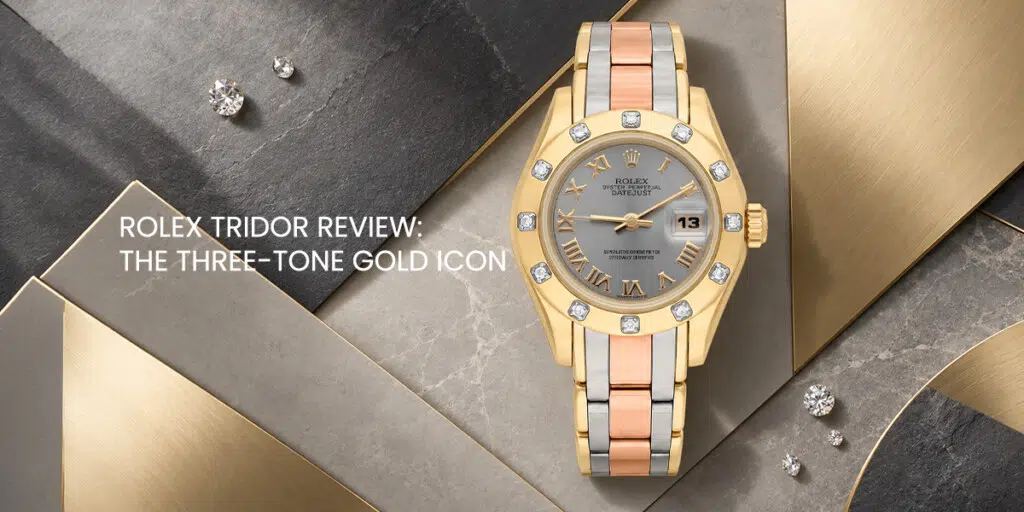
Table of Contents
What Is the Rolex Tridor and Why Was It Created?
The Three-Tone Gold Concept
The name “Tridor” derives from the French words for “three gold,” and the watch delivers this through a metallurgical process no other brand has replicated. Each center link contains five fused layers of 18k gold: rose, yellow, white, yellow, and rose again. Rolex fused multiple layers of gold into a single slab. If you cut a center bracelet link in half, you’d see the same color pattern running through the entire cross-section. The outer semi-circular links of the President bracelet use white gold to match the case, while the fluted bezel features yellow gold. This construction created color lines that run straight the entire length of the bracelet.
1980s Design State-of-the-Art
Tri-colored gold jewelry dominated fashion during the 1980s. Rolex responded with the Tridor around 1980 and introduced reference 18039B. Rolesor blends metals together uniformly. The Tridor kept distinct gold stripes fused for precision. Rolex designated this model as part of their “Crown Collection”. The manufacturing process represented a technological feat, as producing center links with three different colors of gold was thought impossible before. Models like the [Rolex Lady-Datejust 69318 Tridor] brought this state-of-the-art approach to women’s sizes.

Target Market and Positioning
Rolex positioned the Day-Date Tridor for buyers who wanted a difference beyond standard gold models. From a distance, the watch resembled a two-tone Datejust. Closer inspection revealed the premium tri-gold construction. For those wanting a luxury watch that stood apart from typical gold Day-Dates, the Tridor offered raised opulence and exclusivity. Production continued into the early 2000s before discontinuation.
How the Rolex Day-Date Tridor Is Constructed
White Gold Case with Yellow Gold Bezel
Rolex constructed the Day-Date Tridor case from solid 18k white gold and kept the 36mm Oyster case dimensions standard to the Presidential line. The white gold case provides the structural foundation. A fluted bezel in 18k yellow gold crowns the timepiece. This combination creates visual contrast between the case and bezel. Yellow gold hands and hour markers complement the bezel material. The case maintains water resistance up to 100 meters and matches standard Day-Date specifications.
Tri-Tone President Bracelet: Fused Gold Technology
The President bracelet follows a specific metal assignment. Outer semi-circular links use 18k white gold that matches the case, while center links showcase the tri-tone fusion. Cellini bi-gold models relied on white gold with yellow gold plating. The Rolex Day-Date Tridor used actual fused metal layers. Rolex fused multiple gold layers into a single slab. A cross-section cut through any center link reveals similar color striping throughout the whole depth. The bracelet features minimal stretch and incorporates a hidden clasp for uninterrupted esthetics. The Rolex Lady-Datejust 69318 Tridor follows this same construction approach in smaller dimensions.
The Manufacturing Process Behind Tridor Links
Rolex achieved the tri-tone effect by fusing stripes of multicolored gold to produce straight lines running the bracelet’s whole length. The fusion process represented a technological advancement. No other watch brand has replicated this layered gold fusion technique. These Day-Date models retained hollow center links despite the advanced fusion technology. Tridor Pearlmaster variants took a different approach and assembled separate rose gold, yellow gold, and white gold bracelet links together rather than fusing them within individual links.
Rolex Tridor Models and Reference Numbers
36mm Day-Date Tridor (Ref. 18039B and 18239B)
Reference 18039B launched the 36mm Day-Date Tridor line around 1980. Rolex replaced it with reference 18239B during the late 1980s. This new reference added double-quickset functionality for both day and date adjustments through the crown. Both references feature white gold cases with fluted yellow gold bezels. The “B” or “BIC” designation stands for “bicolor.” Some BIC models are bicolor rather than tri-color. They feature white gold Jubilee bracelets with diamond-covered yellow gold center links. An “A” suffix indicates a diamond dial, so reference 18239A BIC combines a diamond dial with the multi-hue gold bracelet.
Rolex Lady-Datejust 69318 Tridor
The 26mm Lady-Datejust 69318 Tridor served as the female equivalent of the Day-Date 18039B. A movement upgrade in the mid-1990s transformed it into reference 79179B. Rolex also produced 31mm Datejust Tridor models. You can identify them by an “8” as the second digit instead of a “9,” such as references 68279B and its replacement 78279B.
Rolex Tridor Masterpiece and Pearlmaster Variants
The early 2000s introduced the 39mm Rolex Tridor Masterpiece. It came with either round diamonds (reference 18948) or trapezoidal diamonds (reference 18958) on the bezel. These Masterpiece models featured Pearlmaster bracelets that differ from standard Tridor construction. They assemble separate yellow gold outer links, rose gold center links and white gold intermediary links instead of fused gold layers.
Diamond-Set Bezel Options
Reference 18129B has a diamond-set bezel equivalent of the 18039B, while reference 18139B has diamonds on both the bezel and lugs. These models featured a unique “cartouche bezel” with diamonds covering most of the bezel except for a small gold plaque at the bottom engraved with “Rolex”. Rolex later replaced these with references 18349B and 18389B that feature standard full-diamond bezels.
Movement Specifications and Performance
Caliber 3055 and 3155: Double Quickset Functionality
Early Tridor references like the 18039B housed the Caliber 3055, a self-winding movement with 27 jewels that introduced single quickset functionality in 1977. Wearers could adjust the date through the crown. The day display required cycling through 24 hours. Reference 18239B arrived in 1988 and brought Caliber 3155, which added double quickset capability. You can now adjust both day and date mechanisms with quick crown twists rather than winding through full rotations. The Rolex Lady-Datejust 69318 Tridor benefited from this movement development as well. Caliber 3155 stands 6.00mm tall with 31 jewels and keeps the 28,800 beats per hour frequency that produces smooth seconds hand sweep.
48-Hour Power Reserve
Both calibers deliver a 48-hour power reserve. Wrist motion powers the self-winding mechanism without manual intervention if you keep taking your Day-Date Tridor. You can set the watch aside for a night or two. It continues running when you return.
Superlative Chronometer Certification
Each movement earned Swiss Official Chronometer Testing Institute certification. Rolex subjects finished watches to additional in-house testing and verifies accuracy within -2/+2 seconds daily. This is a big deal as it means that standard chronometer requirements are exceeded. This Superlative Chronometer designation guarantees precision performance on your wrist.
Rolex Tridor Pricing and Market Value

Image Source : Soethbys
Current Market Prices by Model
Pricing for the Rolex Tridor lines up with standard equivalent gold models in view of its discontinued status. Ladies’ Datejust Tridor models sell between USD 10,000 and USD 16,000, while the Rolex Lady-Datejust 69318 Tridor commands pricing around USD 12,000 to USD 13,000. Standard Day-Date Tridor references such as the 18039B and 18239B range from USD 18,000 to USD 35,000 depending on condition and dial configuration. The Rolex Tridor Masterpiece represents the premium tier. Prices span USD 50,000 to USD 71,000 for models featuring meteorite dials or diamond bezels.
Collector Interest and Rarity Factor
Rolex discontinued the Tridor around 2000 and created finite supply that appeals to collectors who seek distinctive pieces from the brand’s design history. The tri-tone fusion technology remains unreplicated by competitors and adds technical intrigue beyond esthetic appeal.
Investment Potential vs Standard Gold Models
Tridor models sell for the same price as standard gold equivalents rather than commanding premiums. Investment-grade Rolex returns concentrate in stainless steel sports models such as the Submariner, Daytona, and GMT-Master II, while dress watches including gold Day-Dates show more modest appreciation whatever the tri-tone construction.
Conclusion
The Rolex Tridor stands as one of the brand’s boldest design experiments. No competitor has matched its fused gold technology. Prices range from $10,000 for models like the Rolex Lady-Datejust 69318 Tridor to $71,000 for diamond-set Masterpiece variants. You pay the same as standard gold equivalents but get something nowhere near as common. The Tridor rewards collectors who seek technical prowess paired with 1980s flair.
Show facts
Enjoying our watch coverage? Get more of it in Google Search.