The Yacht-Master and Submariner represent two iconic Rolex timepieces, each with its own character and story. The Submariner’s legacy dates back to 1953, and it became the world’s most beloved dive watch. The Yacht-Master made its debut in 1992 and broke new ground as Rolex’s first sports watch with three size options.
These watches show their true colors in their water resistance ratings. The Submariner boasts 300 meters (1,000 feet) of water resistance, which makes it perfect for serious saturation diving. The Yacht-Master’s rating stands at 100 meters (330 feet) – enough for swimming and yachting, but not meant for professional diving. The price points tell another story. A stainless steel Submariner starts at retail price starting around $9,150. The Yacht-Master commands a higher price tag between $13,000-$18,000+. The Yacht-Master holds a special place as Rolex’s first professional watch that came in precious metal options. You’ll find it in Rolesium (a mix of stainless steel and platinum), 18k Everose gold, and 18k yellow gold.
Let me head over to the key differences between these luxury sports watches. We’ll look at their design elements, functionality, movement specifications, and market value. This comparison will help you pick the Rolex that matches your style and needs.
Table of Contents
Design and Build: Yacht-Master vs Submariner Esthetics

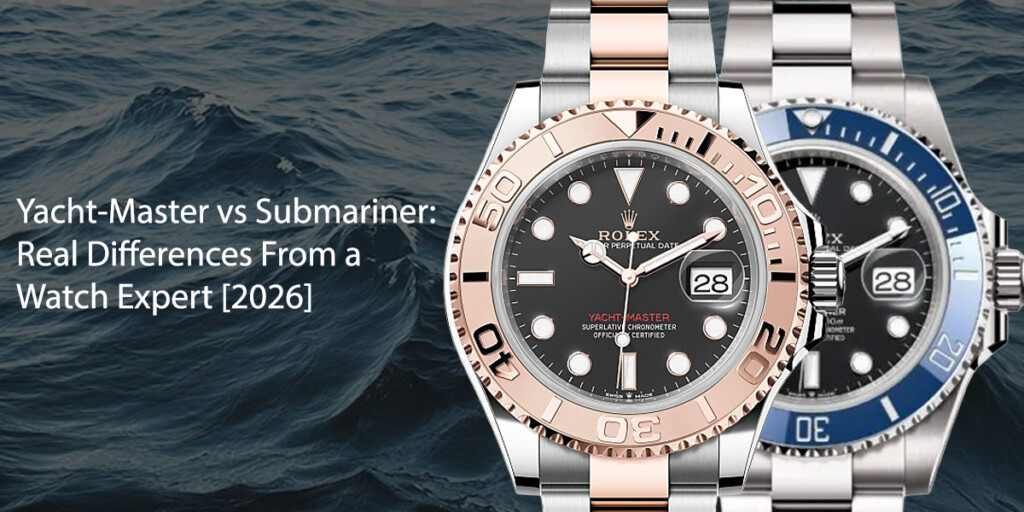
The Yacht-Master and Submariner may share similar dimensions, but each watch shows its own character through design details that make them unique. The Yacht-Master has a refined look with smooth profiles and rounded edges. The Submariner takes a different approach with its beefed-up “Super Case,” angular lugs and prominent crown guards that make it stand out on the wrist.
Case Materials: Rolesium and Everose vs Oystersteel and Rolesor
Luxury materials set the Yacht-Master apart. It brought “Rolesium” to Rolex’s lineup – a mix of stainless steel case with a platinum bezel. You can also get it in 18k Everose gold and Everose Rolesor versions. The Submariner sticks to tough Oystersteel because of its tool watch heritage. Some Rolesor models combine steel and gold for those who want extra luxury.
Bezel Construction: Bidirectional Platinum vs Unidirectional Ceramic
The bezels really show how different these watches are. The Yacht-Master’s bezel turns both ways and uses solid 950 platinum with raised numbers on the surface. It rotates smoothly with a gentle feel. The Submariner’s Cerachrom ceramic bezel only turns one way with 120 clear clicks. The ceramic is harder to scratch, won’t fade, and has engraved markings instead of raised ones.
Dial Options: Sunburst Blue vs Classic Black
The Yacht-Master’s dials catch your eye with sunburst blue or dark rhodium options. The blue version has red details on its seconds hand and model name. The rhodium dial looks elegant with its single-color scheme and turquoise seconds hand accents. The Submariner keeps things traditional with a black dial, white markers and hands that you can read easily anywhere.
Bracelet Styles: Oysterflex vs Oyster Bracelet
The Submariner only comes with the strong Oyster bracelet. It has flat three-piece links and an Oysterlock folding clasp with a Glidelock system that lets you adjust it without tools. The Yacht-Master gives you more choices – either the dressy Jubilee bracelet with five-piece links or the modern Oysterflex rubber strap that feels comfortable like rubber but lasts like metal.
Functionality and Water Resistance

The Yacht-Master and Submariner watches have key differences that come from their unique environments and purposes.
Bezel Utility: Sailing Timer vs Dive Timer
The Submariner’s unidirectional rotating bezel is a vital safety feature for divers. It rotates only counterclockwise with 120 precise clicks to prevent accidentally extending dive time. The Yacht-Master’s bezel works differently – it turns smoothly in both directions with a softer feel that works well for timing sailing maneuvers and regattas. You’ll notice the Submariner has platinum PVD-coated engraved bezel markings, while the Yacht-Master shows off raised, embossed numerals.
Water Resistance: 100m vs 300m Depth Rating
These watches have a significant difference in water resistance capabilities. The Submariner handles depths of 300 meters (1,000 feet), making it perfect for professional diving. This impressive depth rating comes from Rolex’s Triplock waterproof system with three sealed zones. The Yacht-Master reaches 100 meters (330 feet) – great for sailing but not meant for serious diving.
Daily Wear Comfort: Slimmer Caseback vs Super Case Bulk
Most people find the Yacht-Master more comfortable for everyday wear because of its thinner, flatter caseback. The Submariner needs extra bulk to achieve its deeper depth rating, which makes it feel more substantial on your wrist.
Movement and Performance
These iconic timepieces show major differences in their mechanical hearts when you look under their case backs.
Caliber Comparison: 3235 vs 3135
Rolex’s Caliber 3135 became their reliable movement in 1988 and served them for decades. The Caliber 3235 came along in 2015 and brought next-generation technology with over 90% new components and 14 patents. The Yacht-Master got this upgraded movement first in 2019, which gave it an edge until the Submariner caught up in 2020.
Power Reserve: 70 Hours vs 48 Hours
The most practical improvement shows in the power reserve. The 3235 caliber runs for 70 hours compared to the 3135 movement’s 48-hour capacity. Modern versions of both watches can now stay accurate through a weekend without wearing them. This feature helps collectors who switch between different timepieces.
Chronergy Escapement vs Traditional Escapement
The innovative Chronergy escapement powers these performance improvements. This system uses a pierced, lighter escape wheel made from nickel-phosphorus that cuts down inertia. The escapement’s modified geometry boosts efficiency by about 15%. Thinner barrel walls fit a longer mainspring, and these technical improvements work together to deliver better power reserve.
Price, Value, and Market Appeal
Price makes a key difference when you look at yacht master vs submariner watches. These iconic timepieces have different price points that reflect their market position and materials used.
Retail Pricing: $13,000+ vs $9,000+
The Submariner is available at a lower price point, starting around $9,150 for stainless steel models. The Yacht-Master costs substantially more, with prices starting at $13,000 and going up to $18,000+ based on material choices. This big price gap shows the Yacht-Master’s status as a more luxurious option in Rolex’s professional collection.
Resale Value: Submariner’s Market Demand vs Yacht-Master’s Exclusivity
The Submariner has shown amazing value retention through market ups and downs. Stainless steel versions tend to hold or increase their value. Models like the “Kermit” and “Hulk” have seen huge price increases in the secondary market. The Submariner’s value dropped 29% from its peak but stabilized at around $17,295 by June 2025. It still keeps 92% of its highest value.
Availability: Waitlists and Secondary Market Trends
You’ll need patience to buy either watch at retail. Submariner buyers wait between 3 months to 3 years at authorized dealers. The Yacht-Master is easier to get, with typical waits up to 18 months. This availability gap in part explains why the Submariner performs better in the secondary market. Limited supply creates more demand and then higher prices above retail.
Comparison Table
|
Feature |
Yacht-Master |
Submariner |
|
Launch Year |
1992 |
1953 |
|
Water Resistance |
100m (330 feet) |
300m (1,000 feet) |
|
Starting Price |
$13,000-$18,000+ |
$9,150 |
|
Case Materials |
Rolesium (steel/platinum), Everose gold, Rolesor |
Oystersteel with Rolesor options |
|
Bezel Type |
Bidirectional, platinum with raised numerals |
Unidirectional, Cerachrom ceramic with engraved markings |
|
Bezel Action |
Smooth rotation |
120-click rotation |
|
Dial Options |
Sunburst blue, dark rhodium |
Classic black |
|
Bracelet Options |
Oysterflex rubber strap or Jubilee bracelet |
Oyster bracelet only |
|
Movement |
Caliber 3235 (since 2019) |
Caliber 3235 (since 2020) |
|
Power Reserve |
70 hours |
70 hours |
|
Retail Waitlist |
Up to 18 months |
3 months to 3 years |
|
Primary Use |
Yachting and luxury sports |
Professional diving |
|
Case Profile |
Slim, refined silhouette |
Robust case with angular lugs |
Examining these legends side-by-side highlights the differences between them. The Submariner is the quintessential tool watch. Its tough, functional design paired with great water resistance makes it ideal for active users. The Yachtmaster embodies Rolex’s interpretation of a luxury sports watch. High quality materials and elegant design set it apart.
The reason for these differences is founded in the watches’ origins. The Submariner was created in 1953 as a timepiece for working divers. The Yacht-master was introduced 38 years later as a luxury timepiece for yacht sailors.
Price differences between the two come down to market positioning. The Submariner offers a slightly more accessible introduction to Rolex at $9,150. The Yacht Master starts at $13,000 because of luxury materials such as Rolesium and Everose.
Functionality wise, they each serve different purposes when worn daily. The majority of Rolex fans gravitate towards the Yachtmaster for daily wear because of its thinner case and rounded edges. The Submariner is bulkier but offers more toughness and water resistance.
Think about how you’ll wear your watch. If you’re looking for a tool watch that can do it all and hold its value, purchase the Submariner. If you’d rather own something just as versatile but with a touch more flair, go with the Yachtmaster.
As of recent releases, both watches are equipped with the same movement, Caliber 32xxx. Each has a 70 hour power reserve and incredible accuracy. There is no longer a performance trade-off with these watches.
When it comes down to it, it’s just a matter of preference. If you’re looking for the world’s best diving watch, buy the Submariner. If you’d rather own Rolex’s most elegant sports watch, buy the Yachtmaster.
Enjoying our watch coverage? Get more of it in Google Search.