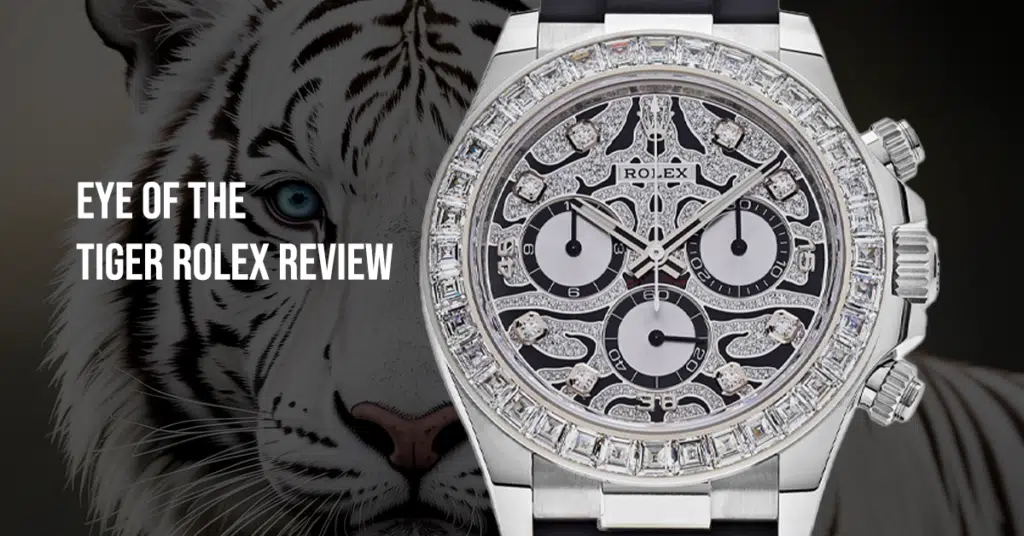
This extraordinary Daytona model, the Eye of the Tiger Rolex, stands as one of the most luxurious and unconventional watches that you won’t find on any official Rolex website. The timepiece launched in 2021, though its story began in 2019. While its retail price sits at $90,000, the market values it at more than $200,000.
What’s remarkable about the Eye of the Tiger Rolex watch is its stunning craftsmanship. The watch features an 18k gold Daytona with a bezel adorned by 36 flawless trapeze-cut diamonds. Its signature tiger-print motif dial combines black lacquer stripes with 243 brilliant-cut diamonds to create a mesmerizing effect. The watch’s mystery continues to captivate enthusiasts even years after its release. Yes, it is worth noting that three different variations of the Eye of the Tiger Rolex exist today, and each one maintains the exclusive appeal that makes these timepieces so desirable.
Many watch enthusiasts wonder why they’ve never seen this $200K masterpiece in person. Let me show you what the luxury watch world keeps under wraps about this exceptional timepiece.
What Is the Eye of the Tiger Rolex and Why Is It So Rare?
Rolex’s most striking timepieces come not from their regular collection but from their hidden workshops. The Eye of the Tiger Daytona shows off this behind-the-scenes craftsmanship and stands as one of the boldest statements in modern watchmaking.
Off-Catalog Status Explained
You won’t find the Eye of the Tiger displayed alongside regular Rolex models in boutiques worldwide. This watch belongs to a special group called “off-catalog” watches. These pieces never show up on Rolex’s website or in their usual marketing materials. The brand quietly offers them to their most valued clients.
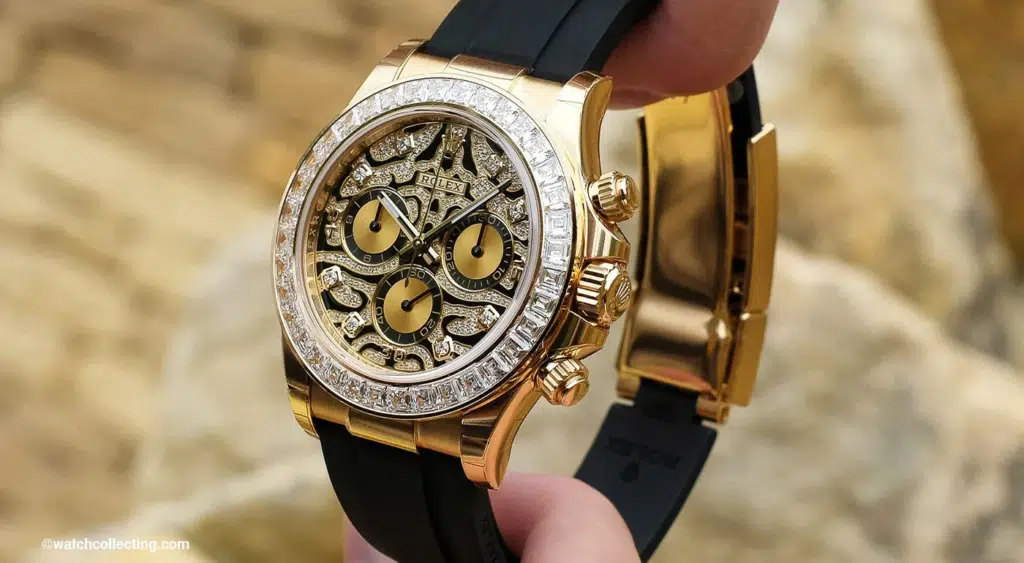
Three different Eye of the Tiger variants exist today. Each watch sports the signature tiger-print dial with black lacquer stripes and diamonds. The first model came out in 2019 (reference 116588TBR in yellow gold). Two more versions followed in 2021, including the white gold reference 116589TBR.
These watches are rare because Rolex makes very few of them and sells them selectively. The market value tells quite a story – from the original retail price of about $90,000–95,000, these watches now sell for $200,000–400,000. This jump shows just how valuable they’ve become.
Origins of the ‘Eye of the Tiger’ Nickname
Rolex never actually named this watch the “Eye of the Tiger.” The catchy nickname came from Suzanne Wong, editor-in-chief of Revolution Asia magazine. She saw how the unique tiger-stripe pattern matched the markings of the magnificent big cat.
Watch lovers also call it the “Rorschach Test Daytona.” The abstract, inkblot-like quality of its pattern sparked this nickname. This psychological connection adds to the watch’s mystery and makes it a great conversation starter.
The design features an 18k gold case with a bezel holding 36 trapeze-cut diamonds, set using the tricky “invisible setting” technique. The dial shows off 243 brilliant-cut diamonds arranged between black lacquer stripes. Together, they create a mesmerizing tiger-eye effect.
Rolex Daytona Lineage and Progress
This isn’t Rolex’s first dance with jungle cat-inspired chronographs. The Eye of the Tiger Daytona follows in the footsteps of the bold Leopard Daytona (reference 116598SACO) from 2004. Many collectors see the Eye of the Tiger models as a more sophisticated take on the concept.
All three Eye of the Tiger versions share the core specs of the previous-generation Daytona (which Rolex discontinued in 2023): 40mm cases, sapphire crystals, and 100 meters of water resistance. Rolex’s in-house Caliber 4130 automatic chronograph movement powers these watches. It uses a column wheel with a vertical clutch, runs at 4Hz, and keeps time for about 72 hours.
Rolex often uses the Daytona platform to create their most luxurious watches. Regular Daytonas focus on practical looks, but these special versions go all out visually. They show how Rolex can redefine artistic limits while keeping their reputation for excellent watchmaking.
The Eye of the Tiger splits opinions among watch fans. Still, it has caught the eye of stars like Conor McGregor, DJ Khaled, and LeBron James. This attention helps cement its place as a bold statement piece for those lucky enough to both afford it and get their hands on one.
Design and Materials: A Closer Look at the 116589TBR
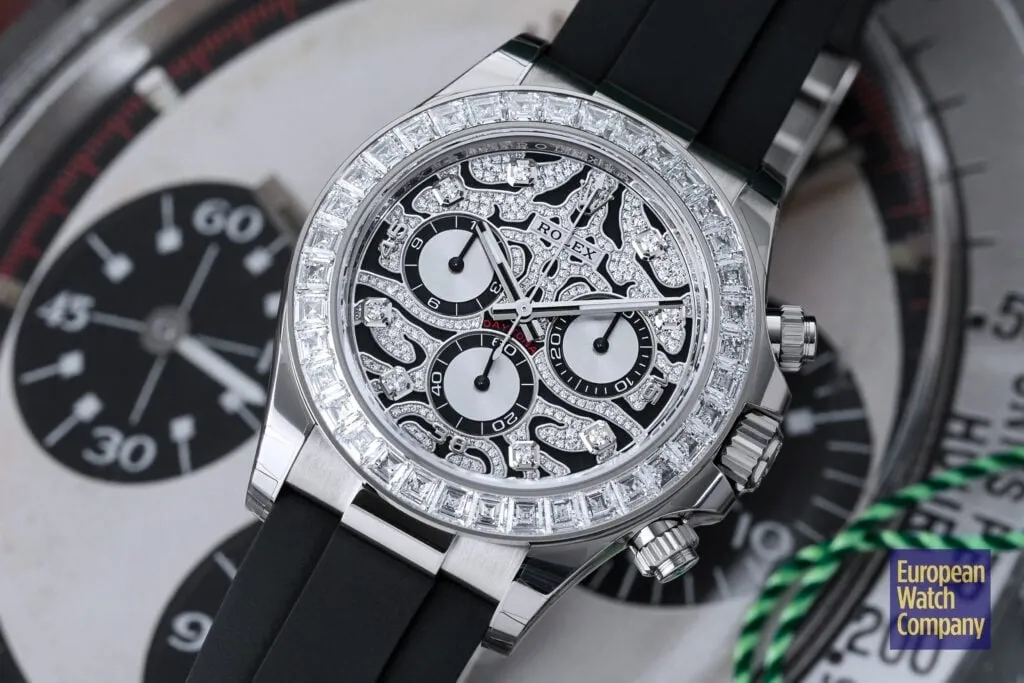
Image Source: European Watch Company
The Eye of the Tiger Rolex 116589TBR stands as a testament to Rolex’s master craftsmanship in its most extravagant form, going way beyond its legendary status and lack of availability. This white gold variant emerged in 2021 after the yellow gold version, and it represents maybe even the most striking take on an already exceptional design.
Case: 18k White Gold, 40mm Dimensions
The 116589TBR’s classic Daytona proportions feature a perfectly balanced 40mm diameter case crafted from solid 18k white gold. The case measures 12.5mm thick with 20mm wide lugs, unlike standard production models. This gives substantial wrist presence without looking oversized. The watch’s water resistance matches the Daytona standard at 100 meters (330 feet), which makes it surprisingly practical despite its opulent looks.
A sapphire crystal protects the technical foundations that link this exotic timepiece to its racing heritage. The Eye of the Tiger keeps the fundamental Oyster case structure that has shaped the collection since its beginning, though it looks remarkably different from standard Daytonas.
Dial: 243 Diamonds with Black Lacquer Stripes
The watch’s mesmerizing dial gives it the “Eye of the Tiger” nickname. The white gold dial matches the case and displays an intricate pattern where black lacquer stripes alternate with areas paved with 243 brilliant-cut diamonds. This distinctive arrangement creates the signature tiger-stripe motif that defines the collection.
The silver-colored subdials feature black rings that add contrast and visual depth while maintaining functional chronograph displays. Additional brilliant-cut diamonds serve as hour markers, and white gold Arabic numerals appear at the 15, 30, and 45-minute positions.
Bezel: 36 Trapeze-Cut Diamonds
The 116589TBR’s bezel stands as its most technically impressive feature. It completely departs from standard Daytona models’ tachymeter scale and showcases 36 flawless trapeze-cut diamonds. These precisely arranged gemstones frame the dial and create a smooth transition between case and dial.
The bezel’s trapeze-cut diamonds total approximately 4.58 carats of perfectly matched stones. Rolex’s strict quality standards must be met by each diamond before expert craftsmen place them meticulously into the bezel.
Bracelet: Oysterflex with Lug Hoods
Rolex’s innovative Oysterflex bracelet completes this horological masterpiece. The Oysterflex is nowhere near a simple rubber strap – it combines flexible metal blades with high-performance black elastomer coating. This design gives it a metal bracelet’s durability with a rubber strap’s comfort and style.
The white gold Eye of the Tiger, as with other precious metal Oysterflex-equipped Daytonas, has small “lug-hoods”. These white gold elements create an elegant transition by filling the space between the case and bracelet attachment points.
An Oysterlock folding safety buckle made from matching 18k white gold secures the bracelet. It has Rolex’s Easylink 5mm extension system that allows quick tool-free adjustments to ensure optimal comfort throughout the day.
Movement and Functionality: Inside the Caliber 4130
The stunning exterior of the Eye of the Tiger Rolex houses an engineering masterpiece that powers this extraordinary timepiece. Rolex launched the Caliber 4130 in 2000, their first in-house chronograph movement after five years of development.
Chronograph Features and Accuracy
The Caliber 4130 distinguishes itself from conventional chronograph mechanisms through its innovative design. This self-winding movement combines a column wheel and vertical clutch system that ensures precise starts and stops without the juddering backlash found in horizontal clutch systems. The vertical clutch design lets the chronograph function run continuously while maintaining the watch’s timekeeping precision.
This movement stands out with its streamlined architecture. It contains just 201 components—all but one of these parts are 60% fewer than its predecessor. The movement achieves better reliability through mechanical simplification. The Swiss Official Chronometer Testing Institute (COSC) has certified that the Caliber 4130 delivers exceptional accuracy of +/-2 seconds per day.
Power Reserve and Frequency
The Eye of the Tiger Rolex runs at 28,800 vibrations per hour (4Hz). This frequency creates the smooth sweep of the seconds hand that premium timepieces are known for. It strikes the perfect balance between timing precision and component longevity.
The movement’s power reserve is remarkable. The watch runs for 72 hours when fully wound, which means you can set it aside for a weekend without rewinding. The extended power reserve comes from improved efficiency throughout the movement. Rolex introduced ceramic ball bearings for the first time in their movement’s automatic winding system.
Parachrom Hairspring and Durability
The Parachrom hairspring sits at the core of the Caliber 4130’s exceptional performance. This revolutionary component uses a special niobium-zirconium alloy that provides unmatched resistance to magnetic fields and temperature variations—two major challenges that affect mechanical watch accuracy.
The Parachrom hairspring delivers 10 times more shock resistance than traditional materials. This feature maintains precise timekeeping during everyday wear. The manufacturing tolerances for this component are incredibly precise. Variations stay within 0.1 microns, about one-thousandth of a human hair’s diameter.
The movement inside the Eye of the Tiger Rolex showcases Rolex’s steadfast dedication to horological excellence. The Caliber 4130 has earned its reputation as one of the most reliable mechanical chronograph movements in modern history. This spectacular timepiece performs as impressively as it looks.
How It Compares: Rainbow, Leopard, and Standard Daytonas
The Eye of the Tiger Rolex stands in a special class among Rolex’s most exclusive timepieces. A look at how it stacks up against other statement Daytonas reveals its unique character.
Versus Rainbow Daytona 116595RBOW
The Rainbow Daytona might be the most recognized off-catalog Rolex that first appeared in 2012. Later versions came in white gold, yellow gold, and Everose. What sets it apart from the Eye of the Tiger is its distinctive bezel with 36 baguette-cut sapphires in a vibrant rainbow gradient.
Rainbow Daytonas started at $90,000-$97,500 based on metal choice and now sell for over $400,000 in the secondary market. The most exclusive Everose version with a diamond pavé dial can fetch double that amount.
Both watches use Rolex’s exceptional in-house caliber 4130 movement and meet strict gemstone standards. Rolex uses only Internally Flawless (IF) quality stones. The Rainbow Daytona makes a more colorful statement than the Eye of the Tiger’s monochromatic sophistication.
Versus Leopard Daytona 116598SACO
Many watch enthusiasts call the Leopard Daytona (ref. 116598SACO) from 2004 the Eye of the Tiger’s spiritual predecessor. The Leopard sports an even bolder look with its full leopard-print dial, cognac-colored sapphire bezel, and matching leopard print strap.
The Leopard Daytona’s market value ranges between $100,000-$150,000. Collectors see the Eye of the Tiger as a more refined take on this jungle cat theme that brings a more abstract and mature interpretation.
Versus Standard White Gold Daytona 116519LN
Watch lovers who like the white gold Eye of the Tiger’s basic setup without the lavish diamond setting might prefer the standard Daytona 116519LN.
This model shares the same case dimensions, movement specs, and Oysterflex bracelet. The main difference shows in its conventional tachymeter bezel and standard dial options.
The standard white gold model delivers the same features with 100m water resistance, screw-down pushers, and superlative chronometer certification. At roughly one-fourth the price of its gem-set sibling, it remains the most attainable option among these premium Daytonas.
Eye of the Tiger Rolex Price and Collector Value
The Eye of the Tiger Rolex shows us the fascinating world of ultra-luxury watches and how their prices work in the market.
Retail vs Market Price
The original retail price of the Eye of the Tiger Rolex was around $90,000-$95,000, but today it sells for an amazing $200,000 to $400,000. This huge jump in price comes from how rare these watches are and their growing appeal to collectors. A recent Christie’s auction saw one piece sell for $352,800, which is a big deal as it means that people are willing to pay way above the expected price.
Why It’s a $200K+ Watch
The watch commands this incredible price tag for several reasons. These watches are made in very small numbers since they’re not in the regular catalog. The watch’s craftsmanship is stunning – it has 243 diamonds on the dial and another 36 trapeze-cut diamonds on the bezel. The price has gone up even more because famous people like LeBron James own one – his piece is worth over $200,000.
Availability and VIP Access
Rolex saves these special timepieces for their most important clients. You can’t just walk in and buy one from a dealer – you need a long purchase history or some really good connections with the brand.
Eye of the Tiger Rolex for Sale: Where to Look
The secondary market is your best bet right now. You’ll find many of these watches on specialized sites like Chrono24, with prices from $185,888 to over $300,000. Top auction houses also sell these pieces from time to time, and they come with detailed service history papers.
Conclusion
This $200,000+ Eye of the Tiger Rolex Daytona shows what happens when traditional watchmaking meets artistic extravagance. No other timepiece captures attention and imagination quite like this chronograph with its mesmerizing diamond-set tiger pattern dial.
This watch means more than just an accessory or investment. It represents the peak of Rolex’s off-catalog creativity. Its bezel features 36 trapeze-cut diamonds and 243 brilliant-cut diamonds arranged between black lacquer stripes. This stunning combination creates a visual effect that makes its extraordinary price tag and exclusive status completely justified.
The market has definitely proven this watch’s importance. These timepieces now sell for double or triple their original $95,000 retail price, making them some of the most coveted modern Rolexes. You can’t just walk into a boutique and buy one – whatever your budget might be.
The technical foundation stays flawless beneath all the visual drama. Rolex’s Caliber 4130 delivers reliability and precision that matches its exterior flamboyance. This ensures the Eye of the Tiger backs up its style with substance.
Traditional watch enthusiasts might debate its merits, but these exotic Daytonas reveal Rolex’s willingness to expand esthetic limits while keeping their legendary standards. The Eye of the Tiger creates its own unique identity in the ultra-luxury watch segment, whether you see it as the spiritual successor to the Leopard Daytona or compare it to the Rainbow variant.
Next time you see one of these rare beasts – maybe even on LeBron James’s or Conor McGregor’s wrist – you’ll know why it draws such attention and commands astronomical prices. This feline-inspired chronograph combines horological excellence with artistic boldness, a rare mix even among prestigious watchmakers.
FAQs
What makes the Eye of the Tiger Rolex so unique and valuable?
The Eye of the Tiger Rolex is a rare, off-catalog Daytona model featuring an 18k gold case, a bezel set with 36 trapeze-cut diamonds, and a striking dial with a tiger-print motif created from black lacquer stripes and 243 brilliant-cut diamonds. Its limited availability and exquisite craftsmanship have driven its market value to over $200,000.
How does the Eye of the Tiger Rolex compare to other exclusive Daytona models?
While similar in exclusivity to models like the Rainbow and Leopard Daytonas, the Eye of the Tiger offers a more refined and abstract interpretation of animal-inspired design. It features a monochromatic sophistication compared to the Rainbow’s colorful gemstones or the Leopard’s bold print.
What movement powers the Eye of the Tiger Rolex?
The Eye of the Tiger Rolex is powered by Rolex’s in-house Caliber 4130 automatic chronograph movement. This movement features a column wheel and vertical clutch system, operates at 4Hz, and provides approximately 72 hours of power reserve.
How can one acquire an Eye of the Tiger Rolex?
Due to its exclusive nature, the Eye of the Tiger Rolex is not readily available through standard retail channels. It’s typically reserved for Rolex’s most valued clients. The secondary market, including specialized platforms and prestigious auction houses, is currently the primary option for potential buyers.
Why does the Eye of the Tiger Rolex command such a high price?
The Eye of the Tiger Rolex’s high value stems from its limited production, exceptional craftsmanship (particularly in diamond setting), and growing collector appeal. Celebrity endorsements have also boosted its profile. The watch’s market price has appreciated significantly from its initial retail value, reflecting its status as a highly sought-after luxury timepiece.
Enjoying our watch coverage? Get more of it in Google Search.