Did you know that the term “waterproof” is technically misleading for watches? Many people wonder if Rolex watches are waterproof. The truth is, Rolex timepieces are “water-resistant” instead of completely waterproof. This means they can handle water pressure up to certain depths for limited time periods.
Rolex became a leading manufacturer of water-resistant timepieces after creating the revolutionary Oyster case in 1926. This breakthrough created a hermetic seal that protected the movement from water and dust. The water resistance levels vary by a lot across different Rolex models. Standard Oyster models resist water up to 100 meters (330 feet). The Submariner takes this further with protection up to 300 meters (1,000 feet). The Sea-Dweller and Deepsea models redefine the limits of water resistance. These watches can handle depths of 1,220 meters (4,000 feet) and 3,900 meters (12,800 feet).
Rolex’s water resistance isn’t permanent. The watch’s gaskets, made from rubber, nylon, or Teflon, seal the case parts but can wear down over time. Regular maintenance keeps the water resistance intact. Rolex tests each watch rigorously underwater. The pressure testing exceeds the rated depth by 10% to ensure reliability when you need it most.
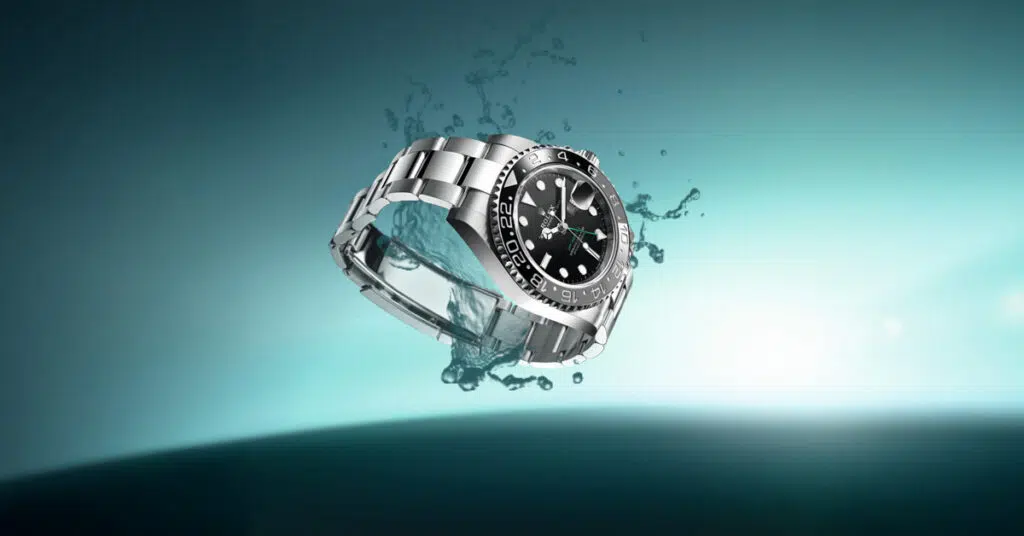
Table of Contents
Are Rolex Watches Waterproof or Just Water Resistant?
Many watch enthusiasts ask: are Rolex watches waterproof? The simple answer is no—not because Rolex’s engineering falls short. The term “waterproof” creates unrealistic expectations about what any timepiece can do.
Why ‘Waterproof’ Is a Misleading Term
The word “waterproof” suggests that a watch can resist water completely under any condition—a claim no watch can validate. Even the best-built timepieces will let water in if they stay underwater too long or face extreme pressure.
A watch labeled as waterproof would need to keep moisture out at any depth, for any time, in any condition—something no watchmaker can guarantee. Water resistance also doesn’t last forever. Seals and gaskets naturally wear down over time.
The watch industry now uses more accurate terms. “Water-resistant” better describes how well a watch can keep water out under specific conditions and time limits.
FTC Guidelines on Watch Terminology
The Federal Trade Commission (FTC) tackled this language issue back in the 1960s by banning “waterproof” in watch ads. They found that “waterproof” suggested “a measure of absolute protection that unfortunately does not exist with respect to watches, especially over prolonged periods of time”.
This decision made manufacturers change their terminology. They switched to the more accurate “water-resistant” label and added specific depth ratings based on standard tests.
These FTC guidelines stayed until 1999. They weren’t dropped because “waterproof” became correct, but because international standards like ISO 2281 and ISO 6425 were now accessible to more people, making the original rules unnecessary.
A 2007 study by Swatch Group engineers showed something interesting. The pressure on watches during normal water activities is nowhere near what people thought. Their research showed that a watch tested at just two bar (20 meters) could handle most water activities except diving.
How Rolex Defines Water Resistance
Rolex takes a different viewpoint on water resistance. Their website uses “waterproofness” instead of “water resistance,” describing it as “merely a corollary of the expertise with which our entire manufacture produces them, from design to final assembly”.
This shows Rolex’s faith in their Oyster case technology. The Oyster case was a breakthrough in 1926 that changed how watches keep water out. Every Rolex Oyster model can resist water to at least 100 meters, while their diving models go much deeper.
Rolex watches stand out not because they’re “waterproof” but because they achieve exceptional water resistance through precise engineering. The company tests each watch in hyperbaric tanks at pressures beyond their rated depth.
All the same, Rolex watches need proper care to maintain their water resistance. Several things can affect a Rolex’s water resistance:
- Gasket degradation over time
- Exposure to extreme temperatures
- Use of aftermarket parts
- Improper servicing
- Chemical exposure from soaps or shampoos
That’s why Rolex suggests regular service to keep optimal water resistance—they know that even their exceptional timepieces can’t claim eternal “waterproofness.”
The Role of the Oyster Case in Water Resistance

Image Source: ScrewDownCrown – WordPress.co
Rolex’s water resistance stems from a breakthrough that dates back to 1926—the revolutionary Oyster case. This design changed watchmaking history forever and remains the life-blood of Rolex’s exceptional water resistance capabilities today, almost a century later.
1926 Invention of the Oyster Case
Rolex created what would become its signature achievement in 1926—the world’s first waterproof wristwatch case. The company’s founder, Hans Wilsdorf, gave it the perfect name “Oyster” case. He explained that “like an oyster, it can remain an unlimited time underwater without detriment to its parts”. This solved a major problem with wristwatches, which didn’t deal very well with moisture, dust, and pressure damage.
Waterproof designs before the Oyster case couldn’t keep water out properly or needed complicated handling to work. The innovation seemed so unbelievable that Rolex stores displayed their watches in aquariums to prove they worked. People needed this visual proof because a truly water-resistant wristwatch seemed impossible at the time.
Screw-Down Crown, Case Back, and Bezel Design
The Oyster case’s brilliance lies in its deceptively simple yet effective hermetic sealing system. The design earned a patent by using three key components—the bezel, case back, and winding crown—that screw down against the middle case to create an impenetrable barrier.
The original bezel had fluting that let it screw onto the middle case using Rolex’s exclusive tool. Fine fluting around the case back’s edge helped secure it firmly. The crown, the most vulnerable spot for water entry, got a complete redesign with the patented screw-down system.
Rolex launched the Twinlock crown in 1953. It used a double gasket system—one inside the tube and another inside the crown—to create two sealed zones. This system evolved into the Triplock crown for diving watches by 1970. It featured three sealed zones to improve protection. You can spot these crowns by their marks: one dot, two dots, or a line for Twinlock, and three dots below the Rolex emblem for Triplock.
Materials Used: Oystersteel, Gold, and Titanium
Today’s Oyster cases use incredibly durable materials. Rolex stamps and machines the middle case from solid blocks of Oystersteel (their unique 904L stainless steel alloy), 18k gold, or 950 platinum. These materials look luxurious and resist corrosion and pressure exceptionally well.
RLX titanium made its debut in the Deepsea Challenge model. This Grade 5 titanium alloy contains aluminum and vanadium and weighs 40% less than steel. The watch tips the scales at 251 grams instead of 350 grams in steel. This material choice helps the watch achieve an incredible 11,000 meters of water resistance.
Rolex created the Ringlock system in 2008 for extreme depths. It combines a slightly domed sapphire crystal, a nitrogen-alloyed steel compression ring, and a titanium alloy case back. This patented architecture lets models like the Deepsea handle pressure at depths of 3,900 meters (12,800 feet).
Understanding Rolex Crown Systems: Twinlock vs Triplock

Image source: Bob Watches
The crown is maybe the weakest spot where water can enter a watch. Rolex tackled this problem by creating two advanced crown systems that seal off any potential water entry.
Twinlock Crown: 100m Water Resistance
Rolex launched the Twinlock crown in 1953 with their Submariner, which was a huge step forward from older single-seal designs. The system uses two sealed zones with synthetic O-ring gaskets instead of metal washers. A first gasket sits inside the crown and presses against the tube’s top when screwed down. The second gasket fits inside the tube around the winding stem.
This design works really well because it stays protected even when you unscrew the crown to set time or wind the watch. The second seal also helps keep the winding stem stable during use.
Most non-diving Rolex watches now come with the Twinlock crown as standard equipment. These include the Datejust, Day-Date, Oyster Perpetual, Sky-Dweller, Air-King, Milgauss, and Explorer collections. Each watch can resist water up to 100 meters (330 feet).
Triplock Crown: Up to 3,900m Water Resistance
Rolex revealed a better crown system in 1970 with their Sea-Dweller. The Triplock crown adds another sealed zone, creating three barriers against water. The design places two O-ring gaskets in the tube and adds a third under the crown.
This strong system delivers amazing water resistance. The Submariner (which got the Triplock in 1977) handles depths of 300 meters. The Sea-Dweller goes down to 1,220 meters, while the Deepsea reaches an incredible 3,900 meters. Some professional models like the Daytona, GMT-Master II, and both Yacht-Master versions use the Triplock with only 100m ratings. We used this mainly because the bigger crown looks better with their case sizes.
Crown Symbols and Model Identification
Rolex marks each crown with specific symbols that show both the crown system type and watch material. Current Twinlock crowns have these markings:
- Stainless steel models show a single line under the Rolex coronet
- Platinum models display one dot
- Gold models have two dots
Triplock crowns follow a different pattern:
- Stainless steel models display three similar dots
- Gold models feature a larger center dot
- Platinum models show a smaller center dot
These small details help watchmakers and collectors quickly identify crown systems without taking the watch apart.
Water Resistance Ratings and What They Actually Mean
The difference between casual enthusiasts and informed collectors lies in their knowledge of Rolex water resistance ratings. These numbers reflect specific capabilities that matter in real-life situations.
30m to 100m: Splash and Swim Safe
A 30m rating means the watch can handle rain and minor splashes but swimming isn’t recommended. Watches rated at 50m allow light swimming, though shower pressure might exceed test conditions. The Cellini and other Rolex dress watches come with 50m resistance.
Rolex gives 100m ratings to most of its collection—the Datejust, Day-Date, Sky-Dweller, Oyster Perpetual, Air-King, Milgauss, Explorer, Explorer II, Yacht-Master, Yacht-Master II, GMT-Master II, and Daytona. These watches perform well during swimming and snorkeling but aren’t meant for scuba diving or intense water sports.
200m to 300m: Recreational Diving
Watches with 200m ratings can handle recreational scuba diving. They work great for most water activities but aren’t suitable when diving with mixed gasses.
The legendary Submariner, rated at 300m, leads Rolex’s recreational diving lineup. This rating lets you enjoy all water sports and extended scuba sessions—everything except saturation diving.
1,220m to 3,900m: Professional Deep Diving
The Sea-Dweller’s introduction in 1967 fixed a crucial issue with the Submariner—crystals popping out during decompression in saturation dives. Rolex added a helium escape valve to release trapped gas. Modern Sea-Dweller models reach depths of 1,220m (4,000 feet).
Launched in 2008, the Deepsea Sea-Dweller pushes limits to 3,900m (12,800 feet). The Ringlock system makes this possible through its nitrogen-alloyed steel compression ring, specialized crystal, and sturdy case design.
11,000m: The Deepsea Challenge in Titanium
Rolex broke records in 2022 with their first titanium watch—the Deepsea Challenge. This watch achieves an incredible 11,000m (36,090 feet) rating and can theoretically survive pressures at the Challenger Deep, the Mariana Trench’s lowest point.
The watch uses RLX grade 5 titanium, which makes it 40% lighter than steel versions. A prototype proved its worth during James Cameron’s historic 10,908m descent in 2012.
Official Water Resistance by Rolex Model
Rolex publishes a depth rating for every current reference on rolex.com, and those ratings fall into just five tiers. Almost the entire Oyster collection, from the 28 mm Oyster Perpetual to the 42 mm Sky-Dweller, is rated to 100 metres (330 feet). Only the dive watches go deeper: the Submariner to 300 metres, the Sea-Dweller to 1,220 metres, the Deepsea to 3,900 metres and the Deepsea Challenge to 11,000 metres.
The crown matters as much as the depth. Most Oyster models use Rolex’s Twinlock crown, a double waterproofness system. The Submariner, Sea-Dweller, Deepsea, GMT-Master II, Cosmograph Daytona, Yacht-Master and Yacht-Master II use the Triplock crown, which adds a third sealing zone. The three deepest models also carry a helium escape valve for saturation diving.
Case material does not change the rating. A Submariner Date in 18 kt yellow gold is rated to the same 300 metres as the Oystersteel version, and a platinum Day-Date 40 matches the 100 metres of every other Day-Date.
The dress watches are the exception. The 1908 and the Perpetual Padellone are not built on the Oyster case, list no Twinlock or Triplock crown, and are rated to 50 metres (165 feet). They are the only current models rated below 100 metres.
The table below lists one representative reference per model, size and case material, with the figures exactly as Rolex states them. Ratings apply to a watch whose crown is fully screwed down and whose seals have been serviced on schedule.
Table: official water resistance by model
| Model | Reference | Size | Case material | Water resistance | Crown | Case |
|---|---|---|---|---|---|---|
| Deepsea Challenge | 126067 | 50 mm | RLX titanium | 11,000 m / 36,090 ft | Triplock | Oyster, Ringlock System, helium escape valve |
| Rolex Deepsea | 136660 | 44 mm | Oystersteel | 3,900 m / 12,800 ft | Triplock | Oyster, Ringlock System, helium escape valve |
| Rolex Deepsea | 136668LB | 44 mm | 18 kt yellow gold | 3,900 m / 12,800 ft | Triplock | Oyster, Ringlock System, helium escape valve |
| Sea-Dweller | 126600 | 43 mm | Oystersteel | 1,220 m / 4,000 ft | Triplock | Oyster, helium escape valve |
| Submariner | 124060 | 41 mm | Oystersteel | 300 m / 1,000 ft | Triplock | Oyster |
| Submariner Date | 126610LN | 41 mm | Oystersteel | 300 m / 1,000 ft | Triplock | Oyster |
| Submariner Date | 126618LB | 41 mm | 18 kt yellow gold | 300 m / 1,000 ft | Triplock | Oyster |
| GMT-Master II | 126710BLNR | 40 mm | Oystersteel | 100 m / 330 ft | Triplock | Oyster |
| Cosmograph Daytona | 126500LN | 40 mm | Oystersteel | 100 m / 330 ft | Triplock | Oyster |
| Yacht-Master II | 126680 | 44 mm | Oystersteel | 100 m / 330 ft | Triplock | Oyster |
| Yacht-Master 42 | 226659 | 42 mm | 18 kt white gold | 100 m / 330 ft | Triplock | Oyster |
| Yacht-Master 40 | 126622 | 40 mm | Rolesium (Oystersteel and platinum) | 100 m / 330 ft | Triplock | Oyster |
| Yacht-Master 37 | 268655 | 37 mm | 18 ct Everose gold | 100 m / 330 ft | Triplock | Oyster |
| Sky-Dweller | 336239 | 42 mm | 18 kt white gold | 100 m / 330 ft | Twinlock | Oyster |
| Explorer II | 226570 | 42 mm | Oystersteel | 100 m / 330 ft | Twinlock | Oyster |
| Explorer 40 | 224270 | 40 mm | Oystersteel | 100 m / 330 ft | Twinlock | Oyster |
| Explorer 36 | 124270 | 36 mm | Oystersteel | 100 m / 330 ft | Twinlock | Oyster |
| Air-King | 126900 | 40 mm | Oystersteel | 100 m / 330 ft | Twinlock | Oyster |
| Land-Dweller 40 | 127335 | 40 mm | 18 kt Everose gold | 100 m / 330 ft | Twinlock | Oyster |
| Land-Dweller 36 | 127236 | 36 mm | Platinum | 100 m / 330 ft | Twinlock | Oyster |
| Day-Date 40 | 228236 | 40 mm | Platinum | 100 m / 330 ft | Twinlock | Oyster |
| Day-Date 36 | 128238 | 36 mm | 18 kt yellow gold | 100 m / 330 ft | Twinlock | Oyster |
| Datejust 41 | 126300 | 41 mm | Oystersteel | 100 m / 330 ft | Twinlock | Oyster |
| Datejust 36 | 126200 | 36 mm | Oystersteel | 100 m / 330 ft | Twinlock | Oyster |
| Lady-Datejust | 279174 | 28 mm | White Rolesor (Oystersteel and white gold) | 100 m / 330 ft | Twinlock | Oyster |
| Oyster Perpetual 41 | 134300 | 41 mm | Oystersteel | 100 m / 330 ft | Twinlock | Oyster |
| Oyster Perpetual 28 | 276200 | 28 mm | Oystersteel | 100 m / 330 ft | Twinlock | Oyster |
| Perpetual 1908 | 52508 | 39 mm | 18 kt yellow gold | 50 m / 165 ft | Domed (no Twinlock/Triplock listed) | Non-Oyster, polished |
| Perpetual Padellone | 53506 | 39 mm | Platinum | 50 m / 165 ft | Dome-shaped (no Twinlock/Triplock listed) | Non-Oyster, polished |
All Oyster cases above have a monobloc middle case with a screw-down case back and winding crown, per each rolex.com spec sheet. Sorted deepest first.
Factors That Can Affect Water Resistance Over Time
Even the strongest Rolex watches struggle to keep their water resistance as they age. Every Oyster case needs proper care to protect its sealing power, no matter what its original rating was.
Gasket Degradation and Seal Wear
Rolex’s water resistance depends heavily on special gaskets made from rubber, nylon, or Teflon—materials that break down naturally over time. These crucial parts usually last 5-10 years. The gaskets slowly lose their bounce and can’t seal out moisture as well as they used to.
This wear and tear happens even when you take perfect care of your watch. You should assume vintage Rolex models have lost their water resistance unless they’ve been serviced recently. That’s why Rolex tells owners to get regular maintenance, which includes new gaskets and water resistance tests.
Heat and Chemical Exposure
High temperatures speed up gasket damage. Your Rolex’s gaskets can warp if you wear it in saunas, hot tubs, or even hot showers. Rolex uses advanced fluoropolymers that handle heat well, but no material stays perfect forever.
Chemicals pose another big threat to your watch. Soap, shampoo, perfume, and cleaning products can damage the seals. Salt water’s corrosive nature can also eat away at gasket integrity. These everyday items slowly chip away at your watch’s water resistance.
Aftermarket Parts and Improper Servicing
Rolex makes parts with incredible precision—down to microns—and tests them thoroughly before making any water resistance claims. Non-Rolex parts just don’t meet these engineering standards and create big risks. Watch repair by non-authorized technicians can also ruin water resistance.
Pressure testing must follow any service work to check water resistance. Gaskets might look perfect but still fail under pressure without proper testing.
Leaving the Crown Unscrewed
The most common water resistance failure comes from a simple mistake—people forget to screw down the crown after setting time or winding. Twinlock and Triplock systems should protect against unscrewed crowns, but this protection gets weaker when:
- Gaskets get old and worn
- Heat damages the seals
- Impacts knock gaskets out of place
To keep your Rolex water-resistant:
- Get yearly gasket checks
- Stay away from extreme heat
- Only use authorized service centers
- Double-check that the crown is secured properly
Conclusion
Learning about Rolex water resistance shows what these impressive timepieces can handle. Rolex watches lead in water resistance technology, but they need proper care to keep their protective features working well. Your Rolex offers different levels of water resistance based on its model, since no watch is truly “waterproof.”
The groundbreaking Oyster case works with advanced Twinlock and Triplock crown systems to shield against moisture. Chemical exposure, gasket wear, and poor maintenance will reduce this protection over time. Regular service from authorized technicians keeps your timepiece’s water resistance strong.
Rolex’s reputation comes from years of breakthroughs in water resistance technology. Their range spans from standard models that handle daily splashes to the remarkable Deepsea Challenge that can reach the ocean depths. Each watch shows Rolex’s steadfast dedication to precision engineering. Knowing your watch’s limits helps it last longer, whether you swim with a Datejust or dive with a Submariner.
A Rolex combines excellent timekeeping with practical features. You can buy waterproof Rolex watches online through authorized dealers who ensure authenticity. Whatever your purchase source, note that good maintenance will preserve your Rolex’s water resistance for future generations.
Rolex Waterproof FAQs
Are Rolex watches truly waterproof?
Rolex watches are not technically “waterproof” but rather highly water-resistant. The term “waterproof” is misleading as no watch can be completely impervious to water under all conditions indefinitely. Rolex uses the term “water-resistant” to accurately describe their watches’ ability to withstand water ingress to certain depths and for limited periods.
What is the water resistance rating of most Rolex watches?
Most Rolex watches, including popular models like the Datejust, Day-Date, and Oyster Perpetual, have a water resistance rating of 100 meters (330 feet). This makes them suitable for swimming and snorkeling but not for scuba diving. Some professional models like the Submariner offer higher ratings of 300 meters or more.
Can I shower with my Rolex on?
While many Rolex watches can technically withstand shower conditions, it’s generally not recommended. Soap, shampoo, and hot water can potentially degrade the watch’s seals over time. Additionally, the sudden temperature changes in a shower can affect the watch’s water resistance. It’s best to remove your Rolex before showering as a precautionary measure.
How does Rolex achieve its water resistance?
Rolex achieves its impressive water resistance through the Oyster case, first introduced in 1926. This case features a screw-down crown, case back, and bezel that create a hermetic seal. Additionally, Rolex uses sophisticated Twinlock and Triplock crown systems with multiple gaskets to further enhance water resistance.
How often should I have my Rolex’s water resistance checked?
Rolex recommends having your watch’s water resistance checked annually, especially if you frequently expose it to water. Over time, gaskets and seals can degrade, potentially compromising the watch’s water resistance. Regular servicing by an authorized Rolex technician can help maintain your watch’s water resistance capabilities and overall performance.
Enjoying our watch coverage? Get more of it in Google Search.