
Center Gemstone Setting Options
One of the most fundamental considerations that you need to undertake when choosing a ring is its center gemstone setting. The setting type you choose will directly affect the way in which the gemstone is displayed and held in place.
Choosing the style according to the level of activeness of your lifestyle is the best course of action.

Basket
The gemstone is secured by prongs in a manner that the overall shape symbolizes that of a basket.
The gemstone is set low in this setting and optimizes the amount of light that passes right through the stone.

Trellis
Such a setting has interlocked prongs that in effect create a sleek design and hold the gemstone at a low level.

Bezel
A thin line of precious metal that may be gold, silver, platinum, etc. surrounds the gemstone completely and serves as a firm holder. The bezel setting gives the gemstone a much more modern look.

Semi Bezel
Like the simple bezel setting that has only one border, a semi bezel setting has two borders of precious metal that secures the gemstone.
The border flanks two sides of the stone and doesn’t encircle it completely allowing more light to pass through its facets.

Halo
In such a setting, the stone is flanked completely by a string of diamonds that both upheave the stone’s glamor as well as glitter. These are one of the most in-demand settings today.

Three Stone
As the name dictates, a three stone ring would have a center gemstone framed by two smaller gems.
This setting is equated with a couple’s past, present and future.

Integrated Head
A ring will either have a peg head or an integrated head. In this case, the head is molded as a contagious piece of metal while gems sit at a lower level.

Peg Head
A peg head holds the gem at a higher level and is soldered separately. Most rings with peg head settings have 4 or 6 prongs for holding the gemstone.
Accent Gemstone Setting Options
An accent gemstone is a diamond of smaller size that has been added into the ring to increase its sparkle. There is a considerable variety of setting options to choose from when looking for accent gemstones.

Channel
This is an extremely elegant setting and has the gemstones suspended between two flanks of metal.
This makes the entire setting very smooth.

Pave/Bead Set
A glamorous setting type, the Pave setting has the gemstones set together to enhance the diamond’s visibility. Small beads of metal hold the gems in place.

Shared Prong
Shared prong approach allows greater amount of light to pass through the gemstone and thus increases the overall brilliance. The concept is simple: precious metal prongs are shared by adjacent gemstones.

Bar
Bar setting is basically a modified version of the channel setting and holds the gemstones between a perpendicular set of channels.

Flush
In a flush setting, the gemstones are set right into the band so that smoothness can be assured at the ring’s surface.
No prongs are required for this setting and the gemstones can be positioned at all points where the height of the ring can compensate the gem.
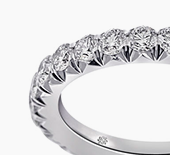
French Pave
In such a setting, the beads that secure the diamonds make a V shaped cutout beneath the gemstones. They are visible from the top as prongs that have been split.

Scalloped Pave
A ring will either have a peg head or an integrated head. In this case, the head is molded as a contagious piece of metal while gems sit at a lower level.
Types of Bands
The band or the ring shank can be thought of as the essence of the ring and is what that keeps it on one’s finger.

Flat
These bands have angled edges.

Comfort Fit
A rounded inside edge is made for comfort fit bands so that they provide coziness to the wearer.

Rounded
These bands have slightly softened external surfaces.

Knife Edge
A knife edge band has two slightly angled sides that coincide at the top.

Split Shank
The band divides into two parts before merging at the central point where the gemstone is bounded.

Cathedral
The central gemstone is bound between two arches that slowly move in the direction of the gem itself.

Bypass
Instead of running in a straight direction, the sides of the shank overlap each other.
Finishing Details
You can spice up your ring by adding a few finishing touches. These will improve the overall splendor of the ring you’ve chosen. Also, by choosing the right detail, you can make your ring look either modern or antique.

Milgrain
This is an intricate beaded effect that runs along the jewelry piece. The style is common in most antique jewelry. In some places, the style is also known as “millegrain”.

Matte/Brushed/Satin
This is a popular alternate to classic polished styles that are highly reflective. A matte finish adds a non-reflective aspect to the piece and makes it more textured. Adding this finish can reduce the onset of scratches as well.

Filigree
This is a vintage design aspect that uses threads of metal to add an artistic feel to your piece.

Hand Engraving
This is something that’s done by a jeweler who has considerable experience carving designs into metals like gold. Hand engraving makes the jewelry piece unique.

Hammered
This style also adds texture to the piece like the matte one in the form of soft indentations. Wear and tear remains hidden and therefore it is ideal for someone who remains active during most part of the day.
Enjoying our watch coverage? Get more of it in Google Search.