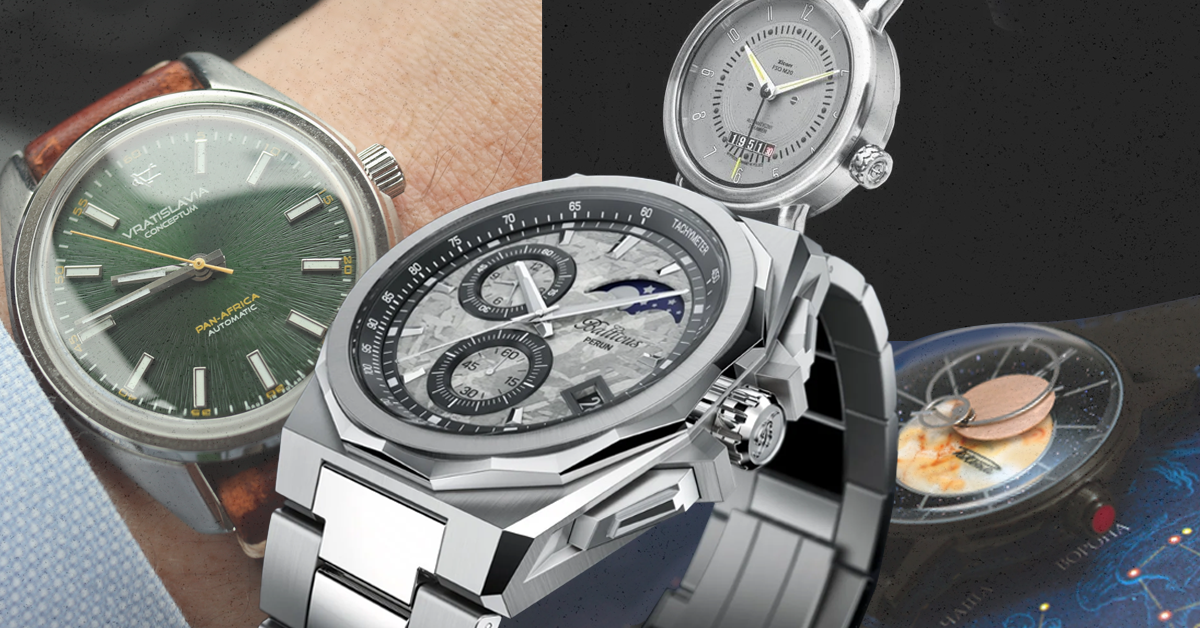
Any feature or function on a wrist-wear other than the standard time are called a watch complications. Complications range from simple additions to highly sophisticated works that require a set of functions to operate and years to perfect.
Date Complications
Just as it sounds, a Date Complication means addition of date to the existing time. The most common types of date complications are the following:
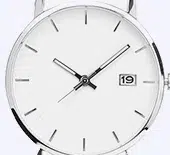
Date Window
Similar to Date Window, the Big Date also displays the day of month, however, it has a much more magnified view.
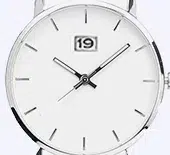
Big Date
Such watches have a center hand with a crescent that points towards the date, which is marked on the outside periphery of the dial. Also known as Bankers date.

Pointer Date
Such watches have a center hand with a crescent that points towards the date, which is marked on the outside periphery of the dial. Also known as Bankers date.

Subsidiary Dial
A Subsidiary Dial show the date on a secondary dial within the main dial and is used in conjunction with other complications.

Day-Date
The Day-Date complication displays the day of the week in addition to the date. Both the day and the date can be set through the crown by moving it in different directions.
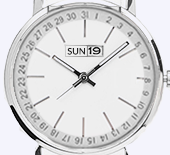
Triple Calendar
A Triple Calendar displays not just the day of the week but also shows the month in addition to the day of the month.
It is also known as a “complete calendar”.

Perpetual Calendar
This is the most sophisticated type of calendar that can be instilled within a watch making it a rare feature. It displays the complete date as well the year, keeping the leap year correction within the loop. Perpetual Calendar watches will only require correction in the year 2100.

Annual Calendar
This is a balance between a triple calendar and a perpetual calendar. It displays the day, month and year but doesn’t make leap year corrections, which must be made manually.

Equation of Time
This is the epitome of perfection with calendar watches. Also called EOT, these watches have all the features of a perpetual calendar but have one final unique feature, the difference between solar time and calendar time in minutes.
Chronograph Complications
Next to date complications, chronograph complications are the most common ones. Such complications add a stopwatch within the movement. The Types of Chronographs are:

Monopoussoir
Prior to 1923, all chronographs were monopousoirs. The one button chronograph cannot measure intermittent time spans while two button chronographs can.

Retour En-Vol
Also called the Flyback Chronograph, when the Retour-En-Vol’s second button is pushed, the counters reset and start again from zero, given that the chronograph is running.

Rettrapante
A chronograph having three pushers on the case and two second hands is a Rattrapante or split-seconds chronograph.

Tachymeter
A tachymeter isn’t something exclusive to watches. It is an instrument with which speed can be measured and installed in watches on the outer or inner bezel. It is usually an extension of the chronograph. The instrument measures speed in units per hour and for proper operation your distance and rate of speed should be constant.

Chronographs vs. Chronometers
A watch with stopwatch built right into its movement is called a chronograph whereas a watch that is outstandingly precise is known as a chronometer.
Other Complications
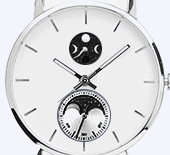
Moonphase Complication
This is a retro, aesthetic feature that indicates whether it’s a new, quarter, half or full moon. It was originally developed as a tool to help sailors make tidal calculations.

Power Reserve Indicator
A very useful complication, the Power Reserve Indicator analyzes the amount of elastic potential energy left within the watch by measuring the tension left in the mainspring. Some watches come with an internal power reserve lasting 10 days in which the indication is in days. This is a complication exclusive to mechanical watches as electric powered ones have batteries that last for months.

Jump Hour
In this complication, the hour is shown in an aperture that alters every 1 hour.

Alarm
This function is common to both manual, auto and quartz watches. Alarm time can be set to remind the user of a particular event. Some models give the user the liberty to manually wind the alarm while in some, the wrist winds it.

Minute Repeater
A small lever is placed on the side of the case, which when activated causes the Minute Repeated to chime out. It was a common installation in most pocket watches and now comes as a collectable feature.

The Tourbillon
The Tourbillon was invented by A.L. Breguet and maintains the balance within a watch. It neutralizes timekeeping errors that are a result of the gravitational pull of the earth as well as changing watch positions. It is a feature that is seldom used as a tool for accuracy but appreciated in rare, collectable watches. The feature requires a lot of effort, time and skill to develop.
Honorable Mentions
Dual Movement
This isn’t completely a complication. A dual movement watch will have two separate movements, running on two separate sources of power and determining their set time zones.
Dual Time
Dual time watches have both their displays working on a single movement.
GMT
A GMT or Greenwich Mean Time watch displays more than one time zones.
GMT with Independent Hour Hand
This is an extension of the GTM watch and has a regular hour hand which is independent of the 24-hour hand, completely altering the functionality of the watch.
GTM with Fixed Hour Hand
Developed by Rolex in the 50s, the complication makes a normal watch sound enough to be called a pilot’s watch. It has a unique hour hand that makes one revolution around the dial over the course of a day. When it points to six, it means noon while pointing to twelve means midnight.
World Time Zone
Such a watch has an inner rotating bezel as well as an outer bezel that lists major cities within the 24 time zones. The outer bezel may be set by the user while the inner bezel makes one revolution per 24 hours.
Enjoying our watch coverage? Get more of it in Google Search.