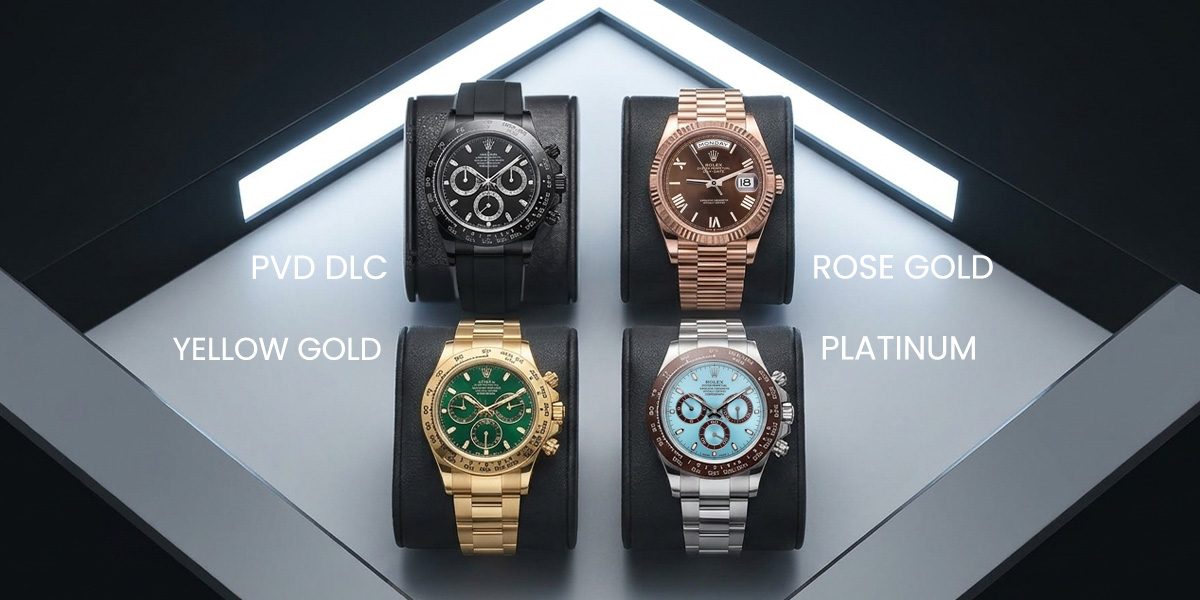
Bracelets for your Rolex are not just some metal pieces that connect your watch to your wrist they are pieces of history and character. There has been so many different types of rolex bracelets since the introduction of the Oyster in 1947. Rolex has created some very unique bracelets that anyone who knows can identify.
You may think all bracelets are the same but they actually each play a big role on the watch. Rolex created the jubilee bracelet in 1945 to honor Rolexs 40th anniversary. This bracelet has five pieces that make up one link. As you can tell the president bracelet was named after the president. One of which was President Lyndon B. Johnson. Last but not least is the pearl master. Which debuted in 1992 this bracelet has diamond’s all over and is made from only precious metals 18k gold.
There are also differences besides aesthetic when it comes to Rolex bracelets. You will see an Oyster bracelet on most of the sport watches such as the submariner and daytona. The jubilee is usually reserved for more elegant rolex watches. Rolex has even created new types of bracelets over the years. The Oysterflex was introduced in 2015 this is made from rubber and metal.

And here is the big question! Why should collectors care about all these bracelet types in 2025? Because knowing your Jubilee from your President doesn’t just make you sound smart at watch gatherings—it helps you understand the heart and soul of each Rolex model. The bracelet isn’t just an accessory; it’s part of what makes a Rolex a Rolex.
Table of Contents
Rolex Bracelet Types
Oyster Bracelet
The oyster bracelet is probably what most people think of when thinking about Rolex. It’s very distinctive and iconic. Patent on 1947 and introduced on the wrist in 1948 the oyster bracelet is something Rolex prides themselves on. The bracelet really represents Rolexs idea of practicality and beauty. You’d think that because the bracelet looks so simplistic there is not much going on. Wrong. The oyster bracelet has been improved upon for the past 70 years.
Oyster Bracelet Design Features

What makes an Oyster bracelet instantly recognizable? It’s all about that three-piece flat link design—broad center links with smaller links flanking each side. This clever configuration balances durability with just the right amount of visual flair. The early versions came with straight end links, creating a noticeable gap between bracelet and case that vintage enthusiasts now cherish. But in 1952, Rolex changed the game by introducing curved end links that merged seamlessly with the watch case. The GMT-Master reference 6542 proudly debuted these revolutionary curved end links in 1954.
The Oyster bracelet’s journey spans three distinct generations:
- Rivet-style (1940s-late 1960s) – These early bracelets featured hollow, folded links joined by visible rivets along the edges. They might be delicate by today’s standards, but collectors treasure them for their historical significance.
- Folded-link (1967-mid-1970s) – A step up in durability, these featured thicker construction with metal folded multiple times and secured with internal pins.
- Solid-link (mid-1970s-present) – The modern heavyweight champion, featuring solid links and eventually solid end links for maximum durability.
The clasps have seen their own revolution. Around 1969, Submariner and Sea-Dweller models got upgraded Oysterlock clasps with an additional safety catch—no more accidental openings during those deep dives! Today’s versions include clever innovations like the Easylink extension system (5mm adjustment without tools) and the Glidelock system on dive watches that lets you make precise 20mm micro-adjustments.
Oyster Bracelet Materials Used
The Oyster bracelet started life in stainless steel but has since expanded to include every material in Rolex’s arsenal. Most models feature Oystersteel (904L grade)—a premium stainless alloy that Rolex has used exclusively since 1985. This isn’t your average steel! It’s packed with chromium and molybdenum to fight off corrosion and impacts while keeping that brilliant shine.
But steel is just the beginning. Your wrist could be graced with:
- Yellow gold and Oystersteel (Rolesor)
- Everose gold and Oystersteel
- White gold
- Yellow gold
- Everose gold (Rolex’s proprietary rose gold alloy)
- Platinum
Each bracelet carries a specific code, with the final digit revealing its material: 0 for steel, 1 for Everose Rolesor, 3 for yellow Rolesor, 5 for rose gold, 6 for platinum, 8 for yellow gold, and 9 for white gold.
Oyster Bracelet Associated Rolex Models
The Oyster bracelet has made itself at home across almost the entire Rolex family, though it’s become particularly iconic on their sports watches. Models sporting this versatile bracelet include:
- Submariner – The dive watch legend, with brushed finish on steel models that cleverly hides scratches
- GMT-Master II – Often flaunting polished center links for that extra touch of class
- Daytona – The chronograph that collectors dream about
- Explorer and Explorer II – Built for adventure and looking good doing it
- Sea-Dweller and Deepsea – Serious dive watches with clasps to match
- Milgauss – The scientist’s antimagnetic companion
- Air-King – Born from aviation heritage
- Datejust – Available in multiple sizes with an Oyster option
- Sky-Dweller – For sophisticated globe-trotters
- Oyster Perpetual – The purest expression of what makes a Rolex a Rolex
The Oyster bracelet effortlessly bridges the gap between rugged tool watches and refined dress pieces. No wonder it’s earned its crown as the most versatile option in the Rolex bracelet kingdom.
Jubilee Bracelet

When Rolex turned 40 back in 1945, they didn’t just celebrate with cake and champagne—they created the Jubilee bracelet! Born specifically for the launch of the now-legendary Datejust, this bracelet wasn’t just another band; it was a statement piece that screamed refinement. While its core design has stayed remarkably true to form for over 75 years, Rolex has quietly tweaked and improved it along the way, making it both more durable and even more luxurious.
Jubilee Bracelet Design Features
One glance at a Jubilee bracelet and you know exactly what you’re looking at—that five-piece link pattern is unmistakable. Three smaller, polished center links catch the light between two larger, brushed outer links, creating this stunning play of textures and finishes. It’s this contrast that gives the Jubilee a decidedly dressier vibe compared to its sportier cousin, the Oyster bracelet.
The Jubilee bracelet has an interesting evolution story. In the 1940s, it started with curved links, then shifted to oval links in the 1950s. By the 1960s, Rolex was using stronger D-shaped links, and finally, in the 2000s, they introduced solid links that put an end to the dreaded “bracelet stretch” that plagued earlier models.
Here’s the thing about the Jubilee that makes it special—it’s incredibly comfortable to wear! The way those smaller links flex and move with your wrist is almost magical. And because the weight is distributed more evenly across all those links, it doesn’t feel as heavy as you might expect. Pretty clever engineering, right?
Jubilee Bracelet Materials Used
The Jubilee has been crafted from just about every premium material in Rolex’s arsenal:
- Oystersteel (Rolex’s fancy name for their 904L stainless steel)
- Rolesor (that gorgeous mix of Oystersteel with either yellow or Everose gold)
- 18k Yellow Gold (the original and oh-so-luxurious option)
- 18k White Gold (subtlety with a serious price tag)
- 18k Everose Gold (Rolex’s proprietary rose gold that doesn’t fade)
Did you know the first Jubilee bracelets were only available in gold? That’s right—they were strictly high-end luxury pieces. It wasn’t until after the President bracelet came around in the mid-1950s that Rolex started making Jubilees in two-tone and eventually all-steel versions. This broadened the appeal while keeping that elegant DNA intact.
Jubilee Bracelet Associated Rolex Models
While the Jubilee has graced several Rolex models over the years, it’s most synonymous with two distinct watches:
Datejust – This is the original pairing—after all, the Jubilee was literally created for this watch in 1945. Even today, a Datejust with a Jubilee bracelet is one of the most instantly recognizable Rolex configurations ever made. It’s practically the definition of a dress watch with personality.
GMT-Master II – In 2018, Rolex made waves by bringing the Jubilee back to the GMT-Master II line, starting with the beloved “Pepsi” bezel model. The following year, the “Batman” GMT joined the party too. Rolex even went as far as announcing that steel GMT-Master II models would come exclusively with Jubilee bracelets! Before this, you’d have to look at vintage models to find a GMT on a Jubilee.
Let’s be honest—if you’re planning to wear your Rolex while rock climbing or swimming with sharks, the Jubilee might not be your best bet. Those intricate links, while gorgeous, don’t handle extreme abuse quite as well as the tank-like Oyster bracelet. But for everyday wear and dressier occasions? The Jubilee is tough to beat for both looks and comfort.
Flat Jubilee

Flat Jubilee Technical Overview
Rolex’s 2025 Flat Jubilee bracelet reimagines the brand’s post‑war icon for modern integrated‑case sports watches such as the new Land‑Dweller. Still engineered in‑house at Plan‑les‑Ouates, the five‑piece link construction now features broad, planar center links that sit perfectly flush with the case mid‑section, creating an unbroken silhouette from lug to clasp.
- Metallurgy & Finishing
- 904L Oystersteel or 18 kt gold outer links receive a technical satin top surface, while their vertical flanks are mirror‑polished.
- Polished center links catch light across a single plane—Rolex added microscopic chamfers at the upper edges of both the case and the first outer links; when viewed from the side these chamfers form a continuous “circle of light,” emphasizing the bracelet’s integration.
- Ergonomics
- The flattened profile lowers the bracelet’s center of gravity, improving comfort on smaller wrists.
- A concealed Crownclasp with Easylink still offers an instant 5 mm extension for heat‑swollen wrists.
- Durability
- Screw‑fixed links and ceramic coated pins resist stretch, while Rolex’s latest Glidelock‑derived ratchet keeps the clasp footprint slim without sacrificing security.
By combining the original Jubilee’s elegance with the seamless flow of an integrated bracelet, Rolex has produced a strap that feels like a natural extension of the case—an evolutionary step backed by the brand’s eight decades of bracelet‑making expertise.
President Bracelet

Want to talk about true luxury? Let’s dive into the President bracelet, first unveiled in 1956 alongside the Day-Date. This isn’t just any bracelet—it’s practically royalty in the watch world! The name didn’t come by accident either. This bracelet earned its prestigious title through its connection with actual world leaders, especially those U.S. presidents who couldn’t resist strapping this beauty to their wrists.
President Bracelet Design Features
The President bracelet stands out immediately with its three-piece semicircular link design. Unlike the flat Oyster links we just discussed, these links are rounded and almost D-shaped, creating a flowing, liquid-metal look on the wrist. It’s like Rolex found the perfect middle ground—not as sporty as the Oyster but not as intricate as the Jubilee. You get sophistication with substance!
Here’s the kicker: the hidden Crownclasp. Introduced shortly after the bracelet’s debut, this clever mechanism blends right into the bracelet itself. The Rolex crown serves as the operating button, which means you get a seamless band circling your wrist with no ugly clasp breaking up the visual flow. Pure elegance!
Those polished surfaces catch light in a way that makes people notice. It’s definitely more “dress watch” than the brushed Oyster bracelet. But it’s not just about looks—these curved links hug your wrist all day without digging in. Despite being a substantial piece of metal, it might just be the most comfortable bracelet Rolex makes.
President Bracelet Materials Used
Let’s be honest—the President bracelet is exclusive with a capital E! You’ll never find one made of stainless steel or even two-tone. Rolex reserves this design strictly for precious metals, putting it firmly at the top of their bracelet hierarchy. Your options? They’re all luxurious:
- 18k Yellow Gold
- 18k White Gold
- 18k Everose Gold (Rolex’s special rose gold that doesn’t fade)
- Platinum
These aren’t just any metals either. Rolex creates these alloys in their own foundry, controlling the exact mixture of gold with silver and copper. This attention to detail ensures your President bracelet will keep its shine and strength for generations. The gold quite literally has a different composition than what you’ll find elsewhere!
President Bracelet Associated Rolex Models
The President bracelet plays hard to get. It appears on only two Rolex models:
Day-Date – This is the original and most famous pairing. The connection is so strong that most collectors don’t even say “Day-Date”—they just call the whole watch “the President.” Rolex made this nickname official in the 1980s by marketing it as the “Rolex President Day-Date Chronometer.”
Lady-Datejust – Some precious metal versions of this smaller watch can be had with the President bracelet, bringing that presidential luxury to women’s wrists too.
By keeping it so exclusive, Rolex has made the President bracelet incredibly desirable. It’s not just a watch part—it’s a statement that says you’ve reached the pinnacle of success. When you spot those semicircular links in yellow gold or platinum, you know you’re looking at something special.
Pearlmaster Bracelet

Want to talk about luxury? The Pearlmaster bracelet takes things to a whole new level! Created in 1992 as Rolex’s jewelry showpiece, this bracelet stands as the crown jewel in the brand’s lineup. It wasn’t just designed for any watch—Rolex specifically developed it for the launch of the Pearlmaster collection, showcasing their expertise not just in watchmaking but in creating pieces that blur the line between timepiece and jewelry.
Pearlmaster Bracelet Design Features
As you can see from the pictures below. There are many reasons why I love the pearlmaster. The bracelet has a 5 piece link with nice curves throughout. It is different than the oyster which has more boxy links and the jubilee is more complex. Every link on the pearlmaster is curved. Not only does this look nice but the bracelet feels great on your wrist.
When you combine this with the crownclasp you get something truly beautiful. The crownclasp allows you to open the bracelet by using a little crown. Which most people will never know about when your wearing it. So you get a smooth flowing bracelet around your wrist. Almost liquid metal around your arm!
Something else that you may not know is that the pearlmaster has ceramic in its links. This allows for the bracelet to be a little more flexible and durable. The polish on the pearlmaster links is very shiny as well. You will notice this if you have diamonds on your watch.
Pearlmaster Bracelet Materials Used
The Pearlmaster doesn’t mess around with ordinary materials. You won’t find stainless steel here! This bracelet comes exclusively in precious metals:
- 18k Yellow Gold – For that classic, warm luxury feel
- 18k White Gold – Perfect for setting off the sparkle of diamonds
- 18k Everose Gold – Rolex’s special rose gold that won’t fade over time
Many Pearlmaster bracelets don’t stop at gold, though. They often come adorned with carefully selected diamonds and colored gemstones. These can appear just in the center links or all throughout the bracelet for maximum impact. Rolex doesn’t cut corners here—each stone undergoes rigorous examination for cut, clarity, color, and carat weight. Only the best make it onto your wrist!
Pearlmaster Bracelet Associated Rolex Models
The Pearlmaster bracelet isn’t for every Rolex. It’s reserved for the cream of the crop:
Rolex Pearlmaster – Comes in either 34mm or 39mm sizes. The smaller version uses Caliber 2235 with a 48-hour power reserve, while the larger one gets Caliber 3235 with a robust 70-hour reserve. These watches often feature domed or gem-set bezels, and the dials? They’re something else—mother-of-pearl or completely covered in diamonds.
Lady-Datejust Pearlmaster – This beauty combines Datejust functionality with Pearlmaster glamour. The 29mm case creates a perfect harmony with those curved links, giving your wrist a silhouette that’s impossible to ignore.
Day-Date “Special Edition” Masterpiece – Some rare Day-Date special editions have featured the Pearlmaster bracelet. These watches are unicorns in the collecting world—incredibly rare and highly coveted.
Let’s be honest—if you’re after a Pearlmaster, you’re not just looking for a way to tell time. You’re making a statement about luxury, exclusivity, and uncompromising quality. With its exquisite design, precious materials, and limited availability, the Pearlmaster bracelet isn’t just a watch component—it’s jewelry art for your wrist.
Oysterflex Bracelet

Most folks think they know rubber straps—boring, functional, basic. But in 2015, Rolex flipped that notion upside down with the Oysterflex. Don’t call it a strap though! Rolex insists it’s a bracelet, and once you understand what’s going on beneath that black exterior, you’ll see why.
Oysterflex Bracelet Design Features
Strip away that sleek black exterior and what do you find? A metal heart! The Oysterflex hides a titanium-nickel alloy blade inside, covered with high-performance black elastomer. It’s like Rolex couldn’t choose between metal and rubber, so they said, “Why not both?” This clever hybrid gives you metal’s structure with rubber’s flex.
The design doesn’t stop there. Look closely and you’ll notice a raised center section creating a tiered profile instead of a boring flat band. But here’s the kicker: Rolex added wing-like cushions underneath that lift the bracelet slightly off your skin. These aren’t just for show—they keep air flowing to reduce sweat and help the watch sit perfectly on your wrist. Pretty smart, right?
True to Rolex form, the Oysterflex narrows elegantly toward the clasp. Depending which model you’re sporting, you’ll get either:
- The Yacht-Master and Sky-Dweller version: Oysterlock safety clasp with Glidelock extension (letting you adjust up to 15mm in tiny 2.5mm steps)
- The Daytona version: Folding Oysterlock safety clasp with Easylink (giving you a quick 5mm adjustment)
Oysterflex Bracelet Materials Used
This isn’t your average rubber band. The inner blade uses a superelastic titanium-nickel alloy that gives structure while staying light and bendy. The black elastomer coating? That’s high-density stuff similar to what’s used in performance cars. It shrugs off UV rays, salt water, and temperature changes like they’re nothing.
Most importantly, the elastomer keeps its properties over time—no deterioration from sweat or chemicals. Smart choice for something that’s constantly touching your skin!
You’ll only find the Oysterflex paired with gold Rolex cases—yellow gold, white gold, and Everose gold models get the honor. No steel models have received the Oysterflex treatment yet, keeping it firmly in the luxury category.
Oysterflex Bracelet Associated Rolex Models
The Oysterflex made its splashy debut on the Everose gold Yacht-Master in 2015. Makes perfect sense for a nautical watch, doesn’t it? The bracelet handles salt water and sunshine with ease, coming in both 40mm (ref. 116655) and 37mm (ref. 268655) sizes.
By 2017, Rolex decided the Daytona needed some Oysterflex love too. They went all in, replacing every leather strap option in the Cosmograph Daytona collection with this modern alternative. Notable models include:
- The warm-toned Everose gold Daytona ref. 116515LN
- Classic yellow gold Daytona ref. 116518LN
- Subtle white gold Daytona ref. 116519LN
The Sky-Dweller joined the party in 2020, with both Everose gold (ref. 326235) and yellow gold (ref. 326238) versions getting the Oysterflex treatment.
This bracelet is Rolex’s freshest take on the wrist attachment game—bringing modern materials to traditional luxury watches without sacrificing that unmistakable Rolex DNA. It’s all about balancing innovation with heritage, and the Oysterflex does it beautifully.
Leather Strap

Leather straps might seem like outliers in the Rolex bracelet family, but they’ve got a fascinating story to tell! These elegant bands carry both historical significance and a touch of exclusivity, becoming increasingly rare treasures in modern Rolex collections. While metal bracelets dominate the brand’s offerings, leather brings a sophisticated alternative that some collectors absolutely adore.
Leather Strap Design Features
Wondering what makes a factory Rolex leather strap different from aftermarket options? It’s all in the details! Rolex leather straps feature those clever metal lug hoods that create a seamless flow between case and strap. No awkward gaps here—just pure, refined elegance that screams Rolex quality.
The securing mechanisms are just as impressive. Some leather straps incorporate the same sophisticated Oysterlock clasps found on metal bracelets, while others feature the brilliant Easylink extension system, letting you adjust by 5mm without any tools. Your wrist swells in the afternoon heat? No problem! This thoughtful touch shows how Rolex thinks about real-world comfort, not just good looks.
The visual design leans toward understated class—clean stitching, subtle finishing, and timeless appearance. These aren’t flashy straps shouting for attention; they’re confident companions that look equally appropriate in a boardroom or at a dinner party.
Leather Strap Materials Used
Rolex doesn’t mess around when it comes to sourcing leather! Their alligator straps—the crown jewel of their leather options—come primarily from American farms, with 99% purchased from European Union tanneries. This isn’t just about luxury; it’s about responsibility too. By 2023, Rolex had traced 84% of their alligator leather through their meticulous supply chain management.
The quality control is seriously impressive. A whopping 86% of these tanneries hold Leather Working Group certification, with the same percentage of alligator leather certified by the International Crocodilian Farmers’ Association. And here’s something crucial—all alligator leather follows the Convention on International Trade in Endangered Species regulations. No ethical corners cut here!
For their lizard straps, Rolex achieved complete 100% traceability in 2023, with all tanneries EU-based and certified by the Leather Working Group. Even their calfskin—used less frequently—primarily (66%) comes from European Union sources. This commitment to quality and sustainability is exactly what you’d expect from a brand that never settles for second best.
Leather Strap Associated Rolex Models
Looking for a new Rolex on a leather strap? Your options are surprisingly limited! Currently, only the Rolex Perpetual 1908 comes fresh from the factory with a leather strap—specifically a gorgeous black or brown alligator with distinctive green lining. This scarcity makes leather-strapped Rolexes increasingly special in today’s market.
Back in the day, several prestigious models featured these elegant bands:
- The gold Datejust (particularly reference 116138) once flaunted colorful leather straps that added personality to this classic model
- The Day-Date collection saw some spectacular leather options, including that eye-catching white gold ref. 118139 with its cherry-colored strap from the “Stella”-inspired 2013 lineup
- Gold Daytona models proudly wore leather from the 1990s until 2017, when the Oysterflex bracelet stepped in as the new alternative to metal
- The sophisticated Sky-Dweller initially offered a rich brown leather option on its Everose gold variant before expanding to yellow and white gold models
- The elegant Cellini line historically came exclusively with leather straps, enhancing its dress watch character
As Rolex gradually phases out leather in favor of the innovative Oysterflex, these leather-equipped models from years past become increasingly collectible. What was once standard is now special—isn’t that how the best collections are built?
NATO Strap

Image Source : Gregoriades.com
Want to give your Rolex a totally different personality on the weekend? Enter the NATO strap—a bracelet rebel that wasn’t born in Rolex’s Swiss workshops but has stolen the hearts of collectors everywhere! These military-inspired bands might be aftermarket options, but they’ve carved out quite a following among Rolex owners looking to mix things up.
NATO Strap Design Features
What makes a NATO strap special? It’s all about that one-piece design that threads completely through the spring bars instead of just attaching to them. This clever setup comes straight from British military specs, with a main strap running under the watch case and two security loops keeping everything in place. Here’s the kicker: even if one spring bar breaks, your precious Rolex stays firmly on your wrist—not exactly a small detail when we’re talking about watches worth thousands!
Most NATO straps come equipped with stainless steel hardware that shrugs off moisture like it’s nothing. You’ll find these metal keepers and buckles in all sorts of finishes—polished, brushed, even PVD-coated—ready to match whatever Rolex model you’re sporting.
NATO Strap Materials Used
The classic NATO strap material? Good old nylon. It’s tough as nails, light as a feather, and dries in a flash if you get caught in the rain. This sturdy fabric just refuses to tear, making it perfect for extended wear—whether you’re diving, hiking, or just showing off at a barbecue.
But let’s be honest—sometimes you want something a bit more sophisticated. That’s where leather NATO straps come in, bringing elegance to the party while still keeping that secure one-piece design. Just don’t take them swimming!
For the water lovers among us, rubber NATO straps offer amazing resistance to everything from pool chlorine to ocean salt, plus they flex beautifully with your every move. And for those special occasions? Some crafty folks have created genuine alligator NATO straps with rubberized calf lining—luxury meets practicality in the best possible way.
NATO Strap Associated Rolex Models
Submariner and NATO strap—name a more iconic duo! Navy blue or that “Specter” pattern in black and gray look absolutely stunning on Rolex’s legendary diver. This pairing honors the watch’s underwater heritage while adding a casual, weekend vibe.
The Air-King has also become a NATO fan favorite, with straps available to perfectly fit its unique proportions. But why stop there? From the rugged Explorer to the globetrotting GMT-Master II and even the racing-inspired Daytona, any Rolex with lug widths between 18mm and 24mm can rock a NATO strap.
Many Rolex owners get creative with colors that highlight specific dial elements—like picking up red accents in the watch face with matching stripes on the strap. It’s all about making that Rolex uniquely yours, while still keeping it secure on your wrist through whatever adventures come your way.
Rubber Strap

When it comes to modern Rolex bracelet options, rubber brings something special to the table. It’s the new kid on the block in Rolex’s lineup, but don’t let that fool you—these aren’t your ordinary rubber bands! They offer unique performance benefits while still screaming “luxury” at every turn.
Rubber Strap Design Features
Here’s something that might surprise you—Rolex doesn’t actually call their rubber option a “strap” at all! The Oysterflex, introduced in 2015, is officially classified as a bracelet. Why? Because hiding underneath that sleek black exterior is a flexible titanium and nickel alloy blade core. This isn’t just rubber slapped on a luxury watch—it’s engineering genius.
The magic doesn’t stop there. Flip the Oysterflex over and you’ll find clever wing-like cushions that lift the bracelet slightly off your skin. These little wonders serve two purposes: they keep your wrist cooler by allowing air to flow underneath, and they help keep that precious Rolex sitting perfectly stable on your wrist. Pretty smart, right?
Depending on which model you’re looking at, the clasps are equally impressive:
- Yacht-Master and Sky-Dweller models get the Oysterlock safety clasp with Glidelock extension
- Daytona sports the folding Oysterlock with Easylink extension
This means you’re getting all the secure, adjustable goodness of Rolex’s metal bracelets, just with a more flexible, comfortable wearing experience.
Rubber Strap Materials Used
Not all rubber is created equal—and Rolex knows it. Quality rubber watch straps are typically made from vulcanized FKM rubber, which absolutely runs circles around regular silicone. Ever noticed how cheaper silicone straps become dust magnets? That’s exactly what Rolex avoids.
The high-grade elastomer used in the Oysterflex stands up to everything you might throw at it—saltwater, sunlight, chemicals, temperature swings—you name it. It doesn’t degrade over time or lose its shape. This is rubber engineered to the same exacting standards as everything else bearing the crown logo.
Rubber Strap Associated Rolex Models
You might think rubber straps would be paired with Rolex’s most affordable models, but you’d be wrong! In a classic Rolex twist, they offer the Oysterflex exclusively on precious metal models. It’s not a budget option—it’s a premium choice for those who want both luxury and performance.
Currently, you’ll find the Oysterflex on:
- Gold Yacht-Masters (available in 37mm, 40mm, and 42mm)
- Select gold Daytona chronographs (references 116518LN, 116515LN, and 116519LN)
- Gold Sky-Dwellers (references 326238 and 326235)
With prices starting around $23,850 for the Everose gold Yacht-Master 37mm, these are serious watches for serious collectors. And if you’re hoping for color options beyond classic black? You’ll have to keep waiting. Rolex sticks firmly to black Oysterflex bracelets, maintaining that sleek, sophisticated look that works with everything.
Settimo Bracelet
Settimo Bracelet – modern flair, vintage soul
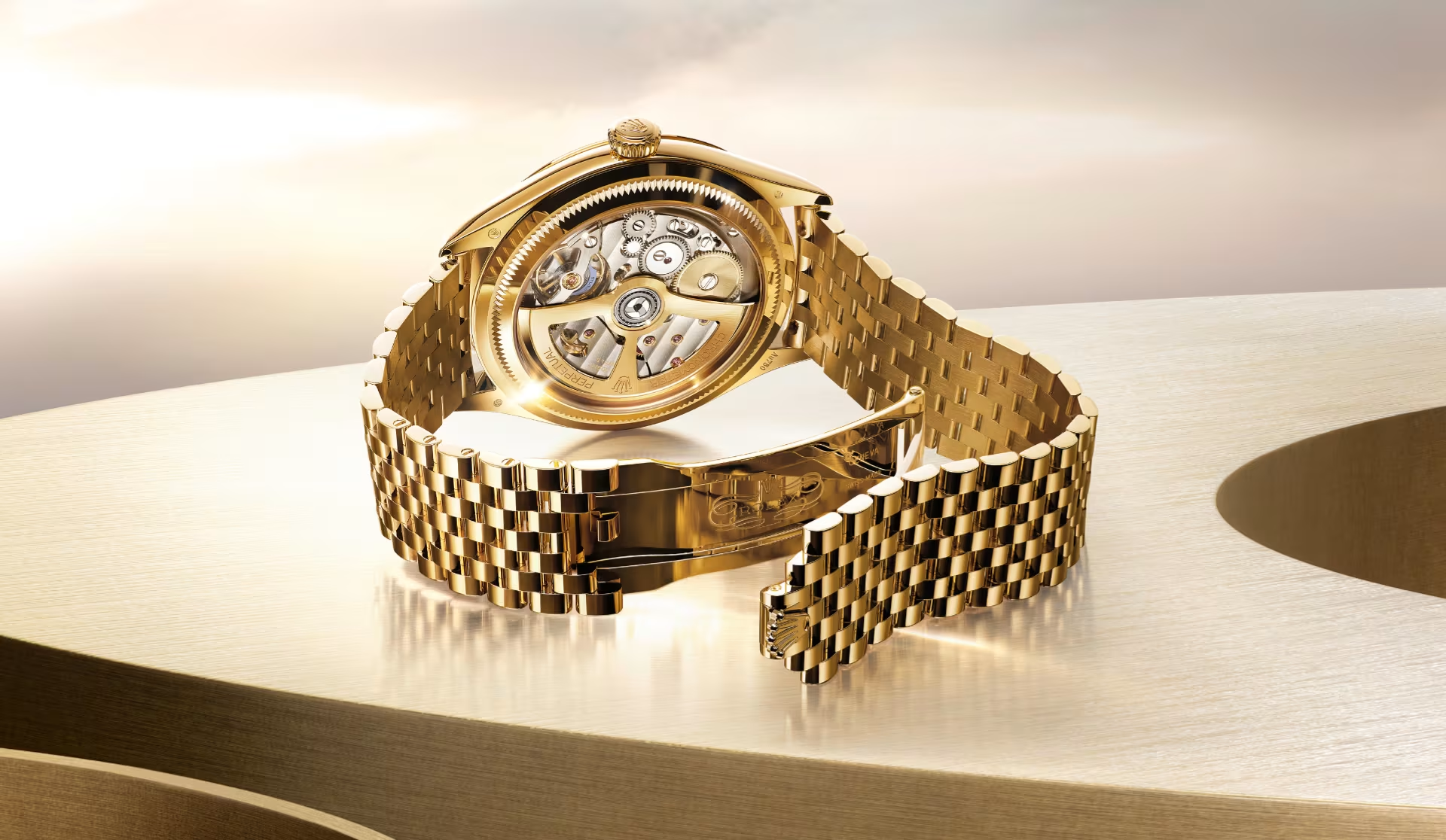
Rolex has come out with their latest bracelet known as the Settimo. The Settimo was designed to only be worn with the 1908. Imagine a high end jewelry piece but made with steel and/or gold. The bracelet consists of many small half rounded links that are all polished to give it that diamond like shine.
The new attachment allows the bracelet to sit very close to the case and remain hidden from the eye. Making it look as if its coming from the case itself. It features a hidden crown clasp that will keep your links attached. Much like what we saw on older rolexs that featured jewelry like bracelets. So overall the Settimo is great addition to the 1908 which pays homage to classic watches. If your looking for something new in a Rolex Bracelook this may be your answer.
Rolex Barcelets Comparison Table
Let’s put it all together! Here’s what makes each Rolex bracelet stand out from the rest. Looking at this table, you’ll see at a glance how these bracelets differ in design, materials, and which watches they typically adorn. Whether you’re hunting for your first Rolex or adding to your collection, this breakdown helps you understand what makes each bracelet special.
And here’s the big question! Which bracelet matches your personal style and needs? The table below gives you the quick facts to make that decision easier. From the versatile Oyster to the prestigious President, each has its own personality and purpose.
| Bracelet Type | Year Introduced | Design Features | Materials Used | Associated Models | Notable Characteristics |
|---|---|---|---|---|---|
| Oyster | 1947 | Three-piece flat link structure; Curved end links (1952) | Oystersteel, Yellow gold, Everose gold, White gold, Platinum, Rolesor combinations | Submariner, GMT-Master II, Daytona, Explorer, Sea-Dweller, Milgauss, Air-King, Datejust, Sky-Dweller, Oyster Perpetual | Most versatile and robust bracelet; Features Easylink and Glidelock adjustment systems |
| Jubilee | 1945 | Five-piece link construction; Three smaller polished center links flanked by brushed outer links | Oystersteel, Rolesor, Yellow Gold, White Gold, Everose Gold | Datejust, GMT-Master II | Originally designed for Datejust; Known for comfort and flexibility |
| President | 1956 | Three-piece semicircular link design; Hidden Crownclasp | 18k Yellow Gold, White Gold, Everose Gold, Platinum only | Day-Date, Select Lady-Datejust models | Exclusively available in precious metals; Associated with world leaders |
| Pearlmaster | 1992 | Five-piece rounded link design; Concealed Crownclasp | 18k Yellow Gold, White Gold, Everose Gold; Often set with diamonds and gemstones | Rolex Pearlmaster, Lady-Datejust Pearlmaster | Most jewelry-oriented bracelet; Features ceramic inserts for flexibility |
| Oysterflex | 2015 | Titanium-nickel alloy core with black elastomer coating; Wing-like cushions underneath | Black elastomer over metal blade; Paired with gold cases only | Yacht-Master, Daytona, Sky-Dweller | Combines metal durability with rubber comfort; Features various clasp systems |
| Leather Strap | N/A | Metal lug hoods; Clean stitching | Alligator, Lizard, Calfskin | Perpetual 1908, Historical models (Cellini, Daytona, Sky-Dweller) | Increasingly rare in modern collection; CITES compliant materials |
| NATO Strap | N/A | One-piece construction; Passes through spring bars | Nylon, Leather, Rubber | Aftermarket option for most models | Not officially produced by Rolex; Popular for customization |
| Rubber Strap | N/A | Similar to Oysterflex when official; Various designs for aftermarket | Vulcanized FKM rubber (aftermarket) | Aftermarket option for most models | Official rubber options limited to Oysterflex bracelet |
| Settimo | 2025 | Seven-piece flat links | 18k yellow gold | 1908 | Discreet flat design with 7 small links |
You see, Rolex doesn’t just make these different bracelets because they can—each serves a specific purpose and creates a distinct feel on the wrist. Some, like the Oyster, have been around since the 1940s, while others like the Oysterflex represent Rolex’s more recent innovations. This variety lets you match your bracelet to your lifestyle, whether you’re diving in the Submariner, attending a gala with your Day-Date President, or sailing with a Yacht-Master on an Oysterflex.
Conclusion
Its more than just a way to keep your watch on your wrist. There is something special about a Rolex bracelet that many don’t understand until they get into them. Once you learn about Rolex bracelets you will never look at Rolex watches the same again.
Since 1947 the oyster bracelet has been the go to choice for many Rolex models. You can find them on just about any Rolex model you like. Whether it’s your everyday sub or your dressy datejust the oyster bracelet will work with almost any model. Next is the jubilee bracelet with its five link pattern that shines from every angle.
How about the president. This is where the name comes from the presidents that have wore this bracelet. Only made for gold and above models. The president bracelet features a semi circle link design. If your looking for more bling the pearlmaster is your answer. With round links most pearlmaster’s will have diamonds set in the bracelet.
Rolex has also created some new bracelet designs in recent years. The oysterflex looks like a rubber band but when you put it on your wrist you’ll know its not. The oysterflex has a metal core that’s covered in elastomer.
As you can see there is more to know about Rolex than what meets the eye. Once you start learning about bracelets you open yourself to more options. Not only does it add to your comfort when wearing your watch but it also adds to its appearance. Some may even buy their model based on the bracelet alone.
So what makes your ideal Rolex. There are so many reasons that you should love your Rolex. Its not only how the bracelet fits on your wrist but it also can make you smile when your looking at it.
FAQs
What are the main types of Rolex bracelets available?
Rolex offers several bracelet types, including the Oyster, Jubilee, President, Pearlmaster, and Oysterflex. Each has unique design features and is associated with specific Rolex models.
Which Rolex bracelet is considered the most versatile?
The Oyster bracelet is widely regarded as the most versatile Rolex bracelet. It’s known for its durability and appears on a wide range of Rolex models, from sports watches to dress pieces.
Are Rolex bracelets made of precious metals?
Many Rolex bracelets are available in precious metals. The President bracelet, for example, is exclusively crafted from 18k gold or platinum. Other bracelets like the Oyster and Jubilee are available in both steel and precious metal versions.
How has Rolex innovated with bracelet design in recent years?
Rolex has introduced the Oysterflex bracelet, which combines a flexible metal core with a high-performance elastomer exterior. This innovation offers the durability of metal with the comfort of rubber.
Can I customize my Rolex with different strap options?
While Rolex doesn’t officially offer customization, many enthusiasts use aftermarket options like NATO straps or rubber straps to personalize their watches. However, this may affect the watch’s warranty and water resistance.
Enjoying our watch coverage? Get more of it in Google Search.