The Rolex Datejust thickness gets overlooked when choosing between models, yet it determines how the watch sits on your wrist and slides under your cuff. Thickness affects daily comfort more than diameter alone. The Datejust 41 measures just 12.0 mm in case thickness, while the Datejust 36 shares a similar 12mm profile. You need to know datejust dimensions, including datejust 41 thickness and rolex datejust case thickness, to select the right fit. This piece breaks down rolex datejust thickness mm in every model and explains how thickness affects wearability for your wrist size and lifestyle.
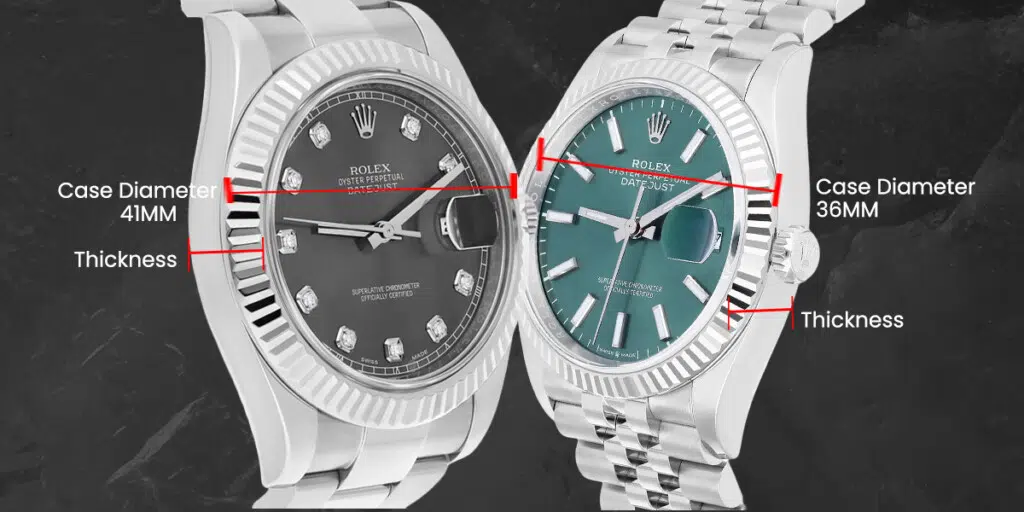
Table of Contents
What Does Case Thickness Mean for a Datejust?
Case thickness measures the vertical height from the caseback’s bottom to the crystal’s top. This dimension determines how tall your watch stands on your wrist. Rolex Datejust thickness sits around 13mm typically, positioning it in the everyday sports watch category that balances comfort with presence.

Why Thickness Matters Beyond Size
Thickness affects your daily experience more than you might expect. A watch measuring thin on paper can still feel awkward on a small wrist. A slightly thicker case can look perfect on a larger wrist. Your wrist shape determines how any measurement translates to comfort.
The difference between a watch that slips under your cuff and one that catches on fabric often comes down to just a few millimeters. Slim profiles slide under shirt cuffs more easily. The 13mm-thick Datejust remains low-profile for daily wear. The 16mm Submariner provides rugged durability for diving.
Thickness changes how your watch balances on your wrist. The watch may feel top-heavy if the case sits too tall relative to its diameter. This leads to discomfort or frequent repositioning during wear. A well-proportioned watch distributes weight evenly across your wrist.
Visual presence changes with thickness as well. Thicker watches appear more substantial and sport-oriented. Slimmer profiles create a refined, discreet appearance. The Datejust strikes a middle ground, so it offers versatility for both casual and formal settings.
How Rolex Measures Case Thickness
Rolex measures case thickness from the caseback’s bottom to the crystal’s top. This measurement captures the entire profile that sits against your wrist and extends upward. Other manufacturers sometimes exclude crystal height or measure in different ways. This makes direct comparisons difficult.
Multiple components contribute to the final measurement. The bezel adds 2 to 3mm to overall height in rotating bezel dive watches. Crystal thickness affects how your watch handles pressure. Thicker crystals resist deformation better under external force. Caseback profile also plays a role. Different designs use varying profiles, with some sitting flatter and others more domed.
Movement architecture impacts thickness a lot. Automatic movements add thickness compared to manual-wind calibers because they must package rotor systems. The rotor mass and its supporting architecture consume vertical space that hand-wound movements avoid.
Thickness in Relation to Other Dimensions
Assessing thickness together with diameter ensures optimal balance. A 40mm to 44mm professional watch on an active lifestyle may require a thicker case for shock resistance. Formal settings favor thinner cases for smooth integration with dress shirts and jackets.
Two watches can share the same diameter and still wear very differently because of thickness, lug design or bezel style. The rolex datejust case thickness works in harmony with its 36mm or 41mm diameter to create balanced proportions.
Watch thickness across Rolex models ranges from 10mm on a 36mm Air-King to 18mm on a Deepsea. Most Rolex models remain fairly slim, especially compared to many modern tool watches. The Datejust falls into the 12mm to 14mm range that most wearers find comfortable.
Your wrist size and shape remain the greatest determining factors in terms of how thick of a watch you can wear comfortably. A thinner case will rest close to your wrist and make it look more sleek. The right thickness for you depends on your individual anatomy and priorities though.
Rolex Datejust 36 Thickness and Dimensions
Modern Datejust 36 models maintain a 12mm case thickness. This makes them one of the slimmer options in the Rolex lineup. Vintage references like the 1601 measure slightly thinner at 11.7mm, but current production models standardize at the 12mm mark in the collection.
Case Thickness of the Datejust 36
The rolex datejust 36 thickness of 12mm creates a profile that looks even more slender when worn. This measurement positions the watch low on your wrist and avoids the bulky appearance that thicker cases can create. The 12mm specification pairs with the 36mm diameter to produce balanced proportions that suit various wrist sizes.
Your watch sits close to your wrist due to this slim profile and creates a sleek appearance that works in professional environments. The thickness allows the Datejust 36 to slip under shirt cuffs without catching on fabric. This makes it suitable for business and formal wear where your watch should complement your outfit rather than dominate it.
Complete Datejust 36 Dimensions
The datejust dimensions go beyond thickness to create the full wearing experience:
Case Diameter: 36mm
Thickness: 12mm
Lug-to-Lug: 43.1mm to 44mm
Lug Width: 20mm
Weight: 121 grams with all links
The 43.3mm lug-to-lug span fits well on smaller wrists, somewhere between 6 to 6.5 inches in circumference. This measurement helps the watch sit balanced on your arm and prevents overhang that can occur when lug-to-lug measurements exceed wrist width.
The 20mm bracelet width spreads across your wrist and gives the Datejust 36 wrist presence that exceeds what you’d expect from its size. This wider bracelet creates visual balance and distributes weight evenly during wear.
How the 36mm Wears Due to Its Thickness
The rolex datejust case thickness makes the 36mm version comfortable enough that you might forget you’re wearing it during daily activities. The watch becomes a true classic in terms of comfort and offers an unobtrusive presence on your wrist throughout the day.
The 36mm Datejust looks better on thinner wrists measuring less than 17cm, or about 6.7 inches. Wrists under 6 inches receive strong recommendations for the 36mm size. Medium wrists between 6 to 7 inches can wear either the 36mm or 41mm, with personal preference determining the final choice.
The dimensions make the watch wear like timepieces from decades ago and cater to the popular preference for classic proportions. The measurements preserve the refined esthetic that made the Datejust iconic while being more modern and robust than earlier versions.
Rolex Datejust 41 Thickness Specifications

Rolex refined its larger Datejust offering with the introduction of the 41mm version. The result is a watch that wears more elegantly than its predecessor and retains substantial wrist presence.
Datejust 41 Case Thickness in MM
The datejust 41 thickness measures 12mm. Many enthusiasts call this the sweet spot for watches around 40mm in diameter. This measurement sits on your wrist with ease and creates a profile that balances presence with comfort.
Some measurements show the watch at 11.7mm, and others record 11.64mm. These minor variations stem from different measurement techniques or points on the case. The consensus remains that the rolex datejust 41 thickness hovers around 12mm. You get a watch that slides under most shirt cuffs without difficulty.
The 12mm specification works well for this case size, especially when you have a 40mm width. Extensive wear testing shows this thickness appears ideal. The profile creates enough substance to feel solid without becoming obtrusive during daily activities. Other Rolex models known for wearability include the Submariner and GMT-Master. Both measure 12mm thick at 40mm wide.
Datejust II vs Datejust 41 Thickness Comparison
The Datejust II preceded the current 41mm model and measured thicker at 12.17mm to 12.22mm. The Datejust 41 slimmed down to 11.70mm. This reduced the profile by half a millimeter. The difference seems minor on paper, but it contributes to a more refined wearing experience.
Rolex achieved this slimmer profile through proportional refinements rather than simply changing the case height. The Datejust 41 features slimmer bezels and thinner lugs compared to its predecessor. These changes created a watch that looks more graceful on the wrist and maintains the same 41mm diameter.
The Datejust II appeared more bulky and masculine due to its thicker bezel and heavier lugs. Stand both models side by side and you can see how the earlier design granted the watch more presence through increased dimensions throughout. The Datejust 41 returns to the classic Datejust esthetic. It functions as a scaled-up version of the traditional 36mm model with all its elegant proportions intact.
Complete Dimensional Profile of the 41mm
The datejust dimensions for the 41mm model create a complete package optimized for wearability:
The case diameter measures 41mm, though actual measurement shows 39.5mm across in some testing. The lug-to-lug span reaches 47.5mm to 47.6mm. This places it just below the 48mm threshold that watch enthusiasts value. This sub-48mm measurement represents a sweet spot for wrist comfort and allows the watch to sit on most wrist sizes without overhang.
Lug width measures 21mm and creates substantial bracelet presence that distributes weight. Coupled with the balanced case shape, these proportions deliver contemporary sizing that wears comfortably throughout your day.
How Thickness Affects Daily Wearability

Thickness determines whether your Datejust becomes a daily companion or remains in the watch box. The 12mm rolex datejust thickness places it in a sweet spot that handles most wearing scenarios without compromise.
Fitting Under Shirt Cuffs
Your shirt cuffs become the main thing to think about with formal attire. Under cuff compatibility sits around 11mm maximum. The Datejust measures 12mm thick and pushes beyond this threshold a bit, but remains manageable for most dress shirts. Watches measuring 16mm thick create noticeable complications. They catch on fabric and sit at awkward angles.
If you enlarge shirt cuffs to accommodate larger watches, functional problems arise. The sleeve risks slipping too far down your hand or compromising the excess fabric needed for proper arm extension. Some watch enthusiasts have one cuff sized larger to accommodate their timepiece, though this approach requires careful tailoring to avoid imbalance.
Slender wrists benefit from cases under 13mm thick so the watch slides under a cuff rather than getting stuck on it. The datejust dimensions work well here and allow the watch to slip beneath most business shirts without requiring wardrobe adjustments.
Weight Distribution and Comfort
Thicker watches feel heavier and less comfortable for extended wear. There’s tension between wearability and durability. Field comfort sits around 11 to 14mm depending on case diameter. Watches beyond 15mm feel cumbersome for extended wear.
The rolex datejust case thickness at 12mm reflects careful balance. Thinner sacrifices protection. Thicker reduces comfort without proportional capability gains. Your watch should distribute weight evenly across your wrist rather than creating pressure points that require frequent repositioning.
Perceived Size vs Actual Thickness
A 40mm watch measuring 15mm thick wears much larger than a 40mm watch at 10mm thick. Visual presence changes above 13mm. The datejust 41 thickness at about 12mm creates substantial presence without appearing overly sporty or bulky.
Thickness adds to overall feel on your wrist. Thin profiles appear more elegant. Thick profiles more rugged. The rolex datejust thickness mm strikes a middle ground suitable for office environments and weekend activities both.
Thickness Effect on Different Wrist Sizes
Small wrists require slimmer cases measuring 7-9mm. For those with smaller wrists, case thickness around 6mm to 8mm receives recommendations. Medium wrists handle versatile choices from 9-12mm. Large wrists accommodate thicker cases from 12-15mm.
The rolex datejust 36 thickness at 12mm works well for medium to smaller wrists. For larger wrists, you can opt for thicker cases from 8mm to 14mm to maintain balanced appearance. The datejust 41 thickness serves medium to larger wrists without overwhelming proportions.
Choosing Your Ideal Datejust Thickness
Selecting the right rolex datejust thickness requires evaluating how you spend your days and what occupies your closet. The 12mm datejust dimensions work in most scenarios, but your specific needs determine whether this measurement serves you.
Think About Your Lifestyle and Wardrobe
Formal watches under 12mm suit dress shirts, while sports models above 13mm deliver rugged durability. The Datejust’s 12mm rolex datejust case thickness positions it at the threshold. This measurement allows the watch to slide beneath cuffs without creating bulk if you wear tailored suits and formal attire on a regular basis. Professions requiring active movement or outdoor work benefit from the substance a 13mm profile provides.
The 36mm version leans toward traditional elegance and pairs easily with tailored suits and formal attire. The 41mm offers a sportier edge that complements contemporary casual wear. Both sizes transition naturally from day to night, but each communicates a different personality.
Wrist Size and Thickness Relationship
Wrists under 6.75 inches tend to pair more naturally with the 36mm case, while wrists over 7 inches may favor the 41mm. The 36mm Datejust receives recommendations if you have small wrists under 6 inches. Medium wrists between 6 to 7 inches can wear either size based on preference. Large wrists over 7 inches find the 41mm Datejust provides better proportion. Wrist shape and bone structure influence how a watch wears.
Testing Thickness Before Purchase
Visit an authorized Rolex dealer to get hands-on experience that numbers alone can’t provide. You can feel the actual weight and comfort on your wrist when you try them on, see how each size matches your bone structure, and check how the watch moves with your arm. Trying both sizes side by side often clarifies which feels more natural.
Conclusion
The rolex datejust thickness of 12mm strikes a balance between elegance and substance, making it suitable in most wearing scenarios. Whether you choose the classic 36mm or the contemporary 41mm, you’re getting a profile that works under dress shirts while providing enough presence on weekends.
So your wrist size and daily activities should guide your decision between these two sizes. The 36mm delivers timeless proportions on smaller wrists and in formal settings, while the 41mm offers modern presence if you prefer substantial wrist coverage.
Visit your nearest authorized dealer to experience both sizes firsthand. Your perfect Datejust thickness becomes clear once you see how each model sits on your wrist.
Enjoying our watch coverage? Get more of it in Google Search.