
Who Is the Owner of Cartier? The Richemont Empire Revealed
If you’ve ever wondered who is the owner of Cartier, you might be surprised to learn that this iconic Parisian jeweler operates more than 200

If you’ve ever wondered who is the owner of Cartier, you might be surprised to learn that this iconic Parisian jeweler operates more than 200 stores in 125 countries of all types with a brand value of $12.2 billion. The answer reveals a complex corporate structure that changed a family-run atelier into a global powerhouse. Richemont, the world’s fourth-largest luxury goods company, owns Cartier after acquiring full control by 2012. The Swiss-based conglomerate controls Cartier through a holding structure the Rupert family owns. This piece explores the ownership story, from Richemont’s acquisition timeline to the current leadership structure. You’ll understand exactly who owns Cartier and how the Cartier parent company operates within the broader Richemont empire today.
The ownership story doesn’t start with a simple buyout. Richemont’s relationship with Cartier traces back to the late 1960s. Anton Rupert sought a 20% stake in Cartier America in exchange for producing Cartier-branded cigarettes at that time. This original connection formed through licensing negotiations and were the foundations of what would become a decades-long acquisition process.
The formal acquisition began in 1993. Vendôme Luxury Group, which was 70% owned by Richemont at that time, purchased a majority stake in Cartier from a group of investors led by Joseph Kanoui. This marked Richemont’s first controlling position in the jewelry house. Richemont bought the remaining 30% of Vendôme in 1998 and eliminated the Vendôme name. Cartier came under Richemont’s control more directly.
The acquisition reached completion in 2012. Richemont purchased all outstanding shares of Cartier. This final transaction gave Richemont 100% ownership of the brand and cemented Cartier’s position as the crown jewel of the Richemont portfolio.
The financial details of these transactions remain undisclosed. Neither the 1993 majority stake purchase, the 1998 Vendôme combination, nor the 2012 final acquisition came with price tags reported publicly. The three-phase structure allowed Richemont to increase control gradually while maintaining operational stability at Cartier.
The transformation started with Robert Hocq, owner of Silvermatch lighter company, who explored buying Cartier alongside investors in 1968. Hocq died in a car accident in Paris in 1979. Anton Rupert acquired a majority stake and combined Cartier’s divisions from France and the United States into one entity. This combination set the stage for Johann Rupert to later spin off Richemont in 1988 and bring Cartier into the corporate structure fully.
South African entrepreneur Johann Rupert founded Richemont in 1988, but the story begins decades earlier with his father Anton Rupert. Anton started the Rembrandt Group in 1941 with a focus on tobacco manufacturing. The elder Rupert built the business into the world’s fourth-largest tobacco company and expanded into wines and spirits.
Johann was born in 1950 and joined Rembrandt in 1984 after working at Chase Bank in Manhattan and Lazard Frères. He led the 1988 spin-off that created Richemont as a separate Switzerland-based entity and grouped luxury operations including Rothmans and Dunhill. Johann Rupert’s net worth reached $10.70 billion as of 2023, which made him the wealthiest person in South Africa.
The Rupert family maintains control through Compagnie Financière Rupert. This entity holds a 51% voting stake in Richemont while owning just 10% of the equity. Johann serves as chairman and largest shareholder of the group he built.
Richemont ranks as the world’s third-largest luxury goods company by both market value and revenue. The conglomerate generated €21 billion in revenue and operates more than 2,410 monobrand boutiques in markets worldwide.
The company employs over 40,000 people representing 130+ nationalities based in 36 locations around the world. Women comprise 58% of the workforce. The average employee tenure is eight years.
Richemont maintains headquarters in Geneva, Switzerland, with five core regional offices that span Europe, Americas, Asia Pacific, Japan, and Middle East/India/Africa. Nicolas Bos became Richemont’s chief executive in June 2024 and replaced Jérôme Lambert. Bos was formerly CEO of Van Cleef & Arpels.
The company describes itself as a “family-spirited group” that takes a long-term view in nurturing its portfolio. Each brand operates with dedicated management teams that preserve distinctive craftsmanship. Central functions provide guidance and support. This structure allows brands like Cartier to maintain their heritage while benefiting from group resources.
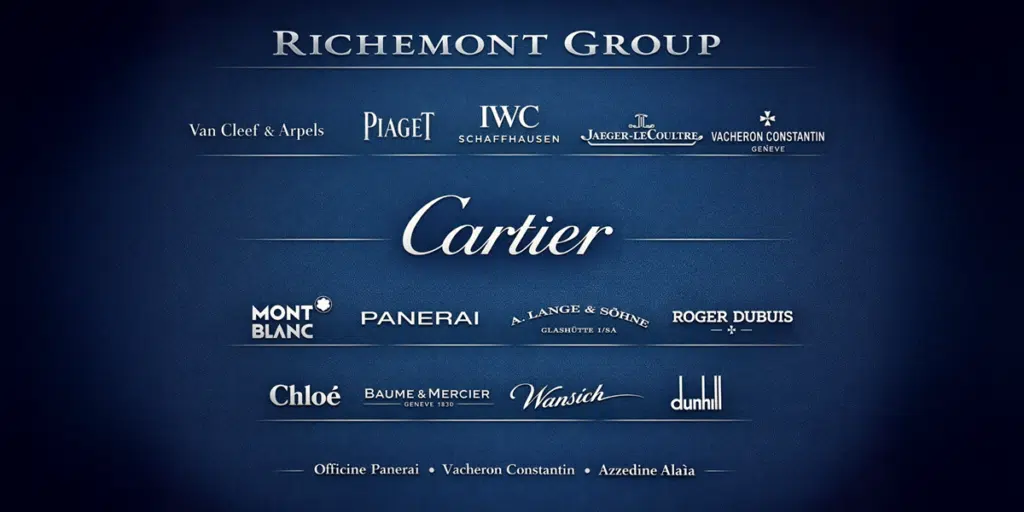
Cartier represents just one jewel in Richemont’s crown. Richemont organizes its portfolio into three distinct divisions as of 2023. Jewelry accounts for 67% of sales, specialist watchmaking generates 20%, and other businesses contribute 13%.
The jewelry division houses four brands: Cartier, Van Cleef & Arpels, Buccellati, and Vhernier. Van Cleef & Arpels joined Richemont in 1999 when the company acquired a 60% stake and later increased it to 80% by 2001. Buccellati came aboard in 2019. Vhernier became part of the portfolio in 2024 through a private transaction. This division outperforms other segments consistently. Jewelry sales grew 11% in Q4 and 8% year-over-year.
Eight brands comprise the watchmaking division: A. Lange & Söhne, Baume & Mercier, IWC Schaffhausen, Jaeger-LeCoultre, Panerai, Piaget, Roger Dubuis, and Vacheron Constantin. Richemont acquired Vacheron Constantin in 1996 and followed with Panerai in 1997. The year 2000 brought three major additions: A. Lange & Söhne, IWC Schaffhausen, and Jaeger-LeCoultre. Roger Dubuis joined in 2008.
The fashion portfolio spans 12 brands that include Alaïa, Chloé, Delvaux, dunhill, Montblanc, Peter Millar, and Watchfinder & Co. Chloé became part of Richemont in 1985. Alaïa joined in 2007. Peter Millar was acquired in 2012, Watchfinder & Co in 2018, and Delvaux in 2021.
Gianvito Rossi represents one of the newest additions. Richemont acquired a controlling stake in 2023. The company also acquired Vhernier in 2024 and deepened its commitment to Italian jewelry craftsmanship.
Louis Ferla assumed the role of CEO at Cartier on September 1, 2024. He replaced Cyrille Vigneron, who retired after eight years leading the brand. Ferla joined Richemont in 2001 with Alfred Dunhill before moving to Cartier in 2006. He held senior positions across the Middle East, India and Africa and became CEO of Cartier China. He served as CEO of Vacheron Constantin from 2017 until his Cartier appointment.
Vigneron transitioned to Chairman of Cartier Culture & Philanthropy. He now focuses on social and charitable initiatives. Cartier surpassed €10 billion in annual revenue during his tenure.
Compagnie Financière Rupert, controlled by Johann Rupert, holds 6,418,850 Richemont ‘A’ shares and 537,582,089 Richemont ‘B’ shares. This represents about 10% of the company’s equity, but the structure grants 51% of total voting rights.
Richemont operates with two share classes. Class A shares trade publicly with standard voting rights. Class B shares, held by Compagnie Financière Rupert, carry enhanced voting rights. Parties associated with Johann Rupert held an additional 2,921,335 ‘A’ shares as of March 31, 2025.
Cartier cannot be purchased as a standalone stock. Those seeking exposure to the brand must buy shares of Richemont, listed on the SIX Swiss Exchange under ticker ‘CFR’. Richemont A shares also trade on the JSE with ISIN CH0210483332. The B shares remain unlisted and represent 9.1% of the company’s equity.
The dual-class structure gives the Rupert family effective veto rights over major strategic decisions despite their minority economic stake. Johann Rupert stated he will not change this capital structure and views it as foundational for sustained control.
The ownership structure behind Cartier reveals a sophisticated corporate hierarchy. Richemont owns the brand outright, while the Rupert family maintains control through a dual-share system that grants them 51% voting rights despite holding just 10% equity. Anyone interested in Cartier’s future direction or investment opportunities needs to understand this arrangement. You cannot buy Cartier stock directly, but you can invest in Richemont shares on the SIX Swiss Exchange. This gives you exposure to this iconic jewelry house and its 20+ sister brands.
If you’ve ever wondered who is the owner of Cartier, you might be surprised to learn that this iconic Parisian jeweler operates more than 200
Do engagement rings have to be diamond? The answer might surprise you. The tradition of diamond engagement rings dates back to 1477, but diamonds became
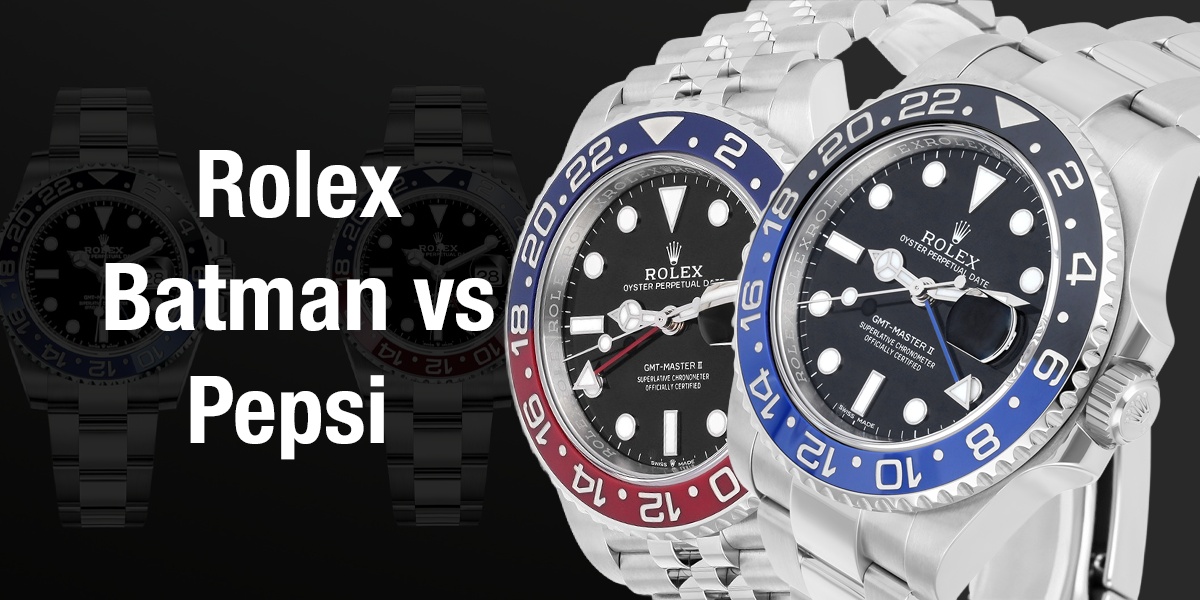
The choice between the Rolex Batman vs Pepsi goes beyond bezel colors. These two GMT-Master II models share similar technical specifications but trade at vastly