
The Tudor Ranger vs Rolex Explorer debate continues to spark discussion among watch enthusiasts looking for the ideal adventure timepiece. With the Tudor Ranger’s 2022 reintroduction, you now have a compelling alternative that retails from around $3,150, while the Rolex Explorer starts at $7,350. Both watches feature the popular 39mm case size and offer excellent wearability to fit most wrist sizes. These tool watches share similar DNA and purpose, but they differ by a lot in price and movement technology. You might be drawn to the Tudor Ranger 39mm for its value proposition or the Rolex Explorer 39mm for its legendary status. Understanding their main differences will help you make an informed decision for your collection.
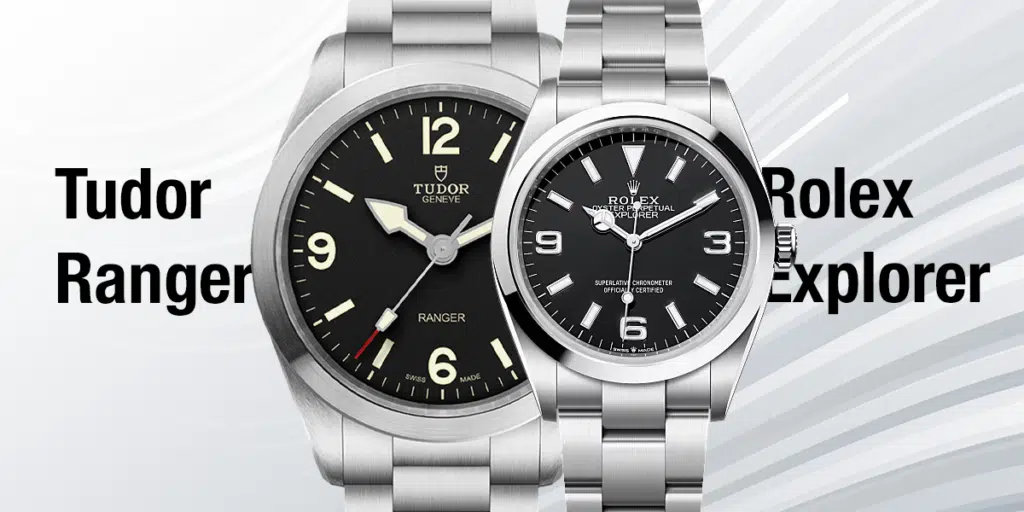
Table of Contents
Tudor Ranger 39mm vs Rolex Explorer 39mm: Design and Case Specifications
Both watches share the 39mm case diameter and 47mm lug-to-lug measurement, making them wear the same on most wrists. The Tudor Ranger measures 12mm thick. The Rolex Explorer 214270 comes in at 11mm. This 1mm difference stems from the Tudor’s more heavily domed sapphire crystal, as opposed to the Explorer’s flat sapphire design.
The Tudor Ranger features a fully brushed 316L stainless steel case with a smooth, satin-brushed bezel. The Rolex Explorer uses 904L stainless steel (Oystersteel) with a polished bezel that creates a distinct visual contrast. Both watches maintain 100 meters of water resistance and have screw-down crowns.
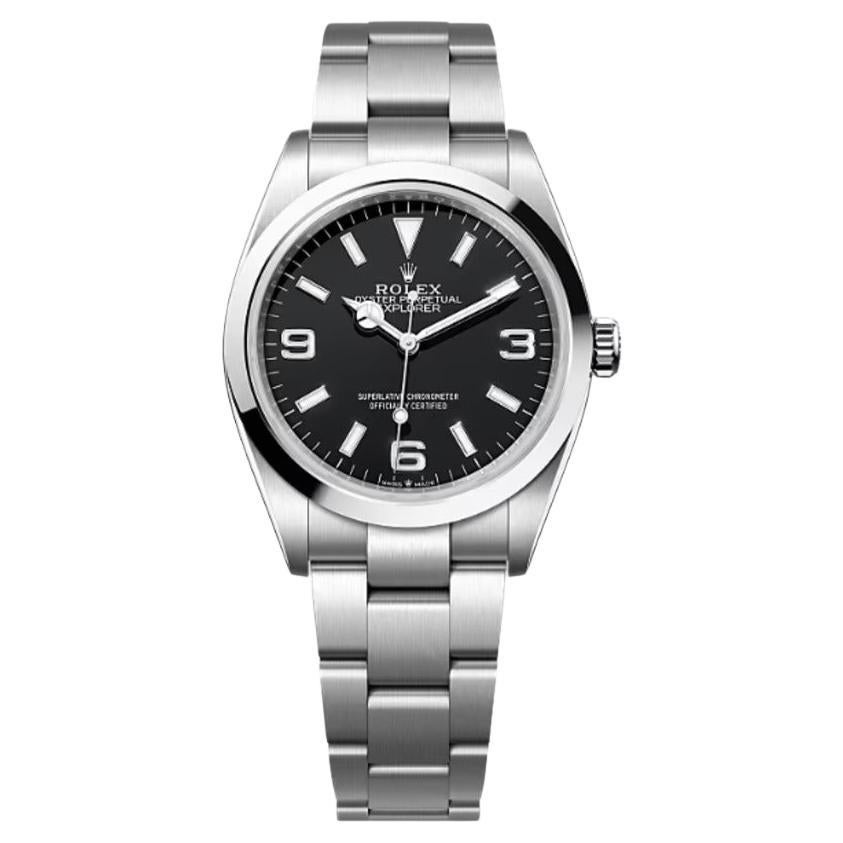
Dial designs follow similar paths. The Tudor Ranger displays large Arabic numerals at 3, 6, 9, and 12 o’clock on its matte black domed dial. The Rolex Explorer presents numerals at 3, 6, and 9 with an inverted triangle at 12 o’clock, paired with Mercedes-style hands. Neither watch has a date window, so they retain their clean, tool-watch esthetic.
The Tudor comes with a three-link bracelet featuring the T-fit rapid adjustment system. The Rolex offers an Oyster bracelet with Oysterlock clasp and 5mm Easylink comfort extension.
Movement Technology and Performance Comparison
The Tudor Ranger 39mm houses the Manufacture Caliber MT5402, a COSC-certified chronometer that Kenissi produces. This movement operates at 28,800 vibrations per hour with 27 jewels and delivers approximately 70 hours of power reserve. The MT5402 features a variable inertia balance with a silicon balance spring for magnetic resistance, mounted on a sturdy traversing bridge.
The Rolex Explorer houses the Caliber 3230, which Rolex developed and manufactured entirely in-house. This movement offers 70 hours of power reserve at the same 28,800 vph beat rate. The 3230 incorporates Rolex’s patented Chronergy escapement for improved energy efficiency, a blue Parachrom hairspring for shock and magnetic resistance, and Paraflex shock absorbers.
Accuracy standards reveal a notable difference. The Tudor MT5402 achieves -2/+4 seconds per day accuracy after full assembly, exceeding COSC’s standard -4/+6 specification. The Rolex movement receives Superlative Chronometer certification with tighter tolerances of -2/+2 seconds per day after casing. Both movements undergo COSC testing first, but Rolex subjects each watch to additional proprietary testing that simulates real-life wearing conditions.
Price, Availability, and Value Assessment
Retail pricing creates the most obvious divide between these adventure watches. The Tudor Ranger 39mm ranges from $3,375 to $3,900 on the bracelet, with fabric strap versions priced at $3,350 to $3,550. The Rolex Explorer starts at $7,250 and extends to $11,750 depending on configuration. This price gap of over $3,500 positions the Tudor Ranger as an available entry point to seek a manufactured movement tool watch.
Availability patterns differ in 2026. Tudor Rangers reach buyers with shorter wait times and better stock levels at authorized dealers. The Rolex Explorer has become more attainable now, particularly the 36mm and 40mm variants. Wait times have dropped to weeks or a few months for first-time buyers at many locations. Some authorized dealers now offer Explorers with minimal waiting periods. This represents a move from the years-long waitlists of 2021-2023.
Resale dynamics favor the Rolex Explorer vs Tudor Ranger comparison. Current Explorer references trade around $8,450, often at or above retail prices. Vintage Explorer models like the reference 1016 can exceed $25,000. Tudor Rangers maintain steady resale interest with moderate appreciation, though values remain below the growth seen with Rolex sport models.
Tudor Ranger vs Rolex Explorer: Comparison Table
|
Feature |
Tudor Ranger 39mm |
Rolex Explorer 39mm |
|
Price & Value | ||
|
Retail Price |
$3,150 – $3,900 (bracelet: $3,375-$3,900; strap: $3,350-$3,550) |
$7,250 – $11,750 (starts at $7,350) |
|
Resale Value |
Moderate appreciation, steady interest |
Trades around $8,450, often at or above retail; vintage models (ref. 1016) exceed $25,000 |
|
Availability (2026) |
Shorter wait times, better stock at authorized dealers |
Wait times dropped to weeks or few months for first-time buyers |
|
Case Specifications | ||
|
Case Diameter |
39mm |
39mm |
|
Case Thickness |
12mm |
11mm |
|
Lug-to-Lug |
47mm |
47mm |
|
Case Material |
316L stainless steel |
904L stainless steel (Oystersteel) |
|
Case Finish |
Fully brushed |
Not specified |
|
Bezel |
Smooth, satin-brushed |
Polished |
|
Water Resistance |
100 meters |
100 meters |
|
Crown |
Screw-down |
Screw-down |
|
Crystal |
Heavily domed sapphire |
Flat sapphire |
|
Dial & Hands | ||
|
Dial Color |
Matte black domed |
Black |
|
Numerals |
Large Arabic numerals at 3, 6, 9, and 12 o’clock |
Arabic numerals at 3, 6, and 9; inverted triangle at 12 o’clock |
|
Hands Style |
Not specified |
Mercedes-style |
|
Date Window |
No |
No |
|
Bracelet | ||
|
Bracelet Type |
Three-link bracelet |
Oyster bracelet |
|
Clasp/Extension |
T-fit rapid adjustment system |
Oysterlock clasp with 5mm Easylink comfort extension |
|
Movement | ||
|
Caliber |
MT5402 (Manufacture, produced by Kenissi) |
3230 (entirely in-house) |
|
Certification |
COSC-certified chronometer |
Superlative Chronometer |
|
Power Reserve |
~70 hours |
70 hours |
|
Beat Rate |
28,800 vph |
28,800 vph |
|
Jewels |
27 |
Not specified |
|
Accuracy |
-2/+4 seconds per day (after full assembly) |
-2/+2 seconds per day (after casing) |
|
Special Features |
Variable inertia balance with silicon balance spring, traversing bridge |
Chronergy escapement, blue Parachrom hairspring, Paraflex shock absorbers |
Conclusion
Deciding between Tudor Ranger vs Rolex Explorer comes down to weighing your preferences. If you want the best value for money spent the Tudor Ranger offers incredible bang for your buck with a reliable manufacture movement at $3,375. If your heart is set on Rolex the Explorer is worth the extra money for tighter tolerance on accuracy and better resale value at $7,350. Functionally they are nearly identical from a size standpoint at 39mm as well as being adventure-ready. You won’t notice a huge difference in performance when worn on your wrist so choose whichever best fits your budget and style preference.
Enjoying our watch coverage? Get more of it in Google Search.