
Steve McQueen’s Watch Collection: What Makes These Timepieces Worth $100,000+ Today
Steve McQueen watches command astronomical prices that might make you look at your own timepiece differently. The “King of Cool’s” personal watches have sold for

Tritium and Luminova showcase a striking difference in watch illumination technology today. Tritium gas tubes shine up to 100 times brighter than SuperLumiNova. This fact makes the comparison vital for anyone who cares about watch visibility in dark conditions.
Tritium watch dials glow steadily for years without needing light exposure. SuperLumiNova needs about 30 minutes of charging to produce light that lasts between 30 minutes to eight hours. The story of these technologies reveals an interesting twist – Rolex stopped using tritium in 1997 and switched to SuperLumiNova. Tritium had been the standard on watch dials since 1962. The debate between tritium and Super Luminova remains active, especially given tritium’s impressive 12.3-year half-life. SuperLumiNova’s dependence on regular light exposure adds another dimension to this ongoing discussion.
Professional divers need reliable illumination underwater, while collectors evaluate vintage timepieces carefully. Knowledge of these luminescent technologies helps make smarter decisions about watch purchases. Let’s take a closer look at how each technology works, their actual performance, and which option might suit your needs better.
Your watch’s glowing dial represents decades of scientific breakthroughs and progress. The mechanisms behind watch luminescence explain why some timepieces glow brighter or longer than others.
Modern watch lume works through photoluminescence. This process happens when a material absorbs photons (light energy) and releases that energy as visible light. The atomic level shows electrons in the luminous material absorbing incoming photons and becoming “excited.” These electrons jump to higher energy states. Light becomes visible when these electrons return to their normal states.
Phosphorescence—the specific type of photoluminescence used in watch dials—is different from fluorescence in one vital way. Fluorescent materials release absorbed energy almost instantly (within nanoseconds). Phosphorescent materials release energy nowhere near as fast, taking many hours. Scientists call this a “forbidden” energy transition because excited electrons enter special energy states where re-emission is statistically unlikely but possible.
![Tritium vs Luminova: Which Watch Lume Actually Lasts Longer? [2025]](https://watchmydiamonds.com/wp-content/uploads/2025/04/luminosity-1.png.webp)
Watch history shows several distinct luminescent technologies:
The experience from dangerous radioactive materials to safe photoluminescent compounds spans over a century. Marie and Pierre Curie found that there was radium in 1898, and watchmakers quickly utilized it for its natural glow. The mid-20th century revealed radium’s severe health hazards—it causes radiation sickness and creates radon gas, a powerful carcinogen.
The industry made a fundamental change to tritium in the 1960s. Though still radioactive, tritium posed much less risk as a low-energy beta emitter. Rolex and other manufacturers used tritium until the late 1990s when regulatory concerns led to another change.
A major breakthrough came in 1993. Nemoto & Co. in Japan created LumiNova, a strontium aluminate-based compound that glowed ten times brighter and longer than earlier phosphors. The company partnered with RC-Tritec AG in 1998 to establish LumiNova AG Switzerland. This partnership supplied the Swiss watch industry with what became Super-LumiNova.
This progress shows both technological advancement and increased safety awareness in watch manufacturing. Each breakthrough balanced brightness, duration, and safety—the foundations of effective watch luminescence.
Tritium technology became a vital advancement in watch illumination after radium’s dangers came to light. The story of watch lume took an interesting turn when manufacturers started using this element in timepieces.
![Tritium vs Luminova: Which Watch Lume Actually Lasts Longer? [2025]](https://watchmydiamonds.com/wp-content/uploads/2025/01/panerai_luminor_bitempo_stainless_steel_44mm_blue_dial_pam01361_1_1_.jpg)
Tritium (symbol T or ³H) is a radioactive form of hydrogen that has one proton and two neutrons in its nucleus. This makes it heavier than regular hydrogen. The element goes through beta decay with a half-life that lasts about 12.3 years. The light comes from a clever bit of science: tritium’s decay sends out low-energy beta particles (electrons) that hit phosphor coating. These electrons make the phosphor glow with visible light. Unlike Super-LumiNova, tritium keeps glowing without needing any external light to “charge” it.
Watch companies used to paint tritium directly onto watch dials. Many brands, including Rolex, used this method until it was banned in 1998 over safety worries. The biggest problem was that tritium could seep through the case and touch the wearer’s skin.
So manufacturers came up with GTLS (gaseous tritium light sources)—tiny glass tubes filled with small amounts of tritium gas. These tubes sit on watch hands, hour markers, and numbers. They have phosphor coating inside that reacts with tritium’s electrons. This state-of-the-art solution is both safe and versatile. It lets watchmakers create displays in different colors to boost readability in the dark.
Tritium’s glow follows a steady pattern based on its 12.3-year half-life. Here’s what that means:
All the same, tritium shines brighter than Super-LumiNova after several hours in the dark. Most watch brands say tritium lights stay useful for about 20-25 years.
Tritium in watches is very safe despite being radioactive. Beta particles from tritium are too weak to get through human skin. The glass tubes keep all radiation sealed inside. A broken tube would release such a tiny amount of gas that it would quickly scatter with no real health effects.
Three things make tritium watches safe: they use very little tritium, beta particles are weak, and the glass tubes provide proper containment. Watch companies can use tritium in consumer products with approval from regulators. Each watch shows a rating (T25 or T100) that tells you its total radiation level in millicuries.
The watch industry saw a game-changing non-toxic alternative emerge after the radioactive materials era. Super-LumiNova stands as one of the most important breakthroughs in watch illumination technology. It provides safety and maintains excellent visibility.
Japanese entrepreneur Kenzo Nemoto started the story of Super-LumiNova with his luminous paint business in 1941. His company first served Japan’s military during World War II before he applied his expertise to clocks and watches. Nemoto & Co. launched LumiNova in 1993, a revolutionary non-radioactive phosphorescent material. That same year, RC Tritec AG opened its doors in Switzerland and got licensing rights to make and sell this technology as “Super-LumiNova”.
The chemical makeup of Super-LumiNova includes strontium aluminate with added europium and dysprosium. This mix creates a very effective phosphorescent material. Europium works as the main luminescent center, and dysprosium helps store and slowly release energy. This ceramic-based compound is very hard. It rates 9 on the Mohs hardness scale, just below diamond at 10.
Super-LumiNova works like a rechargeable light battery, unlike tritium. The material soaks up photons from sunlight or artificial light. This excites electrons to higher energy states. Light emerges as these electrons return to their normal state.
The process stays completely safe without radioactive elements. Users can repeat the charging-discharging cycle forever without wear. Light intensity and charging time affect brightness. Sunlight gives the best results. A full charge lets Super-LumiNova glow up to 15 hours, though it dims over time.
Super-LumiNova comes in three quality grades:
Eight different afterglow colors exist: blue, green, violet, white, yellow, orange, pink, and ultramarine. The C3 variant (cream-colored) sets the standard brightness (100%). Other colors range from BGW9 (white, 95% brightness) to dark red (22% brightness).
Rolex stopped using tritium in 1998 after authorities banned it for watch applications. The company first switched to Luminova, which they saw as better than tritium despite needing light exposure. By 2000, Rolex had moved to Swiss-made Super-LumiNova. The company developed its own Chromalight compound in 2008. This material glows blue instead of green and shines for up to eight straight hours.
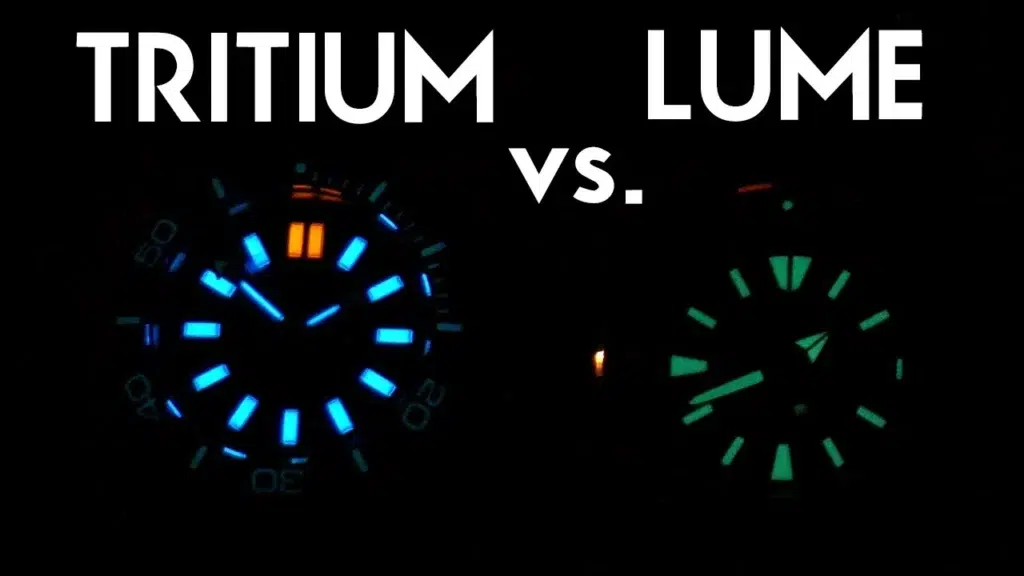
A head-to-head comparison of modern watch illumination technologies reveals several key factors that determine which system best fits your needs.
Recent brightness tests show major differences between these technologies. Ball Watch Company states their tritium gas tube system glows about 100 times brighter than Super-LumiNova. The story changes right after charging though. Super-LumiNova creates an intense “lume bloom” that outshines tritium tubes temporarily. This creates an interesting situation – Super-LumiNova wins the brightness race right after charging but quickly loses its advantage as the glow fades.
Test results clearly show tritium’s advantage in lasting illumination. Tritium keeps a steady brightness all night without needing any light exposure. Super-LumiNova becomes much dimmer than tritium after just 60 minutes in the dark. Standard grade Super-LumiNova becomes hard to see after about 1.25 hours, while tritium continues to glow steadily.
Environmental conditions affect these technologies in different ways. Tritium works the same way in all conditions – underwater, extreme temperatures, or total darkness – without needing a charge. Navy SEALs specifically asked for tritium illumination in their watches for this reason. Super-LumiNova’s performance can suffer over time due to humidity.
These illumination systems age differently. Tritium gas loses about 10% brightness each year due to its 12.3-year half-life. Tests on 11-year-old tritium watches showed no visible difference to new models. Super-LumiNova stays chemically stable without deterioration but needs regular light exposure to work.
Both systems come in multiple colors. Tritium tubes use different phosphor coatings inside glass tubes to create various colors. Super-LumiNova offers eight afterglow colors: blue, green, violet, white, yellow, orange, pink, and ultramarine. The colored versions of both technologies don’t glow as brightly as their standard green/white counterparts.
Your watch needs and usage scenarios determine the right luminescent technology choice. Personal preferences and practical needs should guide your decision between tritium and Super-LumiNova.
Professional divers need reliable illumination where light can’t reach the depths. Marathon’s TSAR (Tritium Search and Rescue) watches have become a favorite among search and rescue teams. These timepieces come with T25 tritium tubes that stay visible underwater without any pre-dive charging. Seiko’s Prospex Marinemaster series provides bright LumiBrite that glows even in daylight. The Black Series Limited Edition SBDX033’s illuminated markers and first 20 minutes of the dive bezel help time decompression stops perfectly.
Both technologies work well for daily use, though practical differences set them apart. Ball watches’ Self Powered Micro Gas Tubes (H3) system outperforms competitors without needing light exposure. Citizen’s Promaster Aqualand NY0040-50W features a full lume dial that watch enthusiasts call superior to Seiko’s Lumibrite. Tritium proves more beneficial if you often move between bright and dark environments since it needs no “charging” throughout the day.
Tritium dials fade over time, creating the “patina” that vintage enthusiasts value. Rolex switched from tritium to Super-LumiNova in 1998, which makes pre-1998 tritium Rolex models more collectible. The watch’s intended ownership duration matters – tritium dims noticeably after 12 years, while Super-LumiNova keeps performing consistently with proper charging.
The technology choice affects pricing significantly:
| Feature | Tritium | Super-LumiNova |
|---|---|---|
| Original Brightness | Up to 100 times brighter than Super-LumiNova in darkness | Creates intense “lume bloom” that temporarily outshines tritium after charging |
| Duration | Steady glow throughout night without charging | 30 minutes to 8 hours (diminishing intensity) |
| Charging Requirements | None – self-powered | Needs ~30 minutes of light exposure |
| Lifespan/Degradation | 12.3-year half-life; brightness decreases ~10% yearly | Indefinite with proper charging; no chemical degradation |
| Safety | Safe inside sealed glass tubes; low-energy beta radiation cannot penetrate skin | Non-toxic, non-radioactive |
| Color Options | Multiple colors through phosphor coatings | Eight colors: blue, green, violet, white, yellow, orange, pink, ultramarine |
| Environmental Performance | Reliable performance in all conditions (underwater, darkness, extreme temperatures) | Humidity affects performance; results depend on charging conditions |
| Best Applications | Military, diving, professional use that needs constant illumination | Everyday wear, situations with regular light exposure |
| Cost Range | Entry: $390-$600 Mid: $1,299-$2,099 High: $2,500+ | Costs less at equivalent quality levels |
| Notable Industry Use | Major brands like Rolex used it until 1998 | Current industry standard that most manufacturers adopted after 1998 |
The choice between tritium and Super-LumiNova comes down to your specific needs rather than a clear “best” option. Tritium gives you consistent illumination without needing light exposure and manages to keep its glow all night with predictable degradation over its 12.3-year half-life. Super-LumiNova shines brightest right after charging but fades over several hours.
Professional divers and military personnel lean towards tritium because it works reliably in tough conditions, especially underwater where visibility is vital. Marathon’s TSAR series watches remain a top pick among professionals who need dependable illumination during critical operations. These tritium watches work great for people who move between bright and dark spaces without time to charge their timepiece.
Super-LumiNova works best for everyday use in normal lighting conditions. This technology has without doubt changed watches since 1998 by offering non-radioactive illumination that lasts forever with proper care. Watch enthusiasts should think about this key difference, especially since pre-1998 tritium Rolex models have become valuable collectibles thanks to their unique aging patterns.
Price gaps between these technologies vary substantially across brands and models. Tritium watches usually cost more at similar quality levels, but both options give you excellent visibility when designed properly.
The rise from dangerous radium to safer tritium and finally to non-radioactive Super-LumiNova shows how the watch industry balances performance and safety. Whatever technology you pick, knowing the science behind watch illumination helps you make smart choices based on your lifestyle, priorities, and practical needs instead of marketing claims.
Tritium offers constant illumination for years without requiring light exposure, while Super-LumiNova provides intense initial brightness but diminishes over several hours.
Tritium has a half-life of 12.3 years, meaning it loses about 50% of its brightness after this period. Most manufacturers suggest a practical useful life of 20-25 years for tritium illumination.
Super-LumiNova does not chemically degrade over time. However, its performance can be affected by factors like moisture exposure and excessive UV radiation, which may lead to a gradual decrease in luminosity.
Professional divers often prefer tritium for its consistent illumination in extreme conditions, especially underwater. Watches like Marathon’s TSAR series with tritium tubes are popular among diving professionals.
Yes, tritium tubes can be replaced when they dim significantly. However, this service can be expensive, with costs ranging from $300 to $700 depending on the watch model and number of tubes.
Steve McQueen watches command astronomical prices that might make you look at your own timepiece differently. The “King of Cool’s” personal watches have sold for

Most people assume a wealthy family or large corporation owns Rolex. The truth might surprise you. This prestigious watchmaker operates under the control of a

Rolex watches mean much more than luxury status symbols to elite warriors in special forces. These prestigious timepieces can save lives in the intelligence and