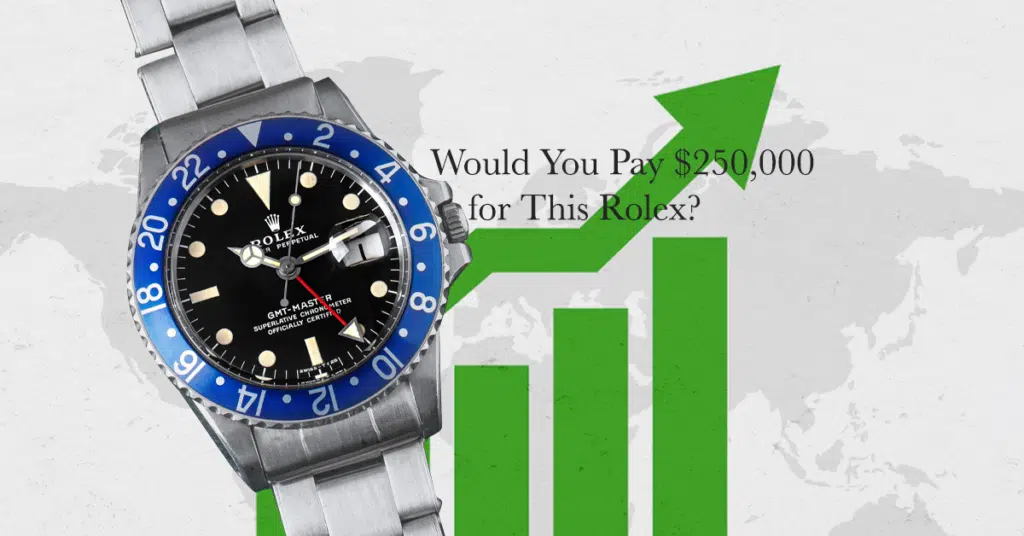
The Rolex Blueberry is one of the most sought-after vintage watches of all time. But just what is it? Its identity remains one of mystery in an already murky vintage watch sea. One thing is for certain though, it’s a version of the GMT-Master. What makes this watch so unique is its all blue bezel. The Blueberry was never officially distributed to the public making it the holy grail unicorn watch of all serious Rolex collectors.
Many collectors ask why the Rolex Blueberry GMT fetches such astronomical prices today. The Rolex 1675 Blueberry has emerged as one of the hottest pieces in vintage Rolex collecting. Original blue bezel inserts in pristine condition now cost more than all other parts of the watch combined. The Rolex Blueberry’s premium price tag brings major authenticity challenges. Questions about its origins and legitimacy remain unanswered, which makes the Rolex 1675 Blueberry both highly coveted and extremely risky to buy.
A timepiece that costs over $250,000 demands complete understanding of its unique features and potential risks. This piece will help you find the fascinating story behind this controversial watch. You’ll learn to spot authentic examples and decide if investing in what experts call “the most desirable and trickiest watch one could set out to acquire” makes sense in 2025.
Table of Contents
The Origins of the Rolex GMT-Master and Reference 1675
The mystique of the Rolex Blueberry GMT makes more sense when you look at its roots in aviation history. This remarkable story started with a partnership that changed watchmaking forever and laid the groundwork for what would become one of the world’s most sought-after watches.
Pan Am and the Birth of the GMT-Master
The GMT-Master’s story began in the early 1950s when Pan American World Airways reached out to Rolex with a unique request. Air travel between continents was becoming common, and Pan Am needed a special watch. Their pilots needed to see multiple time zones at once during their long flights around the world. Pan Am’s President, Juan Trippe, personally asked Rolex to create this innovative tool watch.
Rolex answered by launching the GMT-Master reference 6542 in 1955. This breakthrough watch came with a 38mm Oyster case that could handle depths up to 50 meters. The watch stood out thanks to its rotating 24-hour bezel and an extra 24-hour hand on the dial. Pilots could now track Greenwich Mean Time (GMT)—the standard time used in aviation—along with their local time.
The watch earned its place in history during the Cold War. Pan Am Captain C.N. Warren flew the first non-stop flight between New York and Moscow in July 1959. He used his GMT-Master to help direct the plane and later said that “the flight itself was navigated by Rolex”.
Rolex 1675: The Iconic Pilot’s Watch
Rolex launched the reference 1675 in 1959 to take over from the original GMT-Master. This model stayed in production for about two decades until 1980, making it one of Rolex’s longest-running watches ever. Many collectors see the 1675 as the high point of vintage sports watches.
The 1675 brought several key improvements:
- A bigger 40mm case (up from 38mm)
- New protective crown guards, first pointed then rounded around 1964
- Better movements from caliber 1565 to the high-beat caliber 1575 around 1965-66
- Added hacking seconds around 1971 to set time more precisely
The reference 1675 saw many changes during its run. A big shift happened around 1966-67 when the watch moved from gilt dials to matte dials. These small changes matter a lot to vintage Rolex collectors, especially those hunting for rare Rolex 1675 Blueberry variants.
Transition from Bakelite to Aluminum Bezels
The switch in bezel materials played a vital role in the Blueberry GMT’s story. The first reference 6542 used Bakelite, an early plastic, for its bezel insert. These bezels had glowing radium numbers built into them.
The Bakelite bezels looked great but had two big problems. They broke too easily, and the radium raised safety concerns about radiation. Reports say the US Atomic Energy Commission even recalled the reference 6542.
By 1956, Rolex switched to tougher aluminum bezel inserts. This change opened the door for different bezel colors throughout the 1675’s production run. This included the mysterious blue bezel that collectors would later call the “Blueberry”—a watch that now sells for incredible prices.
The red and blue “Pepsi” bezel became standard, with colors showing day and night hours. All the same, this set the stage for what would become the rare Rolex Blueberry GMT.
What Makes the Rolex Blueberry GMT So Unique?
The Rolex Blueberry stands out from regular GMT-Master watches because of one special feature – its unique all-blue bezel insert. You might think it’s just another reference 1675 at first glance, but this rare version has created its own following among vintage Rolex collectors.
The All-Blue Bezel Insert Explained
The Blueberry GMT is basically a standard reference 1675 from the 1970s with a hard-to-find all-blue bezel insert. Rolex never officially released this blue version through their dealers, unlike the famous “Pepsi” red and blue or all-black inserts. These blue bezels were made in small batches mainly for the Eastern market. Only select retailers and military organizations could order them.
Some documented pieces show the UAE Air Force emblem on the dial, which backs up their military connection. Nobody knows exactly how many were made, but even replacement blue bezels were nowhere near as common as the standard colors. These days, a genuine Blueberry bezel in good shape can cost more than all the other parts of the watch combined.
One thing worth noting about authentic examples is how consistent their blue color looks. Some people think these might be faded black bezels, but real Blueberry inserts have their own distinct, uniform shade of blue. This specific color helps experts verify if these rare watches are genuine.
Dial and Hand Variants: Matte Dials and Red GMT Hands
The blue bezels came out only during the 1970s, after the gilt dial era. That’s why every genuine Blueberry GMT has a matte dial with white text. You won’t find earlier glossy gilt dials or later gloss dials with white gold surrounds for hour markers on these watches.
The Blueberry GMT comes with two different GMT hand styles:
- A classic GMT hand with a red center section
- A rarer version with an all-red GMT hand
Collectors really go after examples with “radial dials.” You can spot these by their smaller hour lume plots that sit a bit further from the minute track than usual. Most of these watches have a beautiful matte black dial, and their tritium markers have aged into a nice creamy color.
Service vs Factory: Theories Behind the Bezel
The blue bezel’s story remains one of vintage Rolex collecting’s biggest mysteries. Here are the main theories:
The first one suggests Rolex made these bezels specifically for Middle Eastern markets, especially for UAE Air Force contracts. Several examples with military markings support this idea.
The second theory, which more people believe, says these blue bezels weren’t installed at the factory but offered as replacement parts. Eric Ku, who knows vintage Rolexes inside and sort, said: “I know that circa early 2000, there was a find of these bezel inserts that were backdoored out of an official Rolex service center somewhere around the world”.
Rolex has never officially recognized the Blueberry GMT. Rolex USA’s stance is clear – they “never made such a watch”. Paul David Maudsley from Phillips & Bonhams auction houses adds: “In my 20+ years in the auction world, sourcing and selling over 100+ GMT Ref:1675’s, all mostly from original owners, not ONE had the blue bezel in question”.
Whatever their true origins, genuine Blueberry GMT-Masters are among the rarest GMT-Masters that ever spread from Rolex. Their lack of availability and growing collector interest makes them highly prized pieces in today’s vintage watch market.
Authenticity Challenges: Real vs Fake Blueberry Bezels
Vintage watch collectors face their biggest challenge when they try to authenticate Rolex Blueberry GMTs. These watches are so rare and valuable that fake and “Franken” versions dominate today’s market.
Rolex’s Official Position on the Blueberry
Rolex has managed to keep things unclear about the Blueberry GMT. A letter from Rolex states they “never made” such watches. The company’s US division made a “bold declarative statement” backing this claim. Collectors now struggle to settle this official denial with physical proof of what look like genuine examples.
Expert Opinions from Collectors and Dealers
Sharp divisions exist in the collecting community about what’s real. Most respected experts split into two groups:
Supporters of legitimate production say these bezels were made just for special orders and military contracts, with focus on the Middle Eastern market. Eric Ku, a well-known dealer, said he was “offered them at the time from the primary source” that had “backdoored” them from an official Rolex service center.
The skeptics have compelling evidence against factory production. Paul David Maudsley noted that in “20+ years in the auction world, sourcing and selling over 100+ GMT Ref:1675’s… not ONE had the blue bezel in question”. Many experts believe genuine factory production would have led to more examples from original owners.
How to Spot a Genuine Blueberry Bezel
Understanding a potential Blueberry’s authenticity requires checking several key features:
Serial numbers should match late 1970s production, usually in the 5-million range. Real bezels should have a small alignment notch or hole on the back, like authentic Root Beer inserts.
Real examples show consistent font patterns and proper color saturation. The blue should look uniform instead of appearing as a faded black bezel. Documentation that links a watch to Middle Eastern military use is a vital piece of authentication evidence.
Why the Rolex Blueberry GMT Commands $250,000+ in 2025
The Rolex 1675 Blueberry’s remarkable price tags show more than collector enthusiasm. They represent a perfect storm of historical importance, lack of availability, and market forces that have driven values above $250,000 in 2025.
Rarity and Limited Production
The Blueberry GMT stands near the top of vintage Rolex’s rarest pieces. Experts estimate only about 100 genuine examples were made, though no official production records exist. The extreme rarity comes from Rolex never offering the all-blue bezel as a public option. Service replacement bezels were also produced in much smaller numbers than regular colors. The supply stays fixed while collectors just need more pieces, which creates the perfect conditions for soaring prices.
Auction Results and Market Trends
Regular Rolex GMT-Master 1675 models sell between $8,453 and $18,170, but the Blueberry GMT’s prices have shot up much faster. The blue bezel insert by itself can cost more than a complete standard watch when it’s in good condition. High-profile auction results keep setting new standards, and each record sale pushes future prices even higher.
Condition, Provenance, and Originality Premiums
Three key factors determine a Blueberry’s value:
The watch’s condition substantially affects its price. Finding pristine bezel inserts gets harder because of their age and aluminum construction. A watch’s history adds great value – especially pieces with proven military connections like UAE Air Force examples. Original pieces that left the factory with blue bezels, rather than later service additions, are the most collectible.
Authenticity matters most. Watches with verified serial numbers from the late 1970s (usually in the 5-million range) and proven verification history bring the highest prices. The $250,000+ price tags in 2025 reflect not just the watch but also the certainty of its authenticity.
Should You Invest in a Rolex 1675 Blueberry Today?
A Rolex Blueberry GMT investment offers an extraordinary chance but comes with major risks. Anyone planning this six-figure purchase should think over several significant factors to protect their money.
Risks of Buying a Frankenwatch
Counterfeit watches and “frankenwatches” flood the Blueberry GMT market. These watches combine authentic parts with non-original modifications. Sellers can buy a blue bezel for just $10, and changing a GMT hand’s color to red takes minimal effort. Fake versions have flooded the market as Blueberry GMTs gained popularity, and now there are more counterfeits than genuine pieces.
Rolex’s unclear stance makes authentication even harder. Many watch experts doubt the existence of factory-made blue bezels. One seasoned collector puts it plainly: “I don’t believe Rolex ever made a GMT-Master with an all blue bezel insert! I NEVER saw a GMT with an all blue bezel before 1999 at any watch show, market or auction”.
Trusted Dealers and Verification Tips
These risks make buying from reputable dealers vital. The best sellers have:
- A strong online presence with genuine positive reviews
- Complete authenticity guarantees
- Clear return policies and warranties
- Transparent service history information
Buyers should request real photos that show every angle of the watch before purchase. The serial number should match 1970s production dates. Original documentation needs verification, and genuine pieces have a specific alignment notch on the bezel’s back.
Long-Term Value and Collector Sentiment
Watch condition and history affect its potential value by a lot. Perfect examples with original papers fetch premium prices and tend to appreciate over time. The extreme rarity of Blueberry models ensures collector interest will continue, though authenticity debates might impact future values.
The decision ended up being a balance of excitement and caution. This controversial timepiece could bring great returns, but market swings and authenticity concerns create real risks. Most collectors see the Blueberry as more than an investment – it represents one of horology’s most fascinating mysteries.
Final Thoughts
As far as vintage watches go, the Rolex Blueberry GMT is the epitome of an enigma. With pieces known to exist at the pinnacle of rarity, there are lingering questions regarding their authenticity. Rolex has never confirmed nor denied knowledge of this watch. Still, documented examples with military provenance will command prices upwards of $250,000 USD today.
Authenticity is by far the largest hurdle for prospective purchasers to overcome if they choose to dwell on it. An original blue bezel alone is worth more than an entire GMT- Master ref. 1675. Take note of serial numbers, bezel construction, and provenance before spending hundreds of thousands of dollars.
If you decide to pursue this watch, be as enamored with it as you are skeptical. Counterfeit Blueberries and frankenwatch creations are bound to become more prevalent as the price continues to climb. I strongly recommend purchasing from reputable dealers that stand behind 100% authentication.
No matter what the blue bezel was or who it was for, there is no denying that original Blueberry examples are some of the rarest Rolex sports watches in existence. Its scarcity will no doubt continue to intrigue collectors moving forward. However, the uncertainty surrounding their validity may hinder future appreciation.Only time will tell…
Who knows why Rolex discontinued the blue bezel option? Was it an off-the-record special for middle eastern clients? Perhaps there was a limited run of blue bezels used for service replacements? Whatever the reason may be, one thing is certain: we love those mysteries. Part of what makes collecting vintage watches so incredible are the stories they tell. From aviation accomplishments and military use to decisions made by the manufacturers that we may never know.
FAQs
What makes the Rolex Blueberry GMT so unique and valuable?
The Rolex Blueberry GMT is exceptionally rare, featuring an all-blue bezel that was never officially offered to the public. Its scarcity, combined with its distinctive appearance and potential military connections, has driven prices to over $250,000 for authentic examples.
How can one authenticate a genuine Rolex Blueberry GMT?
Authenticating a Blueberry GMT involves examining the serial number (typically in the 5-million range for 1970s production), checking for a small alignment notch on the back of the bezel, and verifying consistent font characteristics and proper blue color saturation. Documented provenance, especially military connections, provides the strongest authentication evidence.
Why is there controversy surrounding the Rolex Blueberry GMT?
The controversy stems from Rolex’s official stance of never having produced such a watch, conflicting with the existence of seemingly genuine examples. Experts are divided on whether these were factory-produced for special orders or offered as service replacement parts.
What are the risks of investing in a Rolex Blueberry GMT?
The main risks include the prevalence of counterfeits and “frankenwatches” in the market, the ongoing authenticity debates, and potential market volatility. The high value of these watches has led to numerous fakes, often outnumbering genuine examples.
How does the value of a Rolex Blueberry GMT compare to standard GMT-Master models?
While typical Rolex GMT-Master 1675 models fetch between €8,453 and €18,170, authenticated Blueberry examples command exponentially more, often exceeding $250,000. In some cases, a well-preserved blue bezel insert alone can be worth more than an entire standard GMT-Master watch
Enjoying our watch coverage? Get more of it in Google Search.