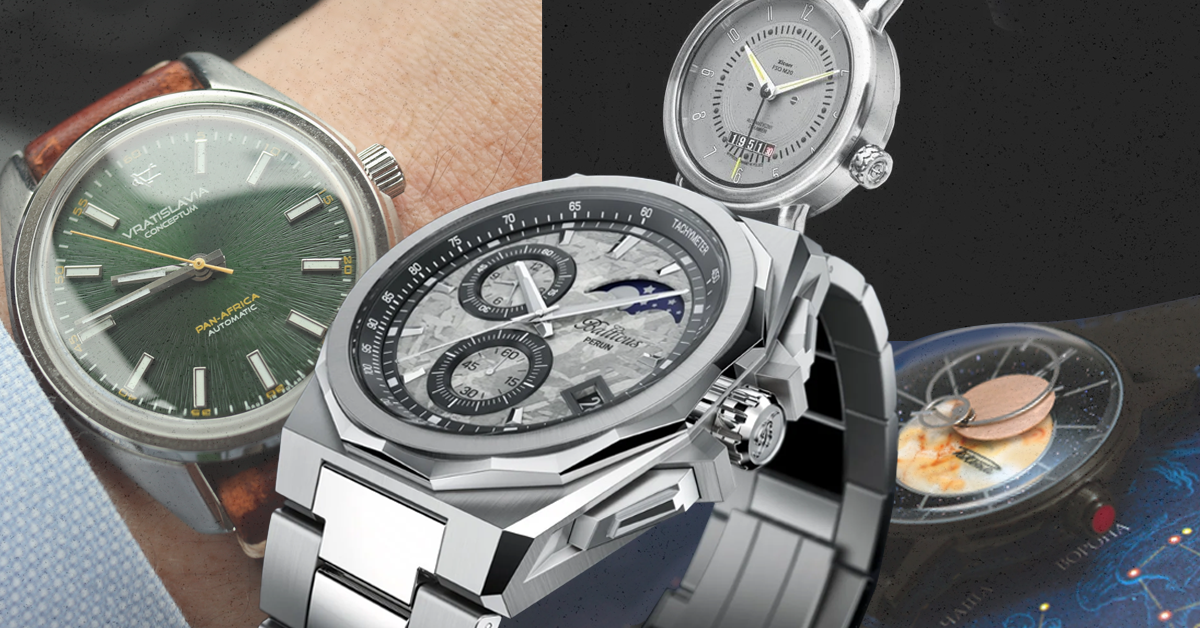
The Rolex day date vs datejust debate centers on a price gap that defines each watch’s position in the luxury market. The Datejust starts at around $7,050 for a steel model. The Day-Date begins at about five times that amount. This rolex day date vs datejust price difference reflects their materials and prestige levels. We’ll break down the rolex day date vs datejust differences across materials and performance specs. You might be comparing the rolex day date 40 vs datejust 41 or weighing the rolex oyster perpetual day date vs datejust to invest. We’ll show you which icon fits your wrist and wallet.
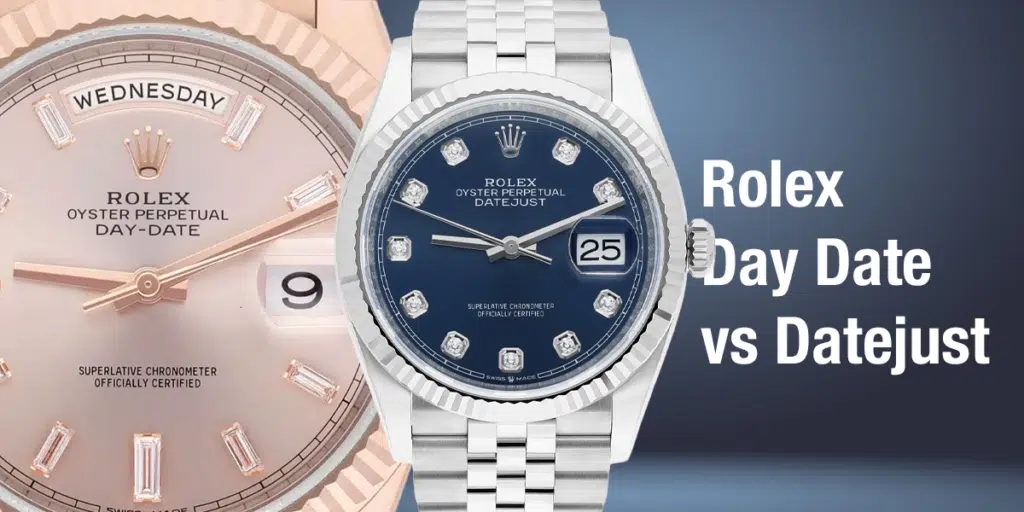
Table of Contents
Understanding the Two Icons: Day-Date and Datejust Models
The Rolex Datejust: Launched in 1945
Rolex showed the Datejust in 1945 to commemorate the company’s 40th anniversary. The watch made history as the first self-winding wristwatch to feature a date window that changed at midnight on its own. This simple function represented a most important engineering achievement and set the standard for modern date complications.
The original Datejust reference 4467 came in solid 18k yellow gold with a 36mm case diameter. This size was substantial for the era and struck an ideal balance between presence and wearability. The watch debuted with a new five-piece link bracelet called the Jubilee, designed for this model. The “Jubilee” name was considered for the watch itself at first, but it ended up becoming the bracelet’s designation.
Stainless steel and Rolesor versions didn’t become available until the 1950s with references 5030 and 5031. The Cyclops magnification lens was added to the crystal in 1953 and enlarged the date display by 2.5 times. The date mechanism was updated in 1955 to switch at midnight rather than roll over.
The Rolex Day-Date: Introduced in 1956
The Day-Date arrived in 1956 as the first wristwatch to display both the date and the day of the week spelled out in full. The day appeared in an arched window at 12 o’clock, while the date remained at 3 o’clock with the Cyclops lens. This double calendar functionality positioned the Day-Date above the Datejust as Rolex’s flagship luxury model.
The Day-Date has been offered in precious metals since its inception. Yellow, white, and Everose gold remain the only material options along with platinum. The watch debuted with the President bracelet, a three-piece link design created for this model. The Day-Date featured a 36mm Oyster case with a Twinlock crown that provided 100 meters of water resistance.
Available Case Sizes and Configurations
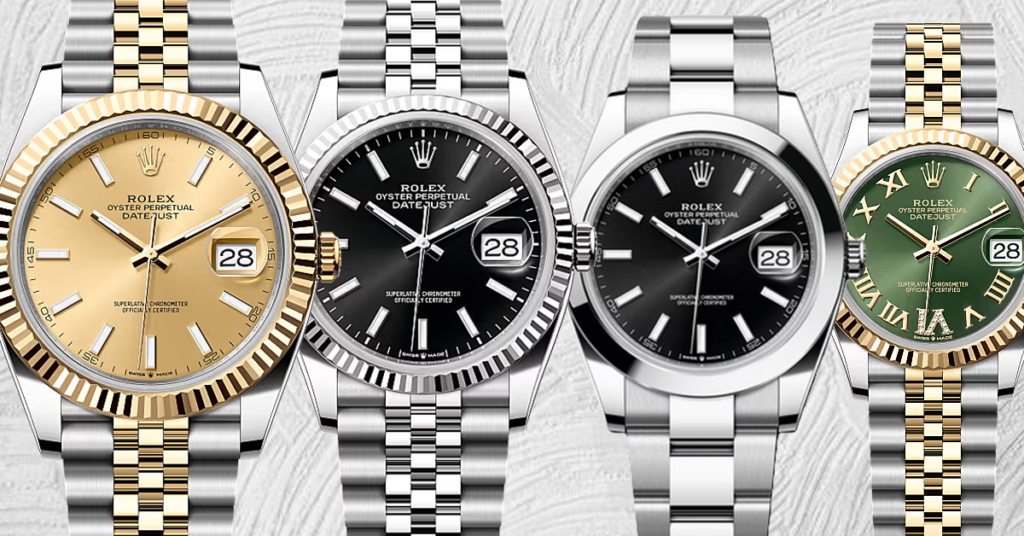
The Datejust collection spans five sizes: 28mm, 31mm, 34mm, 36mm, and 41mm. The 36mm size remained the sole option for several decades until the Lady-Datejust in 26mm appeared in the 1950s. The Datejust II launched in 2009 at 41mm and was later refined as the Datejust 41 in 2016 with slimmer proportions and the Caliber 3235 movement.
The Day-Date maintains a more focused size range. The collection offers 36mm and 40mm options. A 39mm Masterpiece variant existed for a time, while the 41mm Day-Date II appeared in 2008 before being discontinued.
Key Display Differences at a Glance
The fundamental difference lies in their calendar displays. The Datejust shows only the date through a window at 3 o’clock. The Day-Date displays both the day spelled out in full at 12 o’clock and the date at 3 o’clock. Rolex offered the day wheel in 11 languages at first but has since expanded to 26 languages.
Performance Comparison: Movements and Technical Specifications
Caliber 3235 vs Caliber 3255: Movement Architecture
Both movements share the same foundational architecture built around Rolex’s Chronergy escapement, introduced in 2015. The Caliber 3235 powers the Datejust collection, while the Caliber 3255 drives the Day-Date. The 3255 adds an instantaneous day display with a sophisticated calendar mechanism on top of the 3235’s time and date functions.
Over 90% of components in these movements are new compared to their predecessor, the Caliber 3135. The Chronergy escapement increases efficiency by 15% through a pierced escape wheel that reduces inertia. Both the escape wheel and pallet fork are crafted from nickel-phosphorus, which makes them insensitive to magnetic interference.
Power Reserve and Accuracy Standards
Both calibers deliver 70 hours of power reserve, representing a 50% increase over previous generations. This three-day autonomy means the watch continues running from Friday evening through Monday afternoon without winding.
The accuracy standard reaches -2/+2 seconds per day after casing. This precision level is twice as exacting as COSC chronometer certification, which permits -4/+6 seconds daily variation. Rolex tests each movement twice: once uncased at COSC and again after installation in its case.
Water Resistance and Durability Features
Both models feature the Oyster case with Twinlock winding crown, providing 100 meters of water resistance. The case construction uses a monobloc middle case with screw-down case back and winding crown. A scratch-resistant sapphire crystal protects the dial, with the Cyclops lens magnifying the date display.
Quickset vs Double Quickset Functionality
The Datejust uses single quickset and allows independent date adjustment by pulling the crown to the second position. The Day-Date employs double quickset functionality, introduced in 1990. This system lets you set both day and date on their own: turn the crown clockwise to advance the date and reverse direction to cycle through days of the week.
Parachrom Hairspring and Shock Absorption
Both movements incorporate the blue Parachrom hairspring, manufactured from a niobium and zirconium alloy. This component remains insensitive to magnetic fields and temperature variations while being up to 10 times more resistant to shocks than traditional hairsprings.
Paraflex shock absorbers increase shock resistance by up to 50% compared to conventional systems. This combination keeps chronometric performance stable despite daily wear conditions.
Prestige and Materials: What Sets Them Apart
Stainless Steel, Rolesor, and Gold Options for Datejust
The Datejust’s accessibility comes from its material versatility. Stainless steel models use Oystersteel, a 904L grade alloy packed with chromium and molybdenum for corrosion resistance. Rolesor configurations combine Oystersteel with 18k yellow or Everose gold. This creates the two-tone esthetic Rolex trademarked in 1933. Full gold versions appear in yellow, white and Everose gold across the collection.
The Datejust 36 comes in stainless steel and two-tone versions. Fluted bezels are crafted from white gold even on steel models. Gold versions pair with either Jubilee or President bracelets. The Datejust 41 maintains similar material options but uses Oyster or Jubilee bracelets for its sportier proportions.
Exclusive Precious Metals for Day-Date
Material exclusivity separates the Day-Date from every other Rolex model. The watch has been offered exclusively in precious metals since 1956. Your choices include 18k yellow gold, white gold, Everose gold and 950 platinum. Rolex produces these alloys in their own foundry and controls exact mixtures of gold with silver and copper.
Platinum models feature a signature ice-blue dial. You’ll find this dial only on the Day-Date, Cosmograph Daytona, Perpetual 1908 and Sea-Dweller. The 950 platinum alloy consists of 950 thousandths platinum, crafted in-house. This material ranks among the densest metals while remaining soft and malleable, which demands great skill for machining and polishing.
The President Bracelet vs Jubilee and Oyster Options
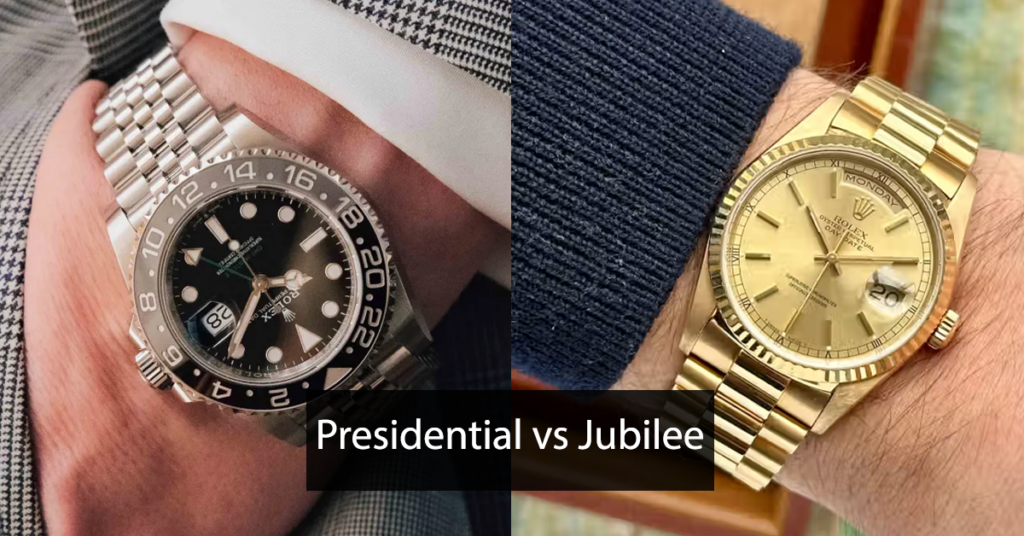
The President bracelet debuted with the Day-Date in 1956 with semi-circular three-piece links. It’s made exclusively from 18k gold or 950 platinum and remains reserved mostly for the Day-Date collection. A concealed Crownclasp blends into the bracelet. You operate it with a small crown-shaped lever.
The Jubilee bracelet launched in 1945 for the Datejust with five-piece link construction. Its three thinner interior links are flanked by larger exterior links. This creates a dressier profile than the Oyster. The Jubilee was offered only in solid gold at first but later expanded to steel and Rolesor versions.
Day Display Feature: A Mark of Difference
The day spelled out in full at 12 o’clock sets the Day-Date apart right away. This feature appears in 26 languages including English, Spanish, Arabic, Chinese, Japanese, Russian and Hebrew.
Association with World Leaders and Celebrities
President Lyndon B. Johnson wore a yellow gold Day-Date while in office. This originated the “President” nickname. The watch has adorned wrists of Presidents Dwight D. Eisenhower, Franklin D. Roosevelt and John F. Kennedy. Outside politics, Warren Buffett, Jack Nicklaus, Elton John and Jay-Z have worn the Day-Date.
Rolex Day Date vs Datejust Price Analysis
New Retail Pricing for Datejust Models
Authorized dealer pricing for the Datejust begins at $7,900 for the 31mm Oystersteel model. The classic 36mm in stainless steel retails for $8,150. The sportier Datejust 41 starts at $8,950. Two-tone Rolesor configurations command premium pricing, with the 41mm Oystersteel and yellow gold version listed at $16,550. Diamond-set models escalate the price by a lot and reach $57,650 for a 31mm Everose gold piece with factory-set stones.
New Retail Pricing for Day-Date Models
The rolex day date vs datejust price disparity becomes apparent at retail right away. Entry-level Day-Date pricing starts at $43,700 for the 36mm yellow gold model. The 40mm yellow gold retails for $48,000, while Everose gold in 40mm commands $51,600. White gold versions reach $57,450 for the 40mm configuration. Platinum models occupy the upper echelon, with the 36mm platinum Day-Date priced at $64,100. Diamond-set bezels and dials push pricing beyond $100,000. Some platinum configurations exceed $126,450.
Pre-Owned Market Price Ranges
Secondary market pricing reveals distinct patterns. Stainless steel Datejust models trade between $9,500 and $15,000 depending on size and configuration. Two-tone versions range from $12,000 to $20,000. The Day-Date shows material-driven pricing in the pre-owned segment, with yellow and white gold 40mm models trading between $32,000 and $40,000. Platinum references remain closer to retail due to intrinsic metal value.
Rolex Day Date 40 vs Datejust 41 Price Comparison
The rolex day date 40 vs datejust 41 price differential is substantial when comparing flagship sizes directly. The steel Datejust 41 at $8,950 retail contrasts sharply with the yellow gold Day-Date 40 at $48,000. This fivefold difference reflects the rolex day date vs datejust difference in materials and positioning.
Long-Term Value Retention and Investment Potential
The Datejust showed 320% appreciation between 2010 and 2025 and climbed from $2,000 to $8,404 average order value. The Day-Date showed 167% appreciation over the same period and rose from $9,245 to $24,718. The Datejust experienced only a 14% decline from its March 2022 peak. The Day-Date saw a 25% correction from its October 2021 high.
Making Your Choice: Which Rolex Fits Your Lifestyle
Best for Daily Wear and Versatility
Which model suits you best depends on your lifestyle. The Datejust moves easily from corporate environments to casual settings and makes it the go-anywhere watch. Stainless steel or Rolesor versions handle daily activities without concern for scratching precious metals. The 100-meter water resistance handles handwashing and unexpected rain. The Datejust works in broader contexts—business to casual and formal to weekend wear.
The Day-Date’s precious metals and commanding design lean toward statement occasions rather than everyday use. Gold scratches during active use. Steel sport models make more practical sense if you work with your hands or do frequent physical activities.
Best for Formal Occasions and Status Symbol
The Day-Date excels where gold watches signal achievement: corporate boardrooms, political settings and formal events. Its association with world leaders and the “President” nickname creates unmatched symbolic value. The watch says you’ve reached the pinnacle of success. It’s especially good for milestone achievements—business exits, career pinnacles and major life accomplishments.
Budget Considerations and Entry Points
Budget realities create clear demarcation. The Day-Date makes sense only when spending $40,000 won’t affect your lifestyle, savings goals or other priorities. Save longer or think over the Datejust instead if you must stretch your finances. Steel Datejust models start around $8,000-$15,000 and provide Rolex quality at pricing that’s available to more buyers.
Wrist Size and Comfort Factors
Wrist circumferences under 6.75 inches pair naturally with 36mm cases. Wrists over 7 inches favor 40-41mm dimensions. The 36mm slides under shirt cuffs without effort. The 40mm provides better balance for larger wrists but adds weight you’ll notice in precious metals. Try both sizes—differences often feel more dramatic than measurements suggest.
Comparison Table
Rolex Day-Date vs Datejust Comparison Table
|
Feature |
Rolex Datejust |
Rolex Day-Date |
|
Launch Year |
1945 |
1956 |
|
Historical Significance |
First self-winding wristwatch with automatic date window |
First wristwatch to display both date and day of week spelled out in full |
|
Available Case Sizes |
28mm, 31mm, 34mm, 36mm, 41mm |
36mm, 40mm |
|
Display Features |
Date only (at 3 o’clock) |
Date (at 3 o’clock) + Day spelled out in full (at 12 o’clock) in 26 languages |
|
Movement Caliber |
Caliber 3235 |
Caliber 3255 |
|
Quickset Functionality |
Single quickset (date only) |
Double quickset (day and date independently) |
|
Power Reserve |
Approximately 70 hours |
Approximately 70 hours |
|
Accuracy |
-2/+2 seconds per day |
-2/+2 seconds per day |
|
Water Resistance |
100 meters (Twinlock crown) |
100 meters (Twinlock crown) |
|
Material Options |
Oystersteel (904L), Rolesor (steel + gold), 18k yellow gold, white gold, Everose gold |
Only precious metals: 18k yellow gold, white gold, Everose gold, 950 platinum |
|
Bracelet Options |
Jubilee, Oyster, President (gold models) |
President (exclusive), Jubilee |
|
Starting Retail Price (New) |
$7,900 (31mm steel) / $8,150 (36mm steel) / $8,950 (41mm steel) |
$43,700 (36mm yellow gold) / $48,000 (40mm yellow gold) |
|
Price Range (Two-Tone) |
$16,550 (41mm Rolesor) |
N/A (not available in two-tone) |
|
Price Range (Platinum) |
Not available |
$64,100 (36mm platinum) |
|
Pre-Owned Market Range |
$9,500-$15,000 (steel); $12,000-$20,000 (two-tone) |
$32,000-$40,000 (yellow/white gold 40mm) |
|
Value Appreciation (2010-2025) |
320% ($2,000 to $8,404 average) |
167% ($9,245 to $24,718 average) |
|
Price Decline from Peak |
14% decline from March 2022 peak |
25% decline from October 2021 peak |
|
Best For |
Daily wear, versatility, business to casual settings |
Formal occasions, status symbol, milestone achievements |
|
Notable Wearers |
Not mentioned |
Presidents Eisenhower, Roosevelt, Kennedy, LBJ; Warren Buffett, Jack Nicklaus, Elton John, Jay-Z |
|
Nickname |
None |
“President” (after President Lyndon B. Johnson) |
Final Thoughts
So which is better, the rolex day date vs datejust? Honestly, it comes down to how much money you want to spend and what you want from your watch. The Datejust is a better value at $8k if you want a flexible daily watch you can dress up or down. The Day-Date is worth the $43k+ if you’ve made it to the top of your career and want the highest status timepiece you can get in metals.
The watches have identical movements and water resistance levels. It all comes down to price and what metals you prefer. The Day-Date is about 5 times more expensive and is available in precious metals only. The Datejust is available in stainless steel which is great for daily wear and can pass for dressy too.
I recommend wearing both watches on your wrist to see which size feels more comfortable. After all, comfort is just as important as prestige.
Enjoying our watch coverage? Get more of it in Google Search.