Rolex watches mean much more than luxury status symbols to elite warriors in special forces. These prestigious timepieces can save lives in the intelligence and special operations world. They serve as valuable trading assets that help operators escape hostile territories, especially when carrying cash proves risky. Rolex’s military legacy runs deep, with roots that stretch back to World War II.
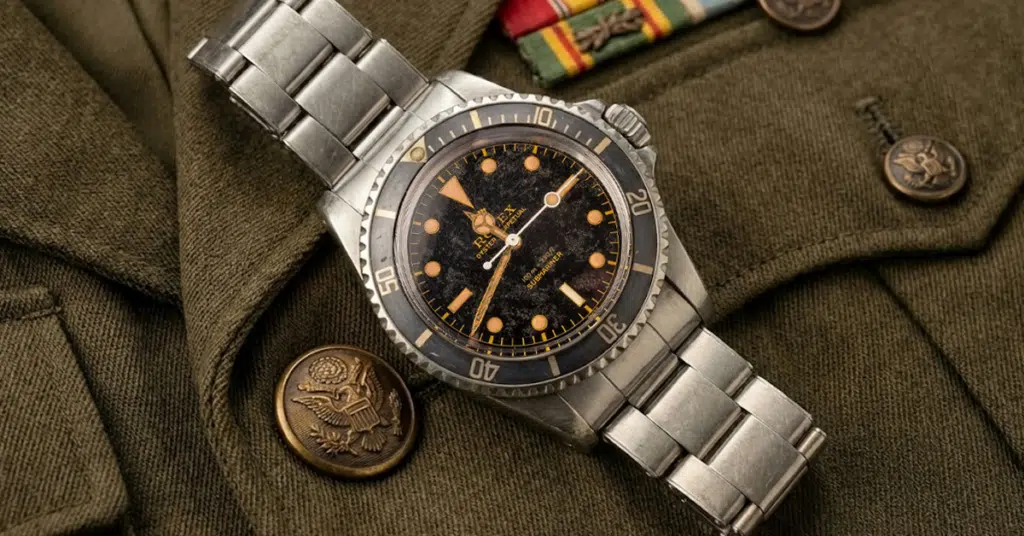
Special forces units worldwide revere the Rolex Submariner as a legendary timepiece. Navy SEALs consider buying a Submariner with their deployment money a sacred tradition that pays tribute to their predecessors. The South African Special Forces’ custom black Submariner Ref. 5513 from the mid-1970s shows how these watches adapted to meet combat needs. This piece explores how these battle-proven timepieces became essential gear for the world’s most elite military units, from US special forces’ Rolex priorities to the Vietnam special forces’ Rolex heritage.
Table of Contents
The Origins of Special Forces Rolex Watches
Rolex timepieces and elite military units share a rich history dating back to the mid-20th century. This legacy shapes tactical timepiece design even today. These watches earned their reputation by performing exceptionally well in the world’s toughest environments.
Rolex Milsub and British MOD Deployment
British Ministry of Defense (MOD) started working with Rolex in 1957. They needed watches tough enough for naval operations. This partnership led to the legendary “Military Submariner” or “MilSub” – watches made exclusively for British military personnel. Only 200 of the 1,200 original MilSubs exist today, making them some of the rarest Rolex pieces.
The MOD tested about 50 reference 6538 “Big Crown” Submariner models before asking for specific changes. They wanted reinforced spring bars replaced with solid, soldered bars between the lugs to hold NATO straps securely. The bezel became larger to extend over the case edges, making it easier to grip with gloves. It also featured hash marks for all 60 minutes instead of just the first 15 minutes found on civilian models.
Vietnam Special Forces Rolex Usage
American special operations forces developed their own connection with Rolex watches. Navy SEALs picked the Submariner as their preferred dive watch in 1962, the same year President Kennedy officially created the elite unit. The Rolex Submariner remained standard Navy SEAL equipment until 1983.
Photos from the Vietnam conflict show both Rolex and Tudor Submariners were popular among special operations personnel. SEAL Team members Harry Humphries and Fran Scollise wore their Navy-issued Rolex Submariners during missions. A 1968 photo shows Lieutenant Philip L. Martin from SEAL Team 1 wearing a Tudor Submariner during a “Seek and Destroy Operation” in the Mekong Delta jungle swamps.
Why Rolex Was Chosen Over Other Brands
Rolex became special forces’ favorite watch for several reasons:
Unmatched durability: The Submariner worked perfectly at depths of 1,000 feet under intense pressure
Tactical reliability: Features like the helium release valve protected the watch during decompression after deep dives
Operational utility: The luminous dial stayed visible in complete darkness
Emergency value: A Rolex served as potential barter currency if escape became necessary in hostile territories
Army Special Forces veteran Cliff says, “I love my Rolex Submariner. It’s so sturdy and it always keeps perfect time, but to me, more than anything it’s a tool”. Rolex used this military connection in their marketing. A 1967 advertisement stated: “For years, it’s been standard gear for submariners, frogmen, and all who make their living on the seas”.
Military Post Exchanges (PX) sold these watches at substantial discounts compared to civilian stores. This easy access and reliable performance made Rolex the go-to tactical timepiece for elite units operating in earth’s most challenging environments.
Rolex Submariner: The Icon of Combat Timekeeping
Rolex created the Submariner as a specialized diving instrument in 1953. This watch became the go-to combat timepiece for elite military units worldwide. The Submariner earned its reputation through reliable performance in brutal conditions rather than marketing campaigns.
Design Features That Made It Battle-Ready
The Submariner’s success on the battlefield comes from its solid construction and smart design elements. The British Ministry of Defense asked Rolex in 1957 to make several key changes to the standard Submariner. These changes would make it perfect for combat diving operations:
Stronger case with thicker stainless steel to handle extreme pressure and impact
Better bezel grip that extends past the case edges so divers could use it with gloves
Complete 60-minute hash marks on the bezel (regular models only had 15 minutes) for exact mission timing
Strap bars soldered between the lugs to keep the watch secure during operations
Sword-shaped hands that you could see better in dark conditions
Matte black dial to avoid reflections during secret missions
British special forces got their own military Submariners, like the super-rare reference 5517. These watches had a “T” mark on the dial that showed they used safer tritium lume instead of radium. Every part of the design served a tactical purpose rather than looks.
Submariner in Underwater Demolition Teams
Navy SEALs trace their roots to the Underwater Demolition Teams (UDTs), which were among the first military units to pick up the Submariner. These special naval units started during World War II. Their job was to check out landing areas and blow up underwater obstacles before beach attacks.
UDTs loved their swimmer-assist submersibles and cutting-edge diving gear throughout the 1950s and 60s. A UDT veteran named Cliff explained why the Submariner became crucial: “UDT divers and SEALs need their watch as a tool to measure time during dives so they can figure out distance in darkness”.
Commander Francis Douglas “Red Dog” Fane led east coast UDTs after WWII. He teamed up with Dr. Chris Lambertsen to boost the teams’ combat-diving skills. The Submariner stayed their trusted tool as these units turned into more tactical elite forces during the Korean and Vietnam Wars.
Special Forces Wearing Rolex Submariners Today
U.S. Navy SEALs officially switched to Casio G-Shock watches in 1983. Yet many special operators keep the Submariner tradition alive. Will Chesney, SEAL Team Six’s dog handler, wore his Submariner during the Osama bin Laden raid.
Today’s Submariner costs a lot—more than $10,000. Many special operators see buying one as a milestone that honors the frogmen before them. Modern warriors often save their deployment money to buy their own Submariners, which connects them to their unit’s rich history.
The watch has changed over time and sometimes feels “more jewel than tool.” Still, many modern special forces members not only own but use Submariners on missions. Getting new Submariners is tough and they cost a fortune. Because of this, you’ll see fewer SEALs wearing these iconic watches compared to past decades.
Real-World Missions: Rolex in the Field
Special forces Rolex watches have proven their worth in some of the most dangerous missions in military history. These timepieces have been silent witnesses to remarkable military operations from jungle warfare to high-profile terrorist manhunts.
Green Berets and the Vietnam War
Green Berets made their Rolex watches an essential part of their equipment in Vietnam’s dense jungles. Billy Waugh, a legendary Special Forces operative who earned his Green Beret in 1954, wore a Rolex on all his combat missions in Southeast Asia. A night raid on a Viet Cong compound in Bong Son in 1965 left Waugh and his team outnumbered. The North Vietnamese Army took everything from him after he suffered multiple injuries, including a bullet to his forehead – even his prized Rolex.
A Rolex became a must-have for Green Berets. A veteran put it simply: “When I arrived there were 3 things you needed to be a ‘legit’ special forces operator; a Randall knife, a star sapphire ring and a Rolex”. These watches were easy to get back then. Post Exchanges sold them for less than $400 in 1970 – nowhere near today’s prices.
Navy SEALs and the Osama Bin Laden Raid
SEAL Team Six operator Will Chesney’s Submariner played a role in one of the most famous special forces missions – Operation Neptune Spear, the 2011 raid that eliminated Osama bin Laden. Chesney chose to wear his most meaningful watch because he thought they might not return. “I thought it would be fitting to wear the watch on that operation since it was my gift to myself for making it there, and I figured we wouldn’t be making it back so I might as well die with it on,” he said.
Chesney bought his no-date Submariner right after completing SEAL selection. He walked into a Virginia Beach authorized dealer and left with the watch that same day. The watch became his lucky charm, going with him to and from every deployment.
Trading a Rolex for Escape: Fact or Fiction?
Stories about special forces operators using Rolex watches as barter currency have circulated for decades. The idea makes sense – you could trade a Rolex for shelter, border crossings, or safe passage from hostile areas. A watch stays secure on your wrist until needed, unlike cash or gold.
Real examples of these trades are hard to find. Chesney thought about using his Submariner as a bargaining chip if stuck in Pakistan, but he made it clear he “would never give the watch up, implying that he would die fighting” instead. Rob Corbett, another SEAL from the Captain Phillips rescue mission, felt the same way about his Submariner. He wore it during a combat jump into the Indian Ocean. When shrapnel hit the crystal during a firefight in Afghanistan, he said he “would have rather the shrapnel go into his arm instead of his sole prized possession”.
Modern-Day Use and Custom Unit Watches
Rolex timepieces still hold their prestigious position among America’s elite warriors, despite the growing popularity of newer tactical watches. The relationship between special forces and these iconic timepieces combines tradition with state-of-the-art features.
US Special Forces Rolex Priorities in 2025
Special forces timepieces have changed dramatically. SEAL-turned-astronaut Jonny Kim shows his commitment to the Rolex tradition by wearing a steel Rolex Daytona aboard the International Space Station. Kim switched between several models during his NASA training and ended up with both a Pepsi GMT-Master II and a Submariner Date on the ISS. The broader special operations community has seen a decline in Rolex ownership compared to previous decades. The current Submariner costs more than $10,000 and limited availability makes these watches hard to get for many operators.
Custom Engravings and Unit Editions
Elite units now recognize their members with custom military watches. Monterey Watch Company runs dedicated engraving programs that turn standard timepieces into personal symbols of service. Unit logos, meaningful mottos, or commemorative messages appear as machine engravings on the caseback of these customized watches. Helicon Watches has been creating bespoke timepieces for specialist units and squadrons since 2012, with their products tested in some of the world’s harshest environments. These projects stay confidential because of the sensitive nature of these military organizations.
The Rise of RESCO and Other SEAL-Approved Brands
An active-duty SEAL founded RESCO Instruments in 2009, marking a shift from traditional Rolex dominance. The company earned the rare “SEAL stamp of approval” by creating many customized unit watches for SEAL Teams. Their flagship UDT model comes with a 42mm diameter case, Sellita SW200 movement, and practical design elements like screw-in lug bars and options for titanium or steel cases. Brands like Stirling have also gained popularity, showing up on the wrists of infantrymen, EOD techs, and even high-ranking officers like Lt. Gen. Curtis Buzzard. These modern alternatives provide the tactical reliability that once belonged only to Rolex, but at better prices.
Collectibility and Value of Military Rolexes
Military-issued Rolex watches have evolved from practical tools into highly coveted treasures that offer extraordinary investment potential. These battle-worn timepieces now command remarkable prices because there is a lack of available pieces and their historical significance.
Army Special Forces Rolex Market Trends
The collector market values authentic military Rolexes at staggering prices. Legendary MilSub models (References 5513/5517) consistently sell for $100,000 to $250,000 based on their condition. A remarkable example from 1975 reached an astonishing $268,000 at Bonhams Knightsbridge. The most valuable pieces still have their original tritium dials, military case engravings, and fixed spring bars. Any Rolex with verified special forces history can reach six-figure prices at auction.
The Shadow: South African Milsub Rarity
The Shadow stands alone among military Rolexes with its unique mystique. Experts found that there was this factory-blackened Submariner Reference 5513 in 2001, which Rolex produced exclusively for South African Special Forces in the mid-1970s. Rolex’s heritage department confirmed its authenticity via fax with this statement: “The watch was destined to the South African army and the feature of this model was to be completely black”. The watch showcases unique gunmetal teflon coating and distinctive engravings between the lugs that set it apart from standard production models.
How to Authenticate a Military-Issued Rolex
A genuine military Rolex authentication requires several key checks:
Serial and reference numbers must match known military production years
Official case-back engravings should show unit insignias or issue numbers
Fixed spring bars should make strap removal impossible without cutting
The bezel needs full 60-minute markings instead of standard 15-minute graduations
A circled “T” on vintage dials confirms tritium lume presence
These watches’ exceptional value makes professional authentication crucial through prominent auction houses like Phillips, Christie’s, or Rolex Service Centers.
Conclusion
Rolex watches have been considered Special Forces watches for years now. Not only did they look cool, but they served their purpose time and time again throughout multiple wars. These watches went through battles, stress, water and much more proving they could keep up with some of the toughest people on the planet. That is why Rolex quickly became the go-to brand for special operations fighters.
Special Forces continue to have that relationship with Rolex today although it is a lot different now. Department of defense contracts go to lesser of brands while operators still buy into Submariners as an investment. Today’s special forces operators have that same relationship with Rolex as the iconic frogmen did back in 1949.
The market for these original issued Submariners is nothing like it used to be. A special forces issued Sub that may have been purchased years ago for a couple hundred bucks at a military PX is now selling for six figures at upscale auction sites. The value of these timepieces came from their limited nature, storied pasts, and history of use in combat situations.
Most SEAL’s today do not operate with a Submariner on their wrist. Companies such as RESCO fill that tactical need with pricing that cannot be beat. There watches are military vetted for reliability and quality. Brands like RESCO are the direct descendants of the first special forces watches.
Enjoying our watch coverage? Get more of it in Google Search.