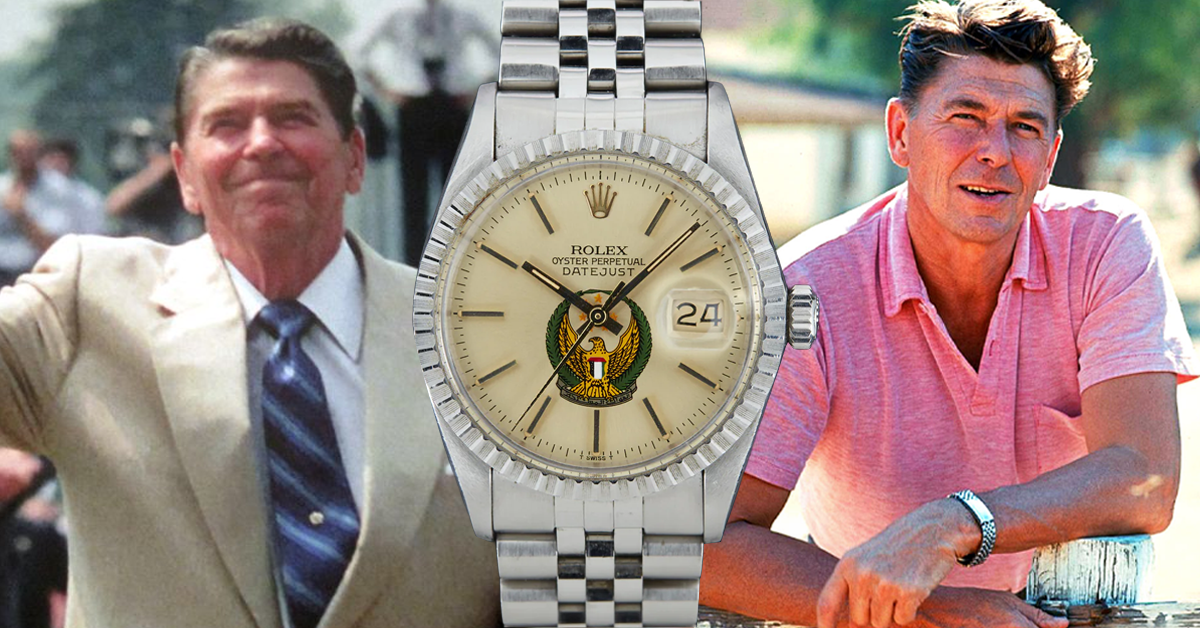
Ronald Reagan’s Watch: The Hidden Story Behind His Presidential Timepiece (2025 Review)
Ronald Reagan’s watch choice reveals a fascinating story about presidential style and tradition. During his time as the 40th President, Reagan wore a steel

Spotting differences between fake and real Rolex Datejust watches can save you from getting scammed. The Datejust’s story began in 1945 to mark the brand’s 40th anniversary. It made history as the first self-winding chronometer wristwatch that displayed the date through a window. Its prestigious status has made it a favorite target for counterfeiters.
A genuine Rolex’s weight starts at 100 grams, and larger models can reach 200 grams. The brand’s legacy of innovation dates back to 1926 when they created the world’s first waterproof wristwatch. Their steadfast dedication to quality remains strong today. A genuine Datejust features a Cyclops lens that makes the date appear 2.5 times larger, perfectly aligned above the three o’clock marker. Each authentic timepiece houses Rolex’s self-winding Perpetual mechanical movement and keeps time within two seconds daily.
This piece guides you through the key indicators of a genuine Rolex Datejust. You’ll learn about visual elements, build quality, mechanical functions, and hidden markers that distinguish authentic pieces from even the most sophisticated fakes.

Visual inspection serves as your best defense against counterfeit Rolex timepieces. Authentic Datejust watches are different from even the best imitations because of their precise details and craftsmanship.
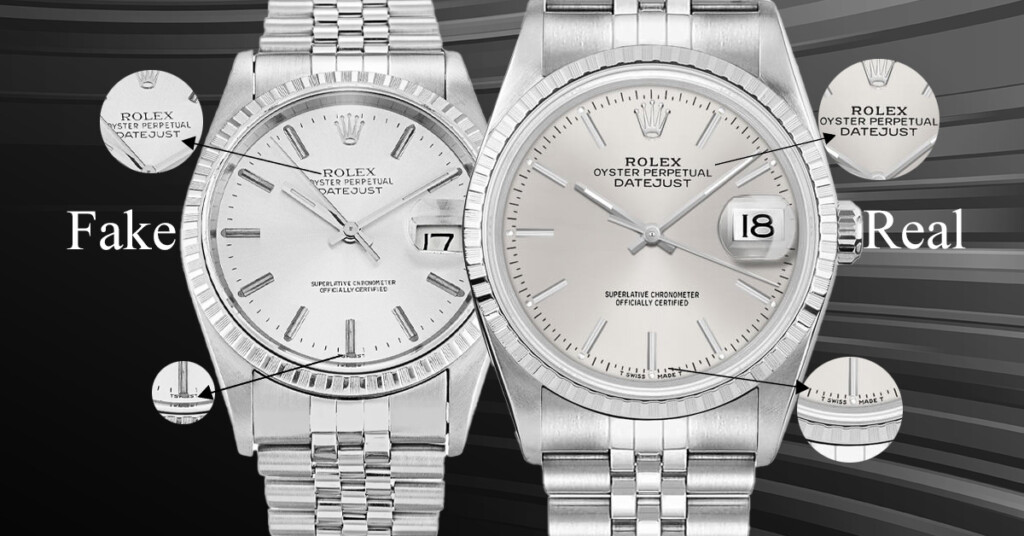
A genuine Rolex Datejust’s dial shows perfect craftsmanship with clean, precise printing. Each letter on authentic dials has perfect spacing between characters without any smudges or misspellings. The famous crown logo sits perfectly centered, usually at the 12 o’clock position on most models.
Counterfeit watches reveal their true nature through uneven letters, poor finishes, or spelling mistakes. On top of that, fake dials often show wavy text edges instead of the sharp, stamped precision found in real models. You should check the watch under good lighting and compare it with official Rolex images—any differences in font style, size, or text placement point to a fake.
Real Datejust hour markers line up symmetrically with even spacing across the dial. Each marker sits exactly where it should without any variation. The materials used are also substantially different—genuine markers have even, symmetrical silver borders around their shapes.
Fake models often have misaligned or asymmetrical hour indices. These markers might look too big or too small, and sometimes you can see glue around the edges. On top of that, counterfeit Datejust watches usually have markers that look like stickers instead of the three-dimensional appearance of real timepieces.
The Cyclops lens stands out as the Datejust’s most distinctive feature. It magnifies the date display by exactly 2.5 times—something fake watches rarely achieve. Real models have this lens bulging outward in a convex shape, creating a bubble-like look over the date window.
Counterfeit Rolex watches are nowhere near perfect with proper magnification. They either under-magnify or skip it completely. Some counterfeiters try to fake this effect by just printing bigger numbers on the date wheel. A real Cyclops always lines up perfectly over the 3 o’clock marker, while fakes often show poor alignment or a flat lens that lacks proper magnification.
Physical characteristics of a Rolex Datejust reveal clear signs of authenticity beyond just looks. Quality differences in construction set genuine timepieces apart from fakes right away.
Real Rolex Datejust casebacks have a smooth, plain finish without fancy engravings or see-through windows. Most genuine Rolex casebacks are solid and don’t show the movement inside. Sea-Dwellers, Milgauss models, and some vintage ladies’ Datejust references (6917, 69173, 69174) are exceptions that come with minimal factory engravings. Any Datejust that shows decorative patterns, logos, or transparent casebacks should make you think twice about its authenticity.
A genuine Datejust’s bracelet shows precise craftsmanship with solid links that fit naturally together. The authentic bracelet blends perfectly with the case design and moves smoothly without any rattling. The clasp mechanism feels solid and secure, with crisp, clear engravings. Fake bracelets tend to feel loose, hollow, and poorly made in comparison.
You can tell real and fake Datejust models apart by their weight. Rolex has used premium 904L “Oystersteel” since 1989, which weighs substantially more than materials used in counterfeits. A genuine Stainless Steel Submariner weighs about 153 grams, while fakes might only reach 124 grams. A real Datejust should feel heavy and solid when you hold it, unlike the lighter fakes that give away their poor construction.
A Rolex Datejust’s authenticity becomes clear from its internal mechanism, whatever the exterior looks like.
The genuine Rolex Datejust has a mechanical movement that creates a smooth sweeping motion at about 8 ticks per second (28,800 beats per hour). The second hand appears to glide around the dial with fluid motion. Most fake watches use quartz movements that make distinct, jerky ticks once every second.
The genuine Datejust’s date display changes in a snap right at midnight, taking just 1-2 seconds. Fake watches can’t match this crisp transition. Their date changes start before midnight and drag on for several minutes.
Real Rolex Datejust watches only use their own mechanical movements that need regular winding, either by hand or through the automatic mechanism. A watchmaker can reveal these movements’ complex gears, springs, and rotors by removing the caseback. Fake versions just use cheap quartz movements with batteries. This key difference explains why real and fake Datejust watches differ in weight, second-hand movement, and precision.
Authentic Rolex Datejust watches have subtle identification markers hidden beneath the surface that counterfeiters find hard to copy perfectly.
Genuine Datejust models made after 2005 feature the inner rehaut ring with “ROLEXROLEXROLEX” engraved around the dial. The genuine timepiece’s “R” markers on the left side match perfectly with hour markers, and each “X” on the right does the same. The crown’s logo sits at 12 o’clock and lines up with its hour marker perfectly. The watch’s unique serial number appears at the 6 o’clock position among other repeating engravings.
Rolex’s serial number positioning has changed by a lot over time. Serial numbers appeared only between the lugs on the 6 o’clock side before 2005, and you had to remove the bracelet to see them. Rolex used both the case and rehaut locations from 2005-2008. The company moved serial numbers exclusively to the rehaut after 2008. The model number stays between the lugs on the 12 o’clock side.
Genuine Datejust models have featured a laser-etched coronet on the sapphire crystal at 6 o’clock since 2001-2002. This micro-etching creates a subtle effect using tiny dots inside the crystal that you can barely see without magnification. In fact, a clearly visible crown without magnification suggests a counterfeit watch. The crown logo on service replacement crystals often includes a small “S” inside.
| Feature Category | Authentic Rolex Datejust | Counterfeit Rolex Datejust |
|---|---|---|
| Dial Text & Logo | Sharp, precise printing with perfect spacing | Wavy edges, uneven lettering, possible spelling errors |
| Hour Markers | Symmetrically arranged, even spacing, 3D appearance | Poorly arranged, asymmetrical, sticker-like appearance |
| Cyclops Lens | 2.5x magnification, convex shape, centered over 3 o’clock | Under-magnified or flat lens, often out of place |
| Caseback | Smooth, unembellished finish (except specific models) | Often decorated, engraved, or with transparent windows |
| Bracelet Quality | Solid links, perfect fit, smooth operation | Slack, hollow feel, cheap construction |
| Weight | 100+ grams (heavy) | Substantially lighter |
| Second Hand Movement | Smooth sweeping motion (8 ticks/second) | Single tick per second, jerky movement |
| Date Change | Instantaneous change at midnight (1-2 seconds) | Gradual change over several minutes |
| Movement Type | Mechanical self-winding Perpetual | Usually quartz with battery |
| Rehaut Engraving | Perfect arrangement with hour markers | Often mismatched or imperfect |
| Crystal Crown Logo | Micro-etched, barely visible without magnification | Easily visible or poorly made |
| Timekeeping Accuracy | Within two seconds per day | Not mentioned |
This complete guide has taught you everything you need to spot real Rolex Datejust watches among sophisticated counterfeits. With this knowledge, you can now confidently evaluate potential purchases like an expert.
A genuine Rolex Datejust shows its authenticity through several layers of craftsmanship. Sharp dial printing, perfectly lined up hour markers, and the 2.5x magnifying Cyclops lens are the original signs to look for. The watch should weigh at least 100 grams. A smooth caseback and solid bracelet construction also prove its legitimacy.
The functional aspects tell just as much about the watch’s authenticity. The second hand’s smooth sweeping motion, the date changing exactly at midnight, and the use of mechanical movements instead of quartz ones set real Datejusts apart from fakes.
You can verify authenticity through hidden markers that counterfeiters find hard to copy. Look for perfectly lined up rehaut engravings, strategically placed serial numbers, and the nearly invisible micro-etched crown at 6 o’clock.
Note that each genuine Rolex Datejust embodies decades of watchmaking excellence and precision engineering. Taking time to check these critical details before buying will protect your investment and give you the true quality that defines Rolex’s legacy. The difference between owning a genuine masterpiece and a fake isn’t just about status – it’s about having a timepiece that keeps its value and performance for generations.
Ronald Reagan’s watch choice reveals a fascinating story about presidential style and tradition. During his time as the 40th President, Reagan wore a steel

Elon Musk’s watch collection mirrors state-of-the-art technology and understated luxury, just like the man himself. The world’s richest person, worth $146 billion, doesn’t always choose
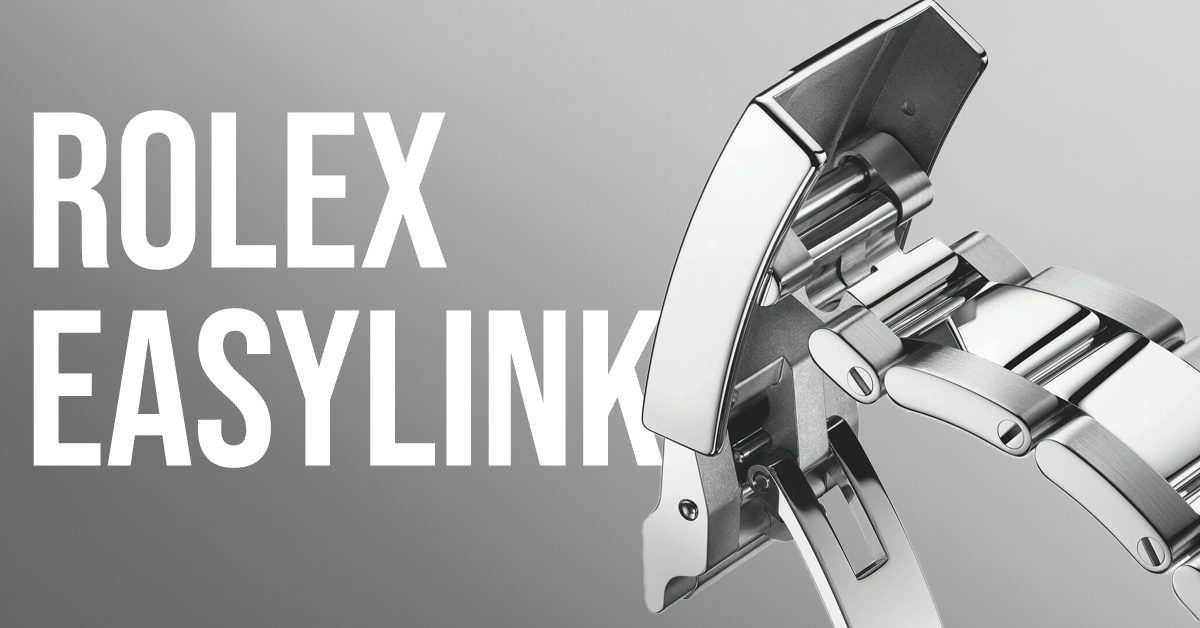
What is Rolex Easylink? Rolex Easylink is a patented micro-adjustment system that lets you fine-tune your bracelet length by exactly 5mm without any tools. This